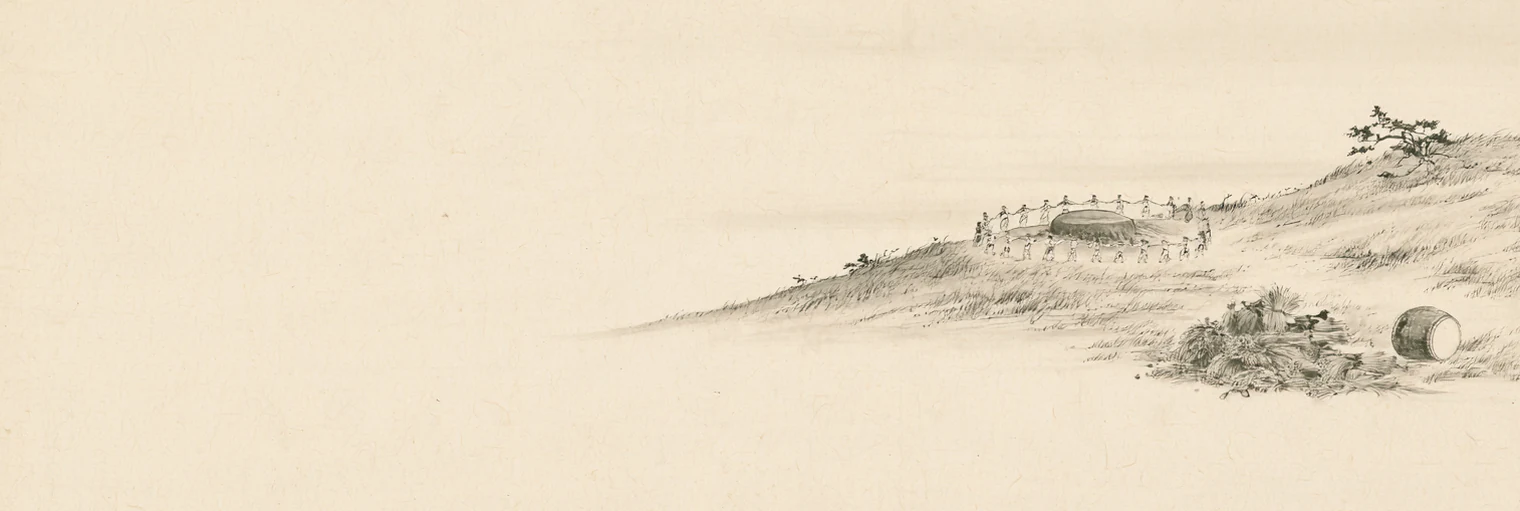
Korea's oldest festivals had three main names — Yeonggo, Dongmaeng and Mucheon — and they were three names for one day. Buyeo held Yeonggo, Goguryeo held Dongmaeng, the Ye held Mucheon, and the Gyuwon Sahwa (규원사화, 揆園史話), a history of Korea's earliest ages written by a scholar under the name Bugaeja, records that the old kingdoms kept the appointment in the tenth month, when the year's work was done. Two of the three names translate straight into sound and movement: welcoming the drum, and dancing to heaven.
And not one of them was held to ask heaven for anything.
That is the part worth slowing down for. Most of the great sacrificial calendars of the ancient world run forward — give something now, so that something comes later. These ran backward. A single line in the Dangun Segi (단군세기), the chronicle of the Dangun rulers, fixes the direction in four characters: 感謝爲本, gratitude is the root. Once you know that, the rest of the day makes sense, including why it finished in dancing rather than in prayer.
If you already know one Korean festival, it is almost certainly Chuseok, the harvest full moon of the eighth lunar month. Chuseok is what survives of this in family life. What follows is the day itself, back when it was still a whole country.
The month a whole country stopped
Start in the tenth month. The fields are cut and there is nothing left in them but stubble, and the roads are full — not the road of one village, but the roads of an entire kingdom, all bending toward the same hill.
The Hwandan Gogi (환단고기, 桓檀古記), the collection of Korean chronicles this site works from, sets the scene in one dense line. It is describing the three Han — in its telling, the three great regions Korea's first kingdom was divided into, each under a ruler called a Han:
三韓古俗, 皆十月上旬, 國中大會, 築圓壇而祭天, 祭地則方丘. "It was the old custom of the three Han that in the first ten days of the tenth month they all held a great assembly of the whole country. They raised a round altar and made the offering to heaven; for the offering to earth, a square mound." — Hwandan Gogi, Taebaek Ilsa, Samsin Oje Bongi
A great assembly of the whole country. Not a village fair, not a court ceremony with the country reading about it afterward. Everyone, on the same ten days, in the same place.
And then the detail that tells you what kind of event this was:
祭天韓必自祭, 其禮甚盛, 可知也. "When the offering was made to heaven, the Han made it himself. From this you can see how full the ceremony was." — Hwandan Gogi, Taebaek Ilsa, Samsin Oje Bongi
The ruler did not delegate. He did not send a priest, a son, or a minister. On the largest day of the year, the person at the top of the kingdom walked up the hill and did it with his own hands, in front of everybody.
Three of the kingdoms that kept this day are worth fixing on the map before we go further, because Korean history assumes them and nobody else has any reason to. Buyeo was an early kingdom out on the northern plains, standing before the Three Kingdoms that came after it. Goguryeo was the northernmost and largest of those Three Kingdoms — Goguryeo, Baekje and Silla, who divided the peninsula between them for most of the first millennium. The Ye were a people settled along the east coast. Different territories, different rulers, different words for the festival, and one identical entry on the calendar.
The Gyuwon Sahwa lists six of those words in a single sentence, with Buyeo, Yemaek, Mahan, Silla and Goguryeo keeping the tenth month and Baekje keeping the four middle months instead. That sentence, and what it says about where the whole custom began, is quoted in full in this site's article on Chuseok. Here we are going somewhere else — inside the day.
Why was one altar round, and the other square?
Go back to the first line and look at what they built. A round altar for heaven. A square mound for earth.
That is not decoration and it is not architecture. It is a belief, made of earth and stone. In this way of seeing the world heaven is round and earth is square, so when these people wanted to hand something upward they built the shape of the sky to hand it from, and when they wanted to hand something down to the ground they built the shape of the ground.
Korea did this once before in a way you can still go and stand next to. The country holds more dolmens — two upright stones with one broad slab laid across them — than anywhere else on earth, and the old chronicles give that shape as a rule rather than a description: heaven is one and earth is two, so one stone above and two below. Same instinct, different geometry. A dolmen is the idea standing still. A round altar is the idea turning.
And a circle is the only shape that fits what this day was for. It has no place where it starts and no place where it stops. The Cheonbugyeong, Korea's 81-character scripture, is built on exactly that motion — it opens with 一始無始一, It begins from the One — a One that began from Mu (무, 無), the source before all things, and closes with 一終無終一, It ends in the One — a One that ends in Mu. What goes out comes back, and what comes back goes out again. You cannot draw repayment as a straight line. You can only draw it as a ring.
Hold on to the circle. It is about to turn up four more times, in four passages that have nothing else to do with each other.
What people carried up the hill
The first thing brought up was chosen long before the day arrived.
舊禮, 凡祭天, 必先定吉日, 擇白牛而護養之, 及期, 宰殺以頭薦之於嶽瀆. "By the old rite, whenever the offering to heaven was to be made, an auspicious day was fixed first; a white ox was chosen and kept under care, and when the time came it was slaughtered and its head presented to the great mountains and rivers." — Gyuwon Sahwa
Read that as a sequence and it changes character. A day is picked. An animal is picked. Then somebody feeds and guards that animal, through the summer, past the harvest, all the way to the appointed morning — which means the festival was already running, quietly, in one shed, for months before anyone heard a drum.
The same chronicle puts a white ox at the very beginning of the line. After Dangun had set his eight ministries in order, it says, 乃殺白牛, 以祭天于太白之麓 — he offered a white ox to heaven at the foot of Taebaek. And it adds a small note that is easy to read past: the name Baekdu, white head — the mountain on Korea's northern border that Koreans still treat as the country's origin point — came from that offered head. Buyeo kept a practice of its own alongside it, reading fortune afterward in the animal's hooves.
Then everybody else arrived, carrying.
是日, 遠近男女, 皆以所産薦供, 鼓吹百戲. "On that day, men and women from near and far all brought what they had produced and set it out as offering, with drums and pipes and a hundred games." — Hwandan Gogi, Taebaek Ilsa, Samsin Oje Bongi
What they had produced. Not what they had bought, not what they had left over — the thing their own hands had made or grown or caught that year. The smaller states came too, with the local goods and rarities of their own districts, and the passage describes what the pile looked like when they were finished: 環積邱山, heaped in a ring, high as a hill.
There is the circle again, and this time nobody drew it on purpose. It is just the shape a crowd makes when everyone walks in from a different direction and sets something down in the same place.
And it is not one chronicle's account. The Budoji (부도지, 符都誌), transmitted under the name of Bak Je-sang of Silla, describes a rite held every year in the tenth month at the markets Dangun had established, where the peoples of the four seas each brought what their own land produced — deer and sheep from the mountain peoples, fish and shellfish from the coastal ones. It calls that day the Joseonje (조선제, 朝鮮祭), and this site's article on Dangun follows the account in full.
What matters here is that it is a second witness, from a different text, to the same three things: the tenth month, the rule that you bring what your own ground makes, and the direction the day faced. The Budoji gives the reason for the offering as making people stop and repay what they had been given, and says that afterward they gathered to feast and saw to it that the goods went round.
Two chronicles, two names for the day, one shape. Everybody brings. Everybody gives it away. Everybody eats. And nobody goes home with only what they arrived with.
The names are the sound of the day
Now translate the names, and the festival stops being history and starts being audible.
Yeonggo (영고, 迎鼓) — welcoming the drum. Mucheon (무천, 舞天) — dancing to heaven. Dongmaeng (동맹, 東盟) in Goguryeo.
Two of the biggest days in the ancient Korean calendar were named after a drum and a dance. Not after a god, not after a ruler, not after a battle or a founding. Whoever named them named them after what you would have heard from the next valley over.
And the Hwandan Gogi preserves one of the songs.
築天壇于東郊, 祭三神, 衆環舞, 擊鼓以唱曰 "A heaven altar was raised in the eastern outskirts and the offering was made to Samsin, the Three Divine. The crowd danced in a circle, beat the drums, and sang:"
With sincerity we have raised the heaven altar — let us pray the blessing of Samsin. We pray for the fortune of the reign — ten thousand, ten thousand years. We look upon all the people — and rejoice in the plentiful year. — Hwandan Gogi, Taebaek Ilsa, Samhan Gwangyeong Bongi, Beonhan Segi
The words came down in idu, an old way of writing Korean using Chinese characters for their sound rather than their meaning, which is why they survived at all.
Singing was not an ornament on the rite. It was part of it: the Budoji records that at the great assembly called the Sinsi, once the offering had been made, the people sang together and played the music of Cheonung (천웅지악, 天雄之樂).
Sit with what that song is doing. It has three lines and it asks for nothing. It notices that the altar was built carefully, it wishes the reign long life, and it looks around at the people and is glad the harvest came in. It is a song about having enough, sung by people who have just carried everything they own to the top of a hill and given it away.
That phrase in the middle of the line — 衆環舞, the crowd danced in a circle — is the third circle. And it keeps happening.
In the opening of the same chronicle's account of the three Han, Hwanung (환웅) comes down: the sky-figure of Korea's founding story and the father of Dangun. He arrives with officials, and one of them is the rain-master, and what the rain-master does at the rite is 雨師迎鼓環舞 — welcomes the drum and dances in a circle. The festival's name and the festival's movement, in four characters, at the very beginning of the story.
The chapter on the Mahan line has people arriving from the four directions and settling — 環聚墟落, gathering in circles into villages — and then, in a year when the seasons were mild and the harvest stood stacked like hills, making a song and passing it on. The song was called Taebaek Hwanmu: the great white circle dance. Mahan is also where a Chinese chronicler, centuries later, found a great tree hung with bells and drums standing in a sodo, the sacred ground set apart for the rite.
An older text quoted inside the Hwandan Gogi goes further back still. People came from every direction without being summoned, tens of thousands of them, and 衆自相環舞 — the crowd fell into a circle dance of its own accord — and out of that gathering they raised up their Hwanin, the ruler's title in the oldest layer of this tradition.
Even the music had a round name. The Taebaek Ilsa's chapter on the sacred texts says that in ancient times the rite to heaven had the music of Mucheon, and identifies it with what the Liao History's treatise on rites calls 繞天 — circling heaven.
Five passages, five different centuries, five different subjects: an altar, a heap of grain, a village, a crowd, a piece of music. All of them round.
One more thing about that drum, and it puts the order of events the right way round. The Dangun Segi records that the forty-fourth ruler, Gumul, raised an altar and made the offering to heaven on the sixteenth day of the third month, took the throne — and renamed the state Dae-Buyeo (대부여, 大夫餘), Great Buyeo. The following year his ritual officials asked to hold the Samsin Yeonggo-je on that same date, the Three Divine welcoming-the-drum rite, and the ruler went in person and bowed: three bows with three touches of the head, then six, then nine, and then ten more with the crowd.
So the drum-welcoming does not begin with the kingdom of Buyeo and get traced backward from it. Buyeo comes out of this reign. Great Buyeo is the late name of Dangun's own state, and from it the chronicles carry the line onward to Bukbuyeo and Dongbuyeo — North and East Buyeo — and so to the kingdom that was still holding Yeonggo as its yearly festival centuries later. One small word, welcoming the drum, names a movement in a procession, then a rite of state, and then a whole country's festival.
If you have ever watched a Korean audience sing an entire song back to the stage without being asked to, you already know the shape these passages are describing. In this scene the crowd is not watching the event. The crowd is the event. Korea still turns in a ring under a full moon, too — ganggangsullae, the women's circle dance, which UNESCO added to its Representative List in 2009.
Not asking. Repaying.
Everything so far has been the outside of the day: the altars, the ox, the pile, the drums, the ring. Here is the inside of it, and it takes four characters.
神市以來每當祭天, 國中大會, 齊唱讚德諧和, 於阿爲樂, 感謝爲本, 神人以和, 四方爲式. "Ever since Sinsi, whenever the offering to heaven was made the whole country gathered and sang together, praising great virtue and settling into harmony. The Eoa song was their music. Gratitude was the root. The divine and the human were in accord, and the four quarters took it as their model." — Hwandan Gogi, Dangun Segi, second ruler Buru
Sinsi (신시, 神市) is the settlement Hwanung founded at the very start of this line, so the sentence puts the practice as far back as the tradition goes.
But the phrase to keep is 感謝爲本. Gratitude is the root. Not one of the purposes. The root.
The Eoa song it names is still on the page, and its first lines go where you would now expect:
Eoa, eoa — the great grace and high virtue of our ancestors. We of Baedal, let none of us ever forget.
Baedal is the name of Hwanung's realm, the era before Dangun. The rest of the song continues in the same direction: remembering, not requesting.
The tradition has a word for that direction, and it is stronger than gratitude. Bobon (보본, 報本) means paying back the root. The Taebaek Ilsa's chapter on the sacred texts uses it twice, once as the reason for the whole practice — 祭祀必謹, 使知報本, offerings must be made with care, so that people know to repay the root — and once as an explanation of what repaying is actually for:
追遠報本者, 其欲重今生, 而續有後之訓也. "To honor what is distant and repay the root is a teaching meant to make this present life weigh more, and to carry it on for those who come after." — Hwandan Gogi, Taebaek Ilsa, Sodo Gyeongjeon Bonhun
That is a startlingly practical sentence. Looking back is not nostalgia and it is not obligation. It is a way of making now heavier.
The Gyuwon Sahwa puts the beginning of the practice on Dangun in a single line, and says that of all the kingdoms of the ages that followed, not one failed to make the offering to heaven.
And then there is the name of an altar. Tracing what became of the rite in later centuries, the Gyuwon Sahwa notes that Balhae — the kingdom that rose in the north after Goguryeo fell — had an altar called the Bobondan (보본단, 報本壇).
The altar of repaying the root. They did not name it after a god, a mountain, a dynasty or a king. They named it after the direction the offering traveled.
What the festival left behind — and what is left today
The most important sentence in the whole account comes after everyone has gone home.
責禍善隣, 有無相資. "They took hardship on themselves and were good to their neighbors; those who had and those who had not supplied one another." — Hwandan Gogi, Taebaek Ilsa, Samsin Oje Bongi
That line sits directly after the drums and the games, as a consequence of them. Which means the thing the festival produced was not the altar and not the offering. It was a country slightly more tied together than it had been ten days earlier. The grain went up the hill, and on the way back down it moved sideways, from the households that had enough to the households that did not.
That is Hongik Ingan — to broadly benefit all human beings, the founding purpose given to Korea's first kingdom — in its most ordinary form. The repayment starts at the sky and finishes at the person standing next to you.
The altars themselves kept going, under new names, for a very long time. The Gyuwon Sahwa runs the list: Balhae's altar of repaying the root, then a shrine to the holy ruler in Goryeo, the dynasty Korea's English name comes from. Then Joseon, the dynasty after it: Sejong — the king who gave Korea its alphabet — set up a shrine to Dangun in Pyongyang, and in the first year of the reign of Sejo the tablet inside it was rewritten to read Shrine of Dangun, Founder of Joseon. Kingdoms fell, the name on the door changed, and somebody kept sweeping the floor.
Two pieces of the day are still in the calendar. Korea keeps a public holiday on October 3, Gaecheonjeol, whose name means the day the heavens opened. And the thanking half went home and became Chuseok — the same gesture, made at a low table by one family, on a night when the moon is full.
If you want one thing to carry out of a four-thousand-year-old festival, it is not the ox and not the altar.
Think of one thing that arrived in your life this year that you did not make. Not something you earned or negotiated or worked for — something that simply came, from a person, or from the ground, or from luck. Let it be specific. Sit with it for as long as it takes to feel slightly indebted.
Then pass one thing on, today, to somebody within reach. Small, unannounced, not aimed at the sky.
That outward movement has a name in this tradition. It is the bell, the third of the three seals of Dangun — the one object among them whose entire purpose is to sound outward. The old festivals were that same instrument, played once a year, at the scale of a country.
Continue with Zexeda
If the thinking underneath an old festival interests you as much as the festival does, the reading continues in the Zexeda newsletter — a quiet weekly letter that takes Korea's ancient wisdom one line, and one small practice, at a time. You are welcome to walk along.
New subscribers get a free PDF: A K-Drama Fan's Glossary of Korea's Ancient Words.
Key takeaways
- Korea's oldest festivals were the yearly rites to heaven: Yeonggo (영고, 迎鼓) in Buyeo — welcoming the drum; Dongmaeng (동맹, 東盟) in Goguryeo; Mucheon (무천, 舞天) among the Ye — dancing to heaven. The Gyuwon Sahwa records the old kingdoms keeping them in the tenth month, Baekje in the four middle months.
- The Hwandan Gogi describes the day as 國中大會, a great assembly of the whole country, held in the first ten days of the tenth month — and states that the ruler made the offering himself, in person.
- Two altars were built, and their shapes were the belief: 築圓壇而祭天, 祭地則方丘 — a round altar for heaven, a square mound for earth. The same instinct raised Korea's dolmens, one stone above and two below.
- A white ox was chosen in advance and kept under care until the day, then offered with its head presented to the great mountains and rivers. The Gyuwon Sahwa traces the name Baekdu — white head — to that offering, and records that Buyeo read fortune afterward in the animal's hooves. White is the color these texts reserve for what goes upward, which is a story of its own.
- Everyone brought what they themselves had produced that year — 皆以所産薦供 — and the offerings stood 環積邱山, heaped in a ring, high as a hill. Then 鼓吹百戲: drums, wind instruments, and a hundred kinds of games.
- The circle is the spine of the whole tradition, and it appears in five unrelated passages: the round altar, the ring-shaped heap of offerings, villages 環聚墟落 gathered in circles, the crowd dancing 環舞, and the music of Mucheon, which the Liao History's treatise on rites calls 繞天 — circling heaven.
- The song they sang survives, written in idu: With sincerity we have raised the heaven altar… we look upon all the people, and rejoice in the plentiful year. Three lines, and not one of them asks for anything.
- The direction of the whole festival is stated in four characters in the Dangun Segi: 感謝爲本 — gratitude is the root. The tradition's word for it is bobon (보본, 報本), paying back the root, and the Taebaek Ilsa explains its purpose as making this present life weigh more.
- The pattern has a second witness in a different text. The Budoji describes a rite held every year in the tenth month, where the peoples of the four seas each brought what their own land produced — deer and sheep from the mountains, fish and shellfish from the coast — and calls the day the Joseonje (조선제, 朝鮮祭). It gives the purpose as making people repay what they had been given, and records feasting and the circulation of goods afterward.
- Balhae — the kingdom that rose in the north after Goguryeo fell — had an altar named the Bobondan (보본단, 報本壇), the altar of repaying the root. The name is the argument.
- The festival's product was not the ceremony but what followed it: 有無相資, those who had and those who had not supplied one another. Repayment begins at the sky and ends at the neighbor — Hongik Ingan at the scale of a village.
- Two pieces of the day are still on Korea's calendar: Gaecheonjeol on October 3, the day the heavens opened, and Chuseok, the family-sized version of the same gesture.
This article is for educational and reflective purposes and shares interpretations of Korea's ancient wisdom traditions. It is not medical, psychological, or professional advice.