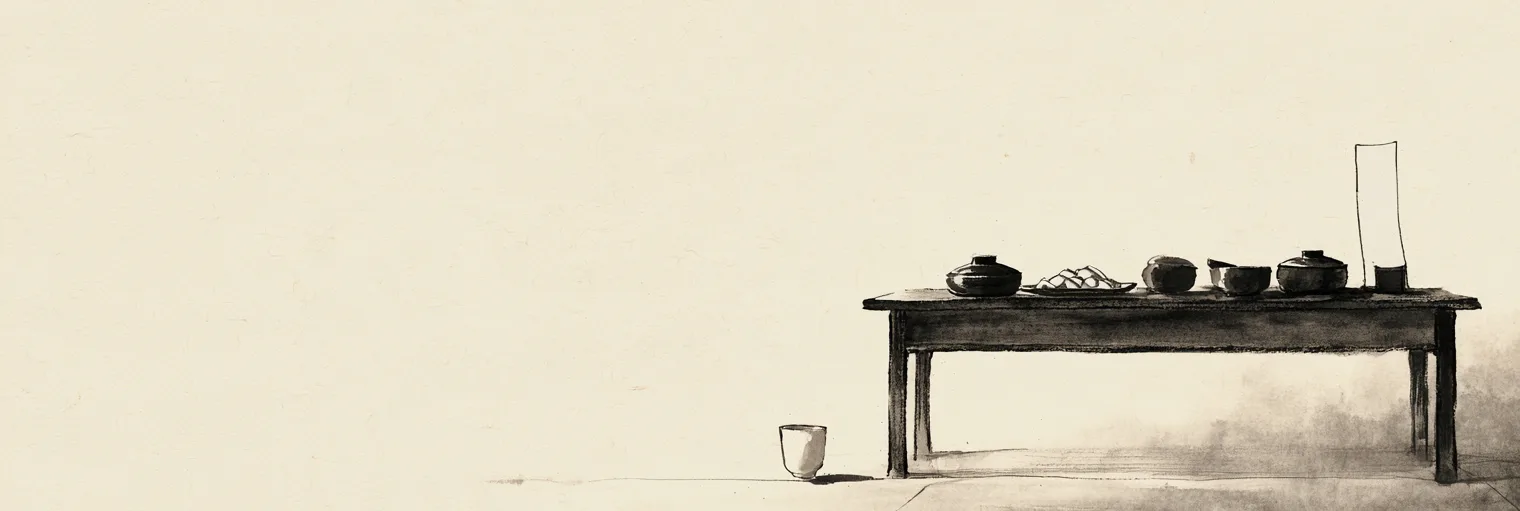
Jesa (제사, 祭祀) is the Korean rite of setting a table of food for ancestors who have died and bowing before it. The National Folk Museum of Korea defines it in one sentence: "Jesa is a ceremony held to commemorate one's departed ancestors and to express one's gratitude to them."
Two kinds of jesa are worth knowing by name. Gije (기제, 忌祭) is held once a year, on the date a person died. Charye (차례, 茶禮) is held on holidays, above all Seollal, the lunar new year, and Chuseok, the harvest full moon. The museum tells them apart in one line: at charye the cup of liquor is offered only once and no written invocation is read, while at gije the cup is offered three times and the invocation is read aloud.
You may have met this table on a screen: a morning when the food is laid out, nobody eats, and the family bows in front of it. So what is actually happening at that table, and what is it for?
What happens on a charye morning?
Picture the morning of Chuseok, in the house of the family's eldest line.
The Encyclopedia of Korean Culture, Korea's national encyclopedia, sets the scene: in most regions charye is held in daylight, and close relatives on the father's side gather, beginning at the house of the eldest line and going on from there in order.
A slip of paper has been set up for the rite. On it is written who this table is for: the ancestor, and their place in the family. The National Folk Museum writes that the rite is generally held before an ancestral tablet, and that a family without one can use a paper tablet, or a portrait or picture of the person who died.
The museum writes that charye calls for the special dish of the season: at Seollal a soup of sliced rice cake called tteokguk, and at Chuseok the half-moon rice cakes called songpyeon. So this morning there is songpyeon, and a cup waiting for liquor.
No candles are lit. The museum's Encyclopedia of Korean Folk Culture gives the plain reason: charye is held in the morning, once the day is light.
The host begins by inviting the ancestors. In the museum's account, the host burns incense, pours liquor three times into a bowl of sand, and bows. Then comes the part you saw on screen. "All members of the family who participate in Charye must make bows," the museum writes.
The cup is filled and offered. Once. Nobody reads anything aloud.
What has just been said, without words? Charye, the Encyclopedia of Korean Culture writes, is the rite that tells the ancestors the month, the season, and the year have turned and come round again, and at the same moment offers them the food of that season.
The season has turned. Here is what it brought.
Then the family shares the liquor and the food from the table. Korean has a name for this step, and the folk encyclopedia gives its meaning: receiving the blessing. It adds that the worth of charye lies here, in a family sharing that food and taking time to think of their ancestors.
Holiday charye, the same encyclopedia says, is a simplified rite that arose because it felt wrong for the living to enjoy the holiday by themselves.
Jesa, gije, charye: what is the difference?
That is the morning rite. Jesa is the family name for all such rites, and the one held at night is another member of the family.
Gije belongs to one person and one date. The museum writes that it can be held for any member of the family who has died, as far back as one's great-great-grandparents. That is four generations: parents, grandparents, great-grandparents, great-great-grandparents. The Encyclopedia of Korean Culture adds that only the ancestor whose day it is has a place at that table.
Gije is also the one held in the dark. The museum writes that it is prepared from midnight and held after one in the morning, or before sunrise. The folk encyclopedia gives a reason for the hour: the first hour of the new day was chosen so that the ancestor would come before everything else that day. Many families, it writes, now hold it in the evening instead.
Charye belongs to a holiday and to everyone at once. The museum writes that it is generally held for the last four generations together, and that it was once held on the first and fifteenth of every month as well.
| Gije | Charye | |
|---|---|---|
| When | Every year on the date a person died | On holidays, mainly Seollal and Chuseok |
| For whom | The one ancestor whose day it is | The last four generations together |
| The cup | Offered three times | Offered once |
| Written invocation | Read aloud | Not read |
Families also hold rites at the graves themselves, and the museum notes that Koreans often did so on the holidays.
Why is it called a tea rite when there is no tea?
Charye is written with the characters for tea and rite.
And there is no tea on the table. The Encyclopedia of Korean Culture says so directly: the charye that Koreans actually hold has no step of offering tea. The folk encyclopedia puts both facts in one sentence: charye means the rite of offering tea, and at a Korean holiday charye, liquor is used in place of tea.
Where did the name come from? Both encyclopedias point to the same book: Zhu Xi's Family Rituals, a Chinese handbook of household rites. Joseon, the dynasty that ruled Korea from 1392 to 1910, took it as its standard.
The word charye, the Encyclopedia of Korean Culture notes, appears nowhere in that book. What the book does have is two customs: greeting the ancestors at the family shrine on set days, such as the new year, the winter solstice, and the first and fifteenth of each month, and offering them the food of the season on the seasonal holidays. The encyclopedia identifies these as what Koreans now call charye. And the folk encyclopedia writes that the name most likely comes from one line in that book, which says that tea is offered at the visit on the fifteenth.
So the tea stayed in the name and left the table. The gesture underneath stayed where it was: the food of the season goes to the ancestors before the family eats.
Is jesa a Confucian rite?
Yes. The form Korean families follow today is Confucian, and Korea's own reference works say so.
The National Folk Museum writes that Confucian ancestral rites spread gradually through Korea at the end of Goryeo, the dynasty before Joseon, as the country took in Neo-Confucianism from China. Chinese books, Zhu Xi's Family Rituals among them, became practical guides for the nobility. Under Joseon, the museum writes, "the standard book on Jesa" was Family Rituals.
How far back a family was allowed to go depended, at first, on rank. The museum cites Joseon's national law code: officials of the sixth grade or higher could hold rites for three generations of ancestors, those of the seventh grade or lower for two, and commoners for their parents only. It did not stay that way. Confucian scholars who practiced Family Rituals kept the rule of four generations, the museum writes, and in the end it became accepted practice whatever a person's position.
The rite on the death day has a history too. The Encyclopedia of Korean Culture passes on what is said of it: that in ancient times there was no custom of holding a rite on the day a person died, and that it first appeared after China's Song dynasty.
The encyclopedia's entry on jesa sums it up: the rites Korean households kept for their ancestors all followed Confucian teaching, and under Joseon they took Zhu Xi's Family Rituals as their base.
Do families still set the whole table?
The National Folk Museum notes that under Korea's national standards for simplified family rites, gije is held for two generations, and that Koreans still keep it for four. And the table itself is allowed to be small.
On September 5, 2022, ahead of that year's Chuseok, Sungkyunkwan announced a simpler charye table through its committee on ritual standards. Sungkyunkwan was the national academy of Confucian learning that Joseon set up in its capital, and the Kukmin Ilbo newspaper, which reported the announcement, describes it as the institution that has preserved Confucian traditional culture.
The heart of it, the newspaper reported, came to two points. Do not fry jeon, the pan-fried dishes. And nine dishes at the most are enough.
The basic Chuseok table has six things on it: songpyeon, seasoned vegetables, a grilled dish, kimchi, fruit, and liquor. A family that wants more can add meat, fish, and rice cake, which, Sungkyunkwan said, is also for the family to agree on.
There are sayings about where each dish belongs on the table, such as red fruit to the east, white fruit to the west. Sungkyunkwan said these phrases are not found in the old books of ritual, and that the food may be placed however is comfortable. A photograph may stand in place of the paper slip.
Sungkyunkwan gave its reason from the Book of Rites, one of the Confucian classics: a great rite must be simple.
And the committee's chairman, Choi Young-gap (최영갑), said in his statement that day that charye is a rite holding the sincere devotion of descendants who miss their ancestors, and that it can never be a desirable thing if it causes people pain or brings discord into a family.
What is the table for?
Korea's reference works give two answers, side by side.
The first is gratitude. It is in the museum's definition: a ceremony "to express one's gratitude to them." The folk encyclopedia's entry on ancestral rites calls them a remembrance of the ancestors who have died and a sign of the sincere wish to repay one's root.
The second is blessing. The very next sentence of the museum's definition calls jesa "an occasion on which to be blessed by one's ancestor and to teach one's descendants filial affection and veneration." The folk encyclopedia's entry on gije writes that in Confucianism jesa is an occasion of praying for blessings, held in the hope of receiving them from one's ancestors, though the rite on a death day, it adds, belongs with the rites of mourning. And the sharing of food after the rite is named receiving the blessing.
This site reads a set of old Korean records, and they hold a word for the first answer. None of the lines below describes a family jesa. Three describe a rite that a whole country offered to heaven, and the last describes a jar that households kept.
The Gyuwon Sahwa, a Korean history whose preface is dated 1675, calls that rite the rite of offering to heaven and bobon (보본, 報本), repaying the root. The Dangun Segi, a chronicle of the Dangun rulers of Korea's first kingdom, gives the root of the same rite in four characters: 感謝爲本, gratitude is the root. It also keeps the song sung there, and its first line is this: Eoa, eoa — the great grace and high virtue of our ancestors. And the Gyuwon Sahwa describes households of its own day keeping a jar of new grain, filled again every tenth month, as a way of repaying Buru, the second Dangun ruler, for taming the waters and giving the people a place to live.
Zexeda reads the altar to heaven and the table at home as facing the same way: toward the root, to give something back.
Korea's scripture the Samil Singo has a chapter called Sinhun (신훈, 神訓), the chapter on Haneunim (하느님), the Ultimate Heavenly Source, and it closes with this line. The translation below follows Zexeda's commentary on the original text.
聲氣願禱 絶親見 自性求子 降在爾腦 Calling out with the voice, exerting your energy, and praying your wishes to an absolute being outside yourself will never bring you face to face with Haneunim. Seek the seed of truth in your own nature. Haneunim has already come down and dwells in your brain.
The line speaks of praying your wishes to an absolute being outside yourself. Zexeda reads a table set in thanks as a different act. At that table a family tells the people their lives came from that the season has turned, sets the season's food before them first, and bows. That is thanks, given back to the root, and Zexeda reads it as standing well beside the Samil Singo's teaching to seek the seed of truth in your own nature.
A jesa table is set for the people you can no longer thank in person.
You do not need a table to try the gesture. Tonight, sit down for ten minutes, look back at one small scene from your day, and notice one thing in it that reached you from someone else's hands.
Continue with Zexeda
If you enjoy finding the real Korea behind the scenes you love, the reading continues in the Zexeda newsletter — a quiet weekly letter on Korea's ancient wisdom, one story and one small practice at a time.
Key takeaways
- Jesa (제사, 祭祀) is the Korean rite of setting a table for ancestors who have died. The National Folk Museum of Korea defines it as a ceremony to commemorate them and express gratitude to them.
- Gije is held each year on the date a person died: the cup is offered three times and a written invocation is read aloud.
- Charye is held on holidays, mainly Seollal and Chuseok: the cup is offered once and nothing is read.
- Charye means "tea rite," and there is no tea on the table. Liquor is used in its place.
- The form is Confucian. Zhu Xi's Family Rituals was the standard book on jesa under Joseon.
- In 2022 Sungkyunkwan announced a simpler charye table: nine dishes at the most, and no need to fry jeon.
- Korea's reference works call the table both an expression of gratitude and an occasion to be blessed by one's ancestors.
- The Dangun Segi gives the root of Korea's old rite to heaven as 感謝爲本, gratitude is the root. Zexeda reads the family table as facing the same way, and reads a table set in thanks as a different act from praying your wishes to an absolute being outside yourself.
This article is for educational and reflective purposes and shares interpretations of Korea's ancient wisdom traditions. It is not medical, psychological, or professional advice.