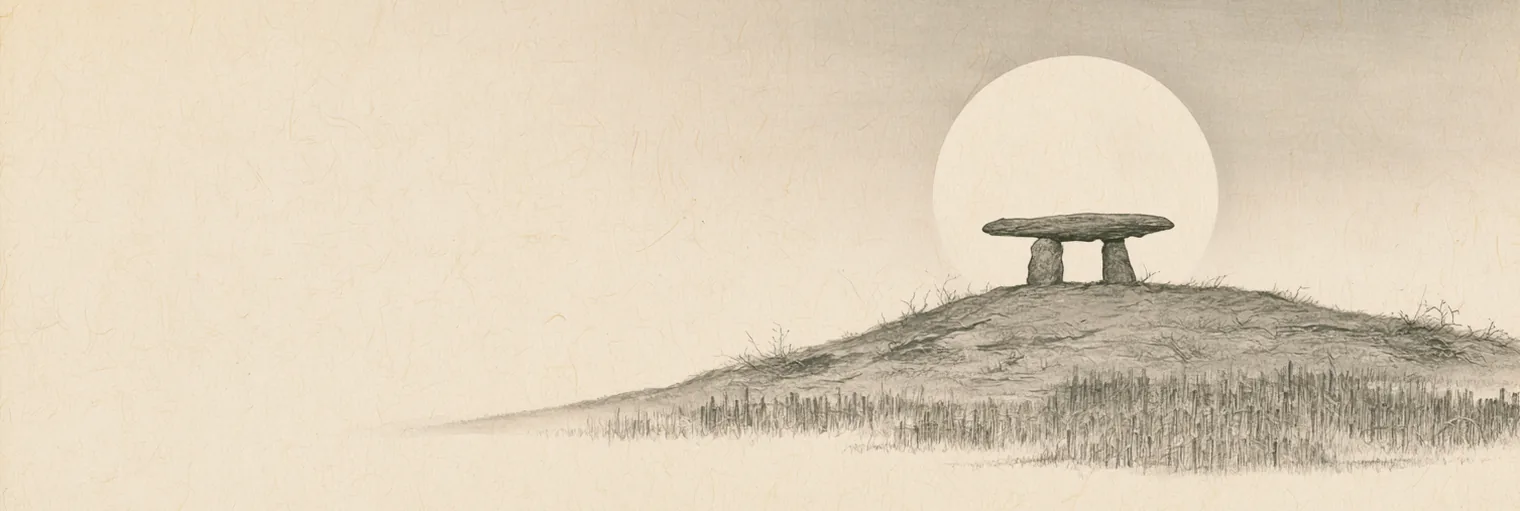
Chuseok (추석, 秋夕) is Korea's harvest festival, held every year on the fifteenth day of the eighth lunar month — the night of the full moon. In 2026 that is September 25. For three days the country empties out of its cities, families travel back to the towns they came from, set a table of the year's new grain and fruit for their ancestors, fold half-moon rice cakes, tend the family graves, and go outside after dark to look at the moon.
If you have heard it called Korean Thanksgiving, that is a fair translation of the feeling and a poor one of the facts. There is no shared origin, no shared date, and no shared story. What Chuseok has instead is a much longer memory — and this article follows it back: what the name means, what the oldest Korean records say the festival was, what stood behind it before that, and why, of all the things a modern country could have let go of, this is the one Korea has held on to hardest.
What is Chuseok, in plain terms?
It is the largest holiday of the Korean year alongside Seollal, the lunar new year. The core of it is simple and has not changed much:
| Custom | Korean | What happens |
|---|---|---|
| Charye | 차례 | A memorial table set for the ancestors, laid with the year's first harvest — new rice, new fruit — offered before the family eats |
| Beolcho · Seongmyo | 벌초 · 성묘 | Clearing the summer growth from the family graves, then visiting to pay respects |
| Songpyeon | 송편 | Rice cakes filled with sesame, chestnut, or bean, folded into a half-moon, steamed over pine needles |
| Moon-viewing | 달맞이 | Going out after dark to see the full moon, and making a wish under it |
| Ganggangsullae | 강강술래 | A circle dance performed by women under the full moon, on the UNESCO Representative List since 2009 |
The order matters more than it looks. The food goes to the dead first, the graves are put in order before the feast, and the year's first grain — not its surplus — is what gets offered. Every one of those is a way of saying the same thing: what arrived this year did not begin with us.
What does the name Chuseok mean?
There are two names, and they come from different places.
추석 (秋夕) is the Sino-Korean one, written with the characters for autumn and evening. The autumn evening — the specific one, the night the harvest moon is full.
한가위 (Hangawi) is the older, native Korean word, and it is the one people reach for when they want warmth rather than formality. It breaks into han (한), meaning great, and gawi (가위), meaning middle. The great middle — the full-moon night at the center of the eighth month, when the year's work is done and its result is finally in the hands of the people who did it.
That word gawi has a paper trail, and it leads somewhere specific.
Where does Hangawi come from? The gabae of Silla
The Samguk Sagi (삼국사기, 三國史記), compiled in 1145 and the oldest surviving Korean chronicle, records the following in the ninth year of King Yuri of Silla — 32 CE:
The king divided the six districts into two halves and set two royal daughters to lead the women of each side. From the sixteenth day of the seventh month they gathered each morning in the courtyard of the great district and spun hemp, breaking off late in the night. On the fifteenth day of the eighth month the work of each side was measured, and the losing side laid out food and drink to thank the winners. Then there was singing and dancing and every kind of entertainment, and this was called gabae (嘉俳). — Samguk Sagi, Silla annals, King Yuri, year 9
Gabae became gawi; great was added in front of it; and Hangawi is what came out the other end.
Three things in that passage are easy to read past.
It is a month long. The contest runs from the sixteenth of the seventh month to the fifteenth of the eighth — the whole waxing of one moon. The festival is not a day. It is the day a month arrives at.
The losers host. The side that worked less feeds the side that worked more, and then everyone sings. Nobody is sent home. The competition exists in order to produce the meal.
It ends in a lament. The chronicle adds that a woman from the losing side rose to dance and cried out Hoeso, hoeso — a sound the record calls sorrowful and refined — and that people later made a song from it, the Hoesogok (회소곡, 會蘇曲). The words are lost. What survives is the shape of the evening: a harvest, a contest, a shared table, and then, at the end of it, someone singing something sad. Korean festivals have kept that combination ever since.
By the time Chinese historians were describing Silla from the outside, the date had hardened into a national institution. The Old Book of Tang (구당서, 舊唐書), compiled in 945, gives an account of Silla's customs that runs straight from the new year to the eighth month:
又重八月十五日, 設樂飮宴, 賚群臣, 射其庭. "They hold the first day of the first month in high regard, exchanging greetings and laying out feasts, and on that day they bow to the spirits of the sun and the moon. They also hold the fifteenth day of the eighth month in high regard: music is performed, a banquet is set, gifts are bestowed on the assembled officials, and archery is held in the courtyard." — Old Book of Tang, book 199a, Account of the Kingdom of Silla
That is a foreign chronicler, writing about somewhere else, singling out the fifteenth of the eighth month as one of the two days Silla took most seriously — and setting it in the same passage as an act of reverence toward the sun and the moon. It is worth noticing what he did not say. There is no harvest in his description at all: only music, a shared table, gifts, and a contest in the courtyard. The oldest outside witness to Chuseok describes it exactly as the Samguk Sagi does — as a day the whole court and country gathers, competes, and eats together.
What stood behind it? The rite of thanking heaven
The Silla contest explains the name. It does not explain why the end of the farming year was already a sacred date before anyone organized a weaving competition around it.
For that, Korea's traditional histories point somewhere earlier, and to a different month.
The Gyuwon Sahwa (규원사화, 揆園史話) states it directly:
蓋祭天報本之禮, 始於檀君, 後世歷代諸國, 莫不祭天. "The rite of offering to heaven and repaying the root began with Dangun, and among the many kingdoms of the ages that followed, there was not one that did not offer to heaven." — Gyuwon Sahwa
The phrase in the middle of that sentence is the one to keep: 보본 (報本) — repaying the root. Not petition, not appeasement. Repayment of something already received.
The same passage then names the descendants of that rite, and the list is a map of the old kingdoms:
"Buyeo, Yemaek, Mahan, Silla, Goguryeo and the rest held it in the tenth month, and Baekje in the four middle months, each with its own name — doncheon, mucheon, jecheon, gyocheon, yeonggo, dongmaeng." — Gyuwon Sahwa
Six names in one line. Yeonggo (영고, 迎鼓) in Buyeo — welcoming the drum. Dongmaeng (동맹, 東盟) in Goguryeo. Mucheon (무천, 舞天) among the Ye — dancing to heaven. Different states, different words, one appointment on the calendar: when the year's work is finished, the whole people stops, gathers, and thanks the sky.
The Danggi Gosa (단기고사, 檀奇古史) adds a place to that. It records that Dangun Wanggeom sent his third son Buu to Ganghwa to raise a fortress on Jeondeungsan, and had an altar for the rite of heaven built on Mount Mani — noting that from this the eastern peoples' custom of offering to heaven began. Then it describes how the altar was made:
"The system of the heaven-altar followed cheon-il ji-i (천일지이, 天一地二) — heaven is one and earth is two: two stones were set standing and one stone laid over them." — Danggi Gosa
Two uprights and a capstone. Anyone who has seen a Korean dolmen will recognize the description immediately, and Korea has more of them than any other country on earth. An altar built as a diagram: earth doubled below, heaven single above, and the space between them where a person stands.
The altar on Mount Mani is not a legend — Chamseongdan is still there, on the summit of Ganghwa Island, a designated historic site, and the sacred flame for Korea's National Sports Festival is lit at it every year. When it was first raised is not something any document can settle; what the tradition says, plainly, is whose altar it is.
Why does the moon matter so much?
Because the festival is not really about the crop. The crop is the evidence.
A full moon does not stay full, and everyone watching it in an agricultural society knew that better than we do. It thins to nothing, returns as a sliver, fills again, and the whole circuit takes exactly as long as the interval between one Hangawi and the next twelve. The eighth-month moon is the one that arrives at the same moment the fields do — fullness in the sky and fullness in the barn, on the same night, once a year.
This is why the rice cake is worth a second look. Songpyeon is folded into a half-moon, not a circle — and Koreans have a standing answer for why. A full moon has nowhere left to go. A half moon is the one still filling. What you eat on the fullest night of the year is a picture of the part of the cycle that is still on its way up.
That is a more useful idea than it first sounds, and it is the same one that runs through Korea's oldest thinking about the world: nothing that has been received is a possession, and nothing that has come to fullness stays there. The Cheonbugyeong, Korea's oldest scripture, is built entirely on that motion — one becoming three, moving without exhausting itself, and returning to one. A harvest moon is that idea with a date attached.
What does Chuseok have to do with Korea's ancient wisdom?
Follow the two threads to where they meet.
The first is the harvest: labor finished, a table set, a family fed. The second is bobon — repaying the root — the rite the Gyuwon Sahwa puts at the beginning of the line, kept in the tenth month by every kingdom that followed. The Budoji shows the two already braided together in the founding of Silla: it says Hyeokgeose, the first ruler, built a Cheonbu Sodo on Nam-Taebaeksan, raised the Cheonbudan on the central terrace with guard-altars at the four quarters, performed the rite of cleansing there — and every year in the tenth month held the white-robe rite, the baegui-je, following the old meaning of Hwanggung binding white grass in offering. The same chapter has him going out on circuit to encourage farming, silkworms, and weaving, so that the fields stood full of stacked grain and the houses had cloth stored in them.
A rite to heaven and a harvest in the same paragraph, under the same ruler, as one activity.
Chuseok is what that looks like after four thousand years of ordinary life has worn the ceremonial edges off it. The state altar became a low table in a living room. The white-robe rite became a clean shirt and a bow. The offering to heaven became a bowl of new rice set down for a grandparent whose face you may not remember. What did not change is the direction the whole thing faces: backward and upward, before it turns to the people at the table.
That direction has a name in this tradition. Hongik Ingan — to broadly benefit all human beings — is the phrase given as the founding purpose of Dangun's kingdom, and the shape of a Chuseok day is a small version of it: receive first, acknowledge where it came from, then feed everyone within reach. The offering does not end at the altar. It ends in the room.
A quiet thing to do on the night
You do not need to belong to any tradition to try this, and it takes about the length of the moon clearing a rooftop.
Go outside. Find the moon. Then, instead of thinking anything about it, stop reacting to it — don't reach for whether it is beautiful, or whether you are the kind of person who does this, or what you should be feeling. Let the commentary go quiet and let the looking continue without it. When the breath settles on its own, leave it alone.
Then let one thing come to mind that arrived in your life this year without you making it. Not a thing you earned. A thing that came.
That is all. In Korean Seondo, the native tradition this site describes, the first of the three practices is exactly this — ji-gam (지감, 止感), stopping the reactive feeling before it takes you somewhere — and it is the entrance, not the summit. A full moon happens to be a good place to try it, because it asks for nothing and gives you something to look at while your mind runs down.
The old rite thanked heaven for the year. This is the same gesture, small enough to fit in a night.
Continue with Zexeda
If the thinking underneath a festival interests you as much as the festival does, the reading continues in the Zexeda newsletter — a quiet weekly letter that takes Korea's ancient wisdom one line, and one small practice, at a time. You are welcome to walk along.
New subscribers get a free PDF: A K-Drama Fan's Glossary of Korea's Ancient Words.
Key takeaways
- Chuseok (추석, 秋夕) — autumn evening — is Korea's harvest festival, held on the fifteenth day of the eighth lunar month, always a full moon. In 2026 it falls on September 25, observed as a three-day holiday.
- Its older Korean name is Hangawi (한가위) — the great middle, the full-moon night at the center of the eighth month.
- The Samguk Sagi traces gawi to gabae (嘉俳), a month-long weaving contest between two halves of Silla's six districts, recorded in the ninth year of King Yuri (32 CE). It ended on the fifteenth of the eighth month with the losing side hosting the winners, then singing and dancing — and a woman's lament that became the lost Hoesogok.
- The Old Book of Tang (945) confirms it from outside Korea: Silla held the fifteenth day of the eighth month in high regard — music, a banquet, gifts to the officials, and archery in the courtyard — recorded alongside the new-year custom of bowing to the spirits of the sun and the moon.
- Behind the harvest festival stands an older rite. The Gyuwon Sahwa says 祭天報本之禮 始於檀君 — the rite of offering to heaven and repaying the root began with Dangun — and that every kingdom afterward kept it: Buyeo, Yemaek, Mahan, Silla, Goguryeo in the tenth month, under names including yeonggo, dongmaeng, mucheon. The tenth month is also where Korea's other surviving date sits — Gaecheonjeol, October 3.
- The Danggi Gosa records Dangun Wanggeom having an altar for the rite of heaven built on Mount Mani, made on the principle cheon-il ji-i (天一地二), heaven is one and earth is two: two standing stones with one laid across them — the shape of a dolmen. Chamseongdan stands on that summit today.
- The Budoji says Silla's founder Hyeokgeose built the Cheonbudan with guard-altars at the four quarters, performed the rite of cleansing, and each year in the tenth month held the white-robe rite — while going out on circuit to encourage farming and weaving. Rite and harvest, one activity.
- Songpyeon is folded into a half-moon, not a circle. On the fullest night of the year, what is eaten is a picture of the moon that is still filling — the same motion the Cheonbugyeong describes as one moving into three and returning to one.
- The order of a Chuseok day carries the meaning: graves cleared before the feast, the year's first grain offered before the family eats. The direction is backward and upward first, and only then to the people in the room — the everyday shape of Hongik Ingan.
- Korean Thanksgiving is a useful nickname and a false cognate. The two festivals share no ancestry, sit on different calendars, and only one of them is built around a moon.
This article is for educational and reflective purposes and shares interpretations of Korea's ancient wisdom traditions. It is not medical, psychological, or professional advice.