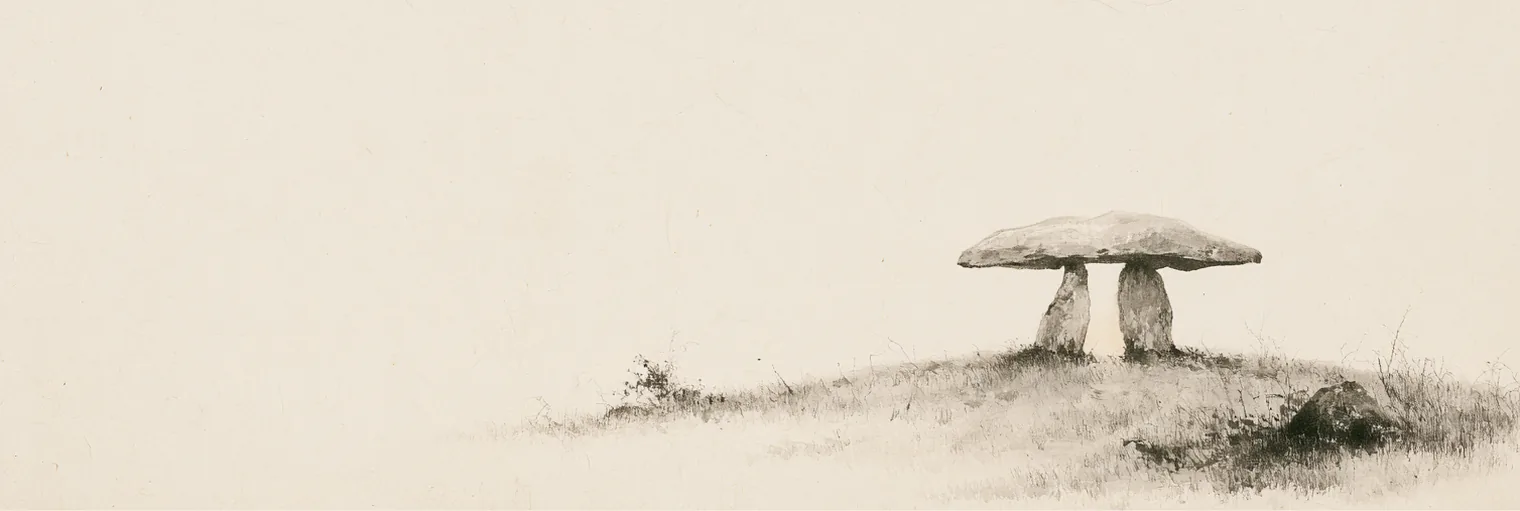
Korea has more dolmens than any other country on earth. The peninsula holds over 35,000 of them — a figure usually rounded to about forty thousand north and south together, and usually described as roughly 40% of the world's total. In 2000 UNESCO inscribed the three densest concentrations, at Gochang, Hwasun and Ganghwa, on the World Heritage List.
That much is on the information boards. What the boards do not say is why a country this size ended up with so many, and here the honest answer comes in two halves. Archaeology supplies the first: settled farming villages, granite everywhere, and a burial custom that held for a long time across a wide area. Korea's own traditional records supply the second, and they are almost never quoted, because they are not making an archaeological claim at all. They describe the shape as a rule.
This article follows that second half. What the stones are, how many there are and where to stand among them — and then what the Danggi Gosa, the Budoji and an eight-hundred-year-old travel diary say the shape was for.
How many dolmens are there, and where?
| Dolmens | What it is known for | |
|---|---|---|
| Korean peninsula | over 35,000 (est.) | roughly 40% of the world's total |
| Gochang (North Jeolla) | 447 | the densest concentration, and the widest range of types |
| Hwasun (South Jeolla) | 596 | the quarries survive — you can see where the stones were cut |
| Ganghwa (island, near Seoul) | a smaller group | the best-known table-type dolmen; Chamseongdan stands on the same island |
All three were inscribed together by UNESCO in 2000 as the Gochang, Hwasun and Ganghwa Dolmen Sites, on the grounds that they hold the highest density and greatest variety of dolmens of any country.
The scale of individual stones is worth sitting with. At Hwasun lies Pingmae Bawi (핑매바위), a capstone roughly 7.3 meters long, 5 meters wide and 4 meters thick, estimated at about 280 tons — among the largest dolmen capstones anywhere in the world. It was quarried, moved, and set down on supports. Whatever else that required, it required a great many people who all agreed the thing was worth doing.
Counts, weights and above all dates are estimates that shift between surveys, so read every figure here as a range rather than a measurement.
What is a dolmen, and what was it for?
A dolmen — goindol (고인돌) in Korean, from goida, to prop something up — is a megalithic structure of upright stones carrying a large flat capstone. Korea has three main forms:
- Table type (탁자식) — tall uprights holding the capstone clear of the ground, so the structure encloses an open space. The northern form; Ganghwa's famous example is one.
- Go-board type (바둑판식) — a capstone resting on low short stones, with the burial beneath.
- Capstone type (개석식) — the slab set directly over a pit, with no visible supports.
Excavation beneath them has produced burials, pottery, polished stone daggers and other grave goods, so their use as tombs is not in question. But that has never been the whole of it. Ritual objects have been found around them; they sit near villages and on ground that carries far; and they are far too numerous, and far too costly to build, to be explained as an ordinary way of burying the dead.
The traditional Korean records give the other half of the answer directly. They call the structure an altar.
The shape is the answer: two below, one above
The Danggi Gosa (단기고사, 檀奇古史), attributed to Dae Ya-bal of Balhae, records that Dangun Wanggeom sent his third son Buu to the island of Ganghwa to raise Samnangseong on Jeondeungsan, and had an altar for the rite to heaven built on Mount Mani. Then it describes how the altar was made:
The system of the heaven-altar followed cheon-il ji-i (天一地二) — two stones were set standing, and one stone was laid across the top of them. — Danggi Gosa
Read that sentence with no context and it is a construction detail. Read it as what it says it is — a rule, cheon-il ji-i, heaven is one and earth is two — and it stops being a description of a monument and becomes a diagram.
Two below. One above. Earth doubled beneath, heaven single across the top. That is a dolmen, given as a principle rather than a report.
This is the same passage this site cited in the article on Chuseok, where the harvest festival turns out to sit on top of a much older rite of thanking heaven. Chamseongdan still stands on the summit of Mount Mani today, and Ganghwa still has its dolmen. The chronicle puts an altar and an island together; the island kept both.
What does "heaven is one, earth is two" mean?
The rule is not a stray phrase. It is the opening structure of the Cheonbugyeong, Korea's 81-character scripture, which sets out the three terms in order:
天一一 地一二 人一三 Heaven, one, is first. Earth, one, is second. The human being, one, is third.
Heaven is one. Earth is two. And then — the human being is three.
Now look back at the stone. The capstone is heaven. The two uprights are earth. And the builders did not fill the space between them. They left it open, and it is the only part of the structure a living person can walk into and stand up in.
The Cheonbugyeong ends on that thought:
人中天地一 Within a human being, heaven and earth are one.
A dolmen is that line built at full scale. Earth carries, heaven covers, and the place where the two meet is not a stone at all — it is a gap, sized for a person.
Korea kept both the stones and the text that explains their proportions, and the two fit each other exactly. Very few traditions anywhere have carried both halves this far.
Reading the sky before setting the stone
The Budoji (부도지, 符都誌), attributed to Bak Je-sang of Silla, adds the step that comes before the building. In its thirteenth chapter Imgeom — Dangun — chooses the ground for the Budo and raises the Cheonbudan, the altar of the heavenly token, on the height of Mount Taebaek, with guard-altars at the four quarters. In the fourteenth, the peoples gather:
They opened a great spirit-market in the birch grove, cleansed themselves and settled their minds, and observed the appearance of the heavens. […] They fixed the positions of the north pole star (北辰) and the seven luminaries (七耀), and upon a flat rock roasted the offering of atonement and set it out, and gathered and sang, and played the music of Cheonung. — Budoji, chapter 14
The order of operations is the whole point. Look at the sky. Fix the positions. Then make the offering on a flat stone. Not a stone chosen for convenience — a stone placed after the sky has been read.
Something in the ground runs alongside that. A number of Korean dolmens and the stone slabs found with them carry seonghyeol (성혈, 星穴) — cup-marks ground deliberately into the rock. The best known came out of Adeugi in Cheongwon: a slab pitted with some sixty hollows, in which researchers from the 1970s onward read an arrangement resembling the Big Dipper, and on which North Korean scholars including Ri Jun-geol and Kim Dong-il published further constellation identifications in the late 1990s.
Set that beside the Budoji and the two hold the same shape. People ground holes in the pattern of stars into these stones — a strange thing to do to a grave, and an unremarkable thing to do to an altar.
The rule outlived the kingdom
Much later in the same chronicle, generations after Dangun Wanggeom, the rule surfaces again — and this time it is not for a royal altar. A king raises a heaven-altar outside the East Gate, and then sends an edict out across the country:
The people should each raise a heaven-altar in every village, and to accord with cheon-il ji-i they should set two stones below and lay one stone across the top. — Danggi Gosa
The same rule, word for word, and now in every village. The passage goes on to describe people gathering at those altars every year on the third day of the tenth month to make the offering, beating drums, singing and dancing.
There is the mechanism the question needed. A form prescribed for the state altar, then ordered for every settlement, then kept alive by an annual gathering, is a form that ends up scattered across a whole country in very large numbers.
And the date is hard to walk past. The third day of the tenth month. Korea still keeps that day. It is Gaecheonjeol, the National Foundation Day, and its name means the day the heavens opened.
What people still remembered eight hundred years ago
By the thirteenth century the builders were long past memory. The stones were not.
Yi Gyu-bo (이규보, 1168–1241), the Goryeo poet and official, kept a travel diary called the Namhaeng Woril-gi (남행월일기), collected in his Dongguk Yi Sangguk Jip. Passing through Geumma-gun, he went out of his way to look at something local people called jiseok (지석, 支石) — propped stones. He wrote that, as it was commonly told, an ancient sage had propped them there.
That single line is the oldest surviving Korean written notice of a dolmen, and its value lies in whose voice it carries. It is not an antiquarian's theory but Yi Gyu-bo writing down what the people living beside the stones said about them — and they did not say graves. They said a sage had set them up.
The passage does not name him. In the line this site follows there is only one builder of altars standing at the beginning of it, and that is Dangun. What matters more is the plainer thing that had come through the intervening millennia unbroken: the sense that these stones were placed on purpose, by someone who knew exactly what he was doing.
Where to stand
If you want to meet one of these rather than read about it, Ganghwa is the place to begin, and not only because it is close to Seoul. It is the island the Danggi Gosa names — where the third son was sent, where the fortress was raised, where the altar to heaven went up on Mount Mani. Chamseongdan is still on that summit, and the island's table-type dolmen is the one every Korean schoolbook prints. Altar and stone, on the same ground, in the same account.
Gochang gives you 447 of them at once, in more forms than anywhere else. Hwasun gives you something rarer — the quarries are still there, so you can stand where the stone was cut, and then walk to where it ended up.
And when you reach one of the table-type dolmens, there is a small thing worth doing that costs nothing.
Step into the space under the capstone and look up.
Not to feel anything in particular, and not to receive anything. Just notice the arrangement you are standing inside: earth beneath and on both sides, heaven a hand's breadth overhead, and the gap between them exactly the size of you. Then let the commentary go quiet — the dating, the tonnage, whether you are the sort of person who does this — and stay a moment longer than is comfortable.
That is the whole of it. In Korean Seondo, the native tradition this site describes, stopping the reactive commentary has a name — ji-gam (지감, 止感) — and it is the doorway, not the destination. A four-thousand-year-old stone is a generous place to try it, because it asks nothing of you and has already waited a very long time.
Continue with Zexeda
If the thinking underneath the stones interests you as much as the stones do, the reading continues in the Zexeda newsletter — a quiet weekly letter that takes Korea's ancient wisdom one line, and one small practice, at a time. You are welcome to walk along.
New subscribers get a free PDF: A K-Drama Fan's Glossary of Korea's Ancient Words.
Key takeaways
- The Korean peninsula holds over 35,000 dolmens — commonly given as around forty thousand — roughly 40% of the world's total, the largest concentration anywhere. Every figure here is an estimate that shifts between surveys.
- Gochang (447), Hwasun (596) and Ganghwa were inscribed together on the UNESCO World Heritage List in 2000, for the highest density and greatest variety of dolmens of any country.
- Hwasun's Pingmae Bawi capstone — about 7.3m × 5m × 4m and an estimated 280 tons — is among the largest in the world, and Hwasun still preserves the quarries the stones came from.
- Korean dolmens are tombs — burials, pottery and stone daggers have been excavated beneath them — but the ritual objects around them, and their sheer number and cost, say they were never only that.
- The Danggi Gosa gives the form as a rule, not a description: cheon-il ji-i (天一地二), heaven is one and earth is two — two stones set standing, one laid across — recorded of the altar Dangun Wanggeom had built on Mount Mani, on the island of Ganghwa where he sent his third son Buu to raise a fortress.
- That rule is the opening structure of the Cheonbugyeong: 天一一 地一二 人一三 — heaven one, earth two, the human being three. The capstone is heaven, the uprights are earth, and the open space between them is the third term.
- The scripture closes on 人中天地一 — within a human being, heaven and earth are one. A dolmen leaves exactly one gap in the structure, and it is person-sized.
- The Budoji (ch. 14) puts the sky first: the peoples observed the appearance of the heavens, fixed the positions of the north pole star (北辰) and the seven luminaries (七耀), and only then made the offering upon a flat rock.
- Some dolmens and their accompanying slabs carry seonghyeol (성혈) — ground cup-marks — in which researchers have read constellation patterns, most famously on the Adeugi slab at Cheongwon, with further identifications published by North Korean scholars in the late 1990s. Holes in the pattern of stars are a strange thing to cut into a grave.
- Later in the Danggi Gosa the same rule is issued again by edict — a heaven-altar in every village, two stones below and one across — with a national gathering on the third day of the tenth month, the day Korea still keeps as Gaecheonjeol. A form prescribed everywhere is a form found everywhere.
- Yi Gyu-bo (1168–1241), in the Namhaeng Woril-gi, records the oldest Korean written notice of a dolmen: local people called them jiseok, propped stones, and said an ancient sage had propped them there — not that they were graves.
- Korea kept both the stones and the text that explains their proportions, and the two fit exactly. Very few traditions anywhere have carried both halves this far.
This article is for educational and reflective purposes and shares interpretations of Korea's ancient wisdom traditions. It is not medical, psychological, or professional advice.