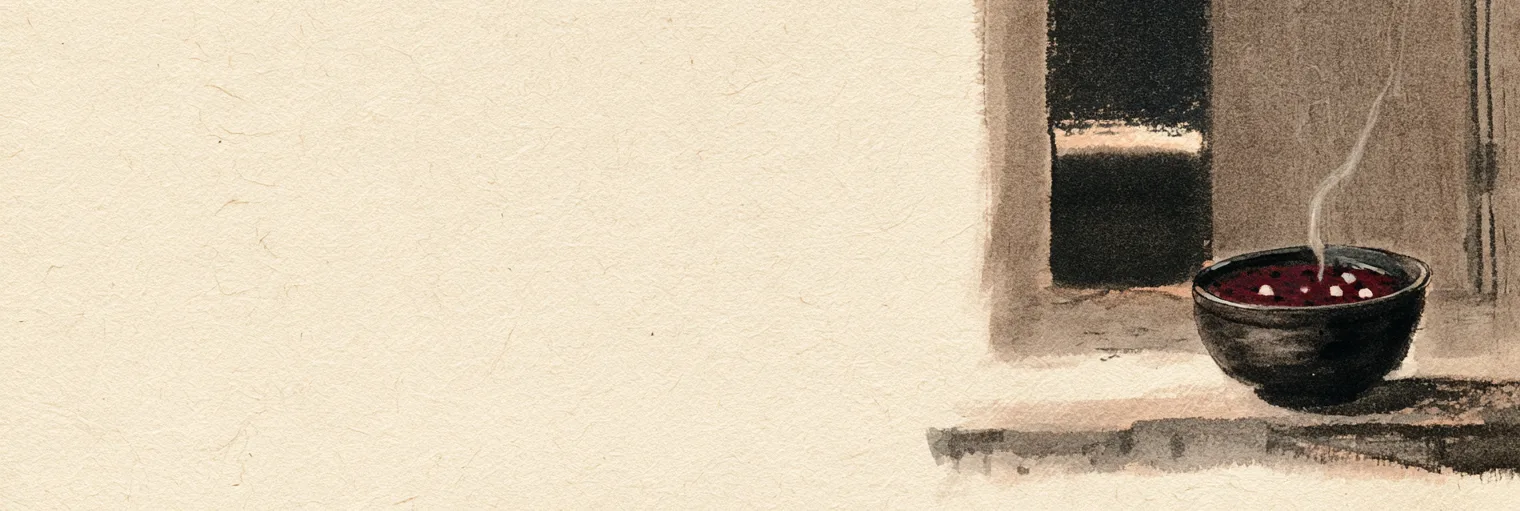
Dongji (동지, 冬至) is Korea's winter solstice — the day with the longest night and the shortest daylight of the year. It comes around December 22, and in 2026 it falls on Tuesday, December 22. On this day Koreans cook patjuk (팥죽), a deep red porridge of red beans and rice with small white rice balls floating in it.
In a traditional household nobody ate it straight from the pot. The first bowl went to the family's ancestors. More bowls were carried to the rooms and storage corners of the house. A little was splashed on the front gate. Only when the porridge had cooled did the family sit down together.
And Koreans gave this night a second name. A Korean book of customs from around 1849 calls it the next thing to the new year. Ordinary people said it more simply: jageun seol (작은 설), the little new year. Eat your bowl, they said, and you are one year older.
Which leaves a question, and this article follows it. Why would the darkest night of the year be a new year?
What happens in a Korean home on Dongji?
Picture the kitchen of an old Korean house on the afternoon when the sun sets earliest.
Red beans are boiling in a big pot. When they are soft, someone lifts them out and presses them through a sieve. The skins stay behind and a dark red liquid runs through. Rice goes into that liquid, and the pot goes back on the fire.
Beside the stove, someone else kneads glutinous rice flour with hot water and rolls the dough between two palms into small white balls, each about the size of a bird's egg. That is exactly what they are called: saealsim (새알심), bird's-egg centers. They sink into the red. When the porridge thickens and its color deepens, the white balls float up one by one, and a pinch of salt goes in.
Now watch where the bowls go, because the first bowl is not for anyone at the table.
It is carried to the family shrine, the building where a household keeps the name tablets of its ancestors. The next bowls go to each room, to the terrace where the big clay jars of soy sauce stand, and to the shed. Soon there is a bowl of red porridge steaming in every corner of the house. Then someone takes a spoonful and flicks it across the boards of the front gate.
Outside it is already dark. The longest night of the year has begun.
By the time the porridge has cooled, the family is sitting in a circle around it. A grandmother looks into a child's bowl and counts the white balls, because in some homes you were given as many as your age. And then comes the old saying of the day: finish this bowl, and you are one year older.
Seollal, the lunar new year, is still weeks away. After this year's Dongji it does not come until February 7, 2027, forty-seven days later. So why is this child a year older tonight?
Why do Koreans call it the little new year?
Because this household is already welcoming the new year. It is doing it ahead of the calendar, on the darkest night it can find.
The name is written down in the Dongguk Sesigi (동국세시기, 東國歲時記), a book in which the scholar Hong Seok-mo recorded Korea's customs month by month. He wrote it around 1849, late in Joseon, the dynasty that ruled Korea from 1392. His entry for this day opens with six characters: 冬至日稱亞歲, the day of the winter solstice is called Ase.
Ase (아세, 亞歲) joins a character meaning next to with a character meaning year. The next thing to the new year. The dictionary of seasonal customs published by the National Folk Museum of Korea gives the everyday Korean name for the same day: jageun seol, the little new year, the one that stands right behind Seollal.
The reason is in the sky. Until this day, every night of autumn has been a little longer than the one before. From this day on, every day is a little longer. Korea's national Encyclopedia of Korean Culture writes that ancient people took the solstice as the day the sun came back from death, and held festivals for it. The year does not turn when the weather warms. It turns here, at the bottom, while it is still cold and dark.
So people counted their age from here. The same encyclopedia records two sayings still heard today: you grow a year older only once Dongji has passed, and you have to eat Dongji porridge to really grow a year older.
One more detail makes the name solid. In Joseon, the royal observatory — the office that watched the sky and made the calendar — presented the calendar for the coming year to the palace on Dongji. The court stamped it with the royal seal and handed copies to the officials, and the officials passed them on to their relatives. In the capital, the Dongguk Sesigi says, officials gave their clerks fans in summer and clerks gave officials calendars at Dongji. This was called 夏扇冬曆, fans in summer, calendars in winter, and the custom spread to relatives and friends in the countryside and to farm villages.
Think about what that means. The new year's calendar did not arrive on New Year's Day. It arrived on the longest night. This was the day the coming year was first put into people's hands. Koreans still give each other calendars at the end of the year, and the Folk Museum's dictionary traces the habit to this one.
Why red beans?
Go back to the color in the pot. Hong Seok-mo explains it with a story, and he says where he found it:
按荊楚歲時記 共工氏有不才子 以冬至死 爲疫鬼 畏赤小豆 故冬至日作粥以禳之 "According to the Jingchu Suishiji, Gonggong had a good-for-nothing son who died on the winter solstice and became a spirit of plague. He was afraid of red beans. So on the solstice, porridge is cooked to keep him away." — Dongguk Sesigi, eleventh month, winter solstice
The book he names, the Jingchu Suishiji (荊楚歲時記), is much older. Zong Lin of the Liang dynasty in China compiled it in the middle of the sixth century as a record of the yearly customs of the Hubei and Hunan regions. Its own line for the day is short: on the winter solstice, make red bean porridge to ward off plague; measure the sun's shadow. The story of Gonggong's son stands in the note attached beneath that line.
Notice the second half of that short line. On the same day people cooked the porridge, they also measured the shadow of the sun.
The Encyclopedia of Korean Culture gives the thinking behind the color. Red was the color of the bright, sunlit side of the world, and people believed it drove off the spirits that belong to the dark. On the night when the dark is longest, you cook the reddest thing you have.
The porridge was on Korean tables long before Hong Seok-mo. The collected writings of Yi Saek, a scholar at the end of Goryeo — the dynasty before Joseon, and the one Korea's English name comes from — already mention the porridge, and the encyclopedia concludes that by Goryeo it was a fixed dish of the day.
Now look at where else a Korean family cooked it. When they moved into a new house, they made patjuk, splashed it inside and outside, and shared it with the neighbors. When a neighbor was in mourning, they cooked a pot and sent it over. Red bean porridge was not only solstice food. It was what Koreans cooked when they stood at a doorway — a new home, a death, a new year. Dongji is the doorway of the year, and so the porridge goes on the gate.
There is one exception. When the solstice falls in the first ten days of the eleventh lunar month, it is called aedongji (애동지), child Dongji, and because the porridge was held to be bad for children in such a year, families with little ones made rice cakes instead. In 2026 the solstice lands on the fourteenth day of that month, so the pot goes on the fire as usual.
Where does the first bowl go, and why?
Return to the bowl that nobody at the table touched.
If patjuk were only for chasing things away, that bowl would make no sense. You do not chase away your own grandparents. The Encyclopedia of Korean Culture separates the two movements clearly. The bowls placed around the house are there to drive out what should not stay. The bowl in the shrine is something else: an offering of the season's food, set before the ancestors in thanks before any living person eats.
One pot, two directions. Part of it pushes outward, toward the gate. Part of it goes upward first.
That second direction runs deep in a Korean home. At Chuseok, the harvest full moon, the year's first rice and fruit go on the ancestors' table before the family eats. The Gyuwon Sahwa, a Korean history whose preface is dated 1675, describes households setting out a jar and filling it with new grain every tenth month. The direction never changes. First you offer. Then you eat.
So the Dongji table says two things at once. Let nothing harmful cross into the new year. And: what we are about to receive did not begin with us.
How many new years does Korea have?
Here is where Zexeda's own reading begins.
Count the days Korea has called the start of the year. There is Seollal, the first day of the first lunar month, when the moon has gone dark and begins to fill again. There is Dongji, when the sun stops sinking and begins to climb. And there is a third. The Taebaek Ilsa, one of the old Korean chronicles this site reads, records that the fifth Dangun — Dangun is the title carried by the rulers of Korea's first kingdom — made the tenth month the head of the year. That is the month when the fields are cut, the month when Korea's oldest festivals gathered whole kingdoms to give thanks.
Read side by side, the three dates have the same shape. Each one sits where something has just run out. The harvest is finished. The daylight has shrunk as far as it will go. The moon has disappeared. And each time, Koreans did not call that place the end. They called it the first day.
That is the reading this site takes from Dongji. A year does not begin when things are full and bright. It begins at the lowest point, because the lowest point is the turn.
What does the longest night ask of you?
The Cheonbugyeong, Korea's 81-character scripture, is built as a circle: it begins from the One and ends in the One, with the same One at both ends. And near its close it has this line: 本心本太陽, the original mind is, at its root, the sun.
Set that line next to the solstice. On Dongji the sun has not gone anywhere. It is low and brief and hidden for most of the day, and it is exactly the same sun. Nobody in that old kitchen thought they had to make a new one. They cooked something red, set the first bowl down, and waited for the light that was already on its way back.
The scripture says the same about a person. Brightness is where you start from. What a long year leaves behind is not darkness. It is covering.
So here is one small thing to do on the night of December 22, and it needs no porridge.
Turn the lights off. Sit for ten minutes in the dark, the real dark of the longest night. Let the year walk past you, and choose one thing you have been carrying that does not need to cross the doorway with you. You do not have to fix it. Just look at it, and let it stay on this side of the night.
If you would like a simple way to sit like that, step by step, there is one here: a ten-minute Korean evening practice for beginners.
Then eat something warm. By the old Korean count, you are a year older now, and the days are already getting longer.
Continue with Zexeda
If you like finding the thought hidden inside a bowl of porridge, the reading continues in the Zexeda newsletter — a quiet weekly letter on Korea's ancient wisdom, one story and one small practice at a time. You are welcome to walk along.
Key takeaways
- Dongji (동지, 冬至) is Korea's winter solstice, the longest night of the year. It comes around December 22 and falls on December 22 in 2026.
- The food of the day is patjuk (팥죽): red beans boiled and strained, rice cooked in the red liquid, and small white rice balls called saealsim, bird's-egg centers.
- In the traditional home the first bowl went to the family shrine, more bowls were set in the rooms, by the soy-sauce jars and in the shed, a little was splashed on the gate, and the family ate when the pot had cooled.
- The Dongguk Sesigi (around 1849) calls the day Ase (亞歲), the next thing to the new year. Ordinary people called it jageun seol, the little new year, and said a bowl of Dongji porridge makes you a year older.
- In Joseon the royal observatory presented the coming year's calendar on Dongji, and it was passed from the court to officials to relatives in the countryside — fans in summer, calendars in winter.
- The Dongguk Sesigi explains the red beans with a story it quotes from the sixth-century Chinese Jingchu Suishiji: Gonggong's son died on the solstice, became a spirit of plague, and feared red beans. Korean families also cooked patjuk for a new house and for a house in mourning — the food of doorways.
- The Encyclopedia of Korean Culture reads two meanings in one pot: the bowls around the house drive out what is harmful, and the bowl in the shrine is an offering made first, the same order kept at Chuseok and with the jar of new grain.
- Korea remembers three beginnings of the year — the tenth month, Dongji, and Seollal — and each sits where something has just run out. The lowest point is the turn.
- The Cheonbugyeong says 本心本太陽, the original mind is, at its root, the sun. On the longest night the sun is hidden, not gone.
This article is for educational and reflective purposes and shares interpretations of Korea's ancient wisdom traditions. It is not medical, psychological, or professional advice.