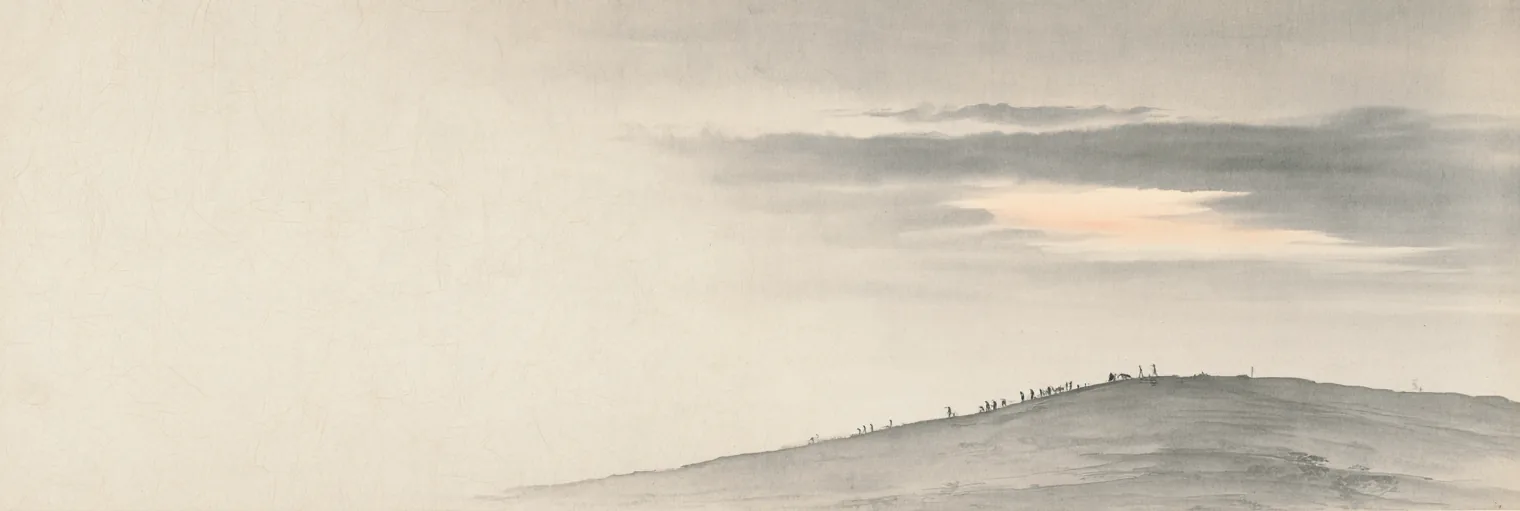
Every October 3, South Korea closes. English-language calendars list the day as National Foundation Day, which makes it sound like a birthday for a country — fireworks, a flag, a founding date. The Korean name says something else entirely. It is Gaecheonjeol (개천절, 開天節), and the three characters mean open, heaven, and festival day: the day the heavens were opened.
That gap between the two names is not a translator being careless. It is the whole point, and Korea's own chronicles are unusually direct about it. They use 개천 (開天), the opening of heaven, as a dating system — they count years from it the way the Western calendar counts from a birth — and when they count forward to the day Dangun arrived and Korea's first kingdom began, the number they reach is 1,565.
So the opening and the founding are not the same event. There are fifteen and a half centuries between them.
This article follows that number back to where it starts, and then forward again to the reason the day sits on October 3 in particular — which turns out to have nothing to do with a coronation, and everything to do with where the year used to begin.
What does "Gaecheonjeol" actually mean?
Take the name apart first, because the pieces do the explaining.
개 (開) is to open. 천 (天) is heaven, the sky. 절 (節) is the word Korean uses for a day marked on the calendar — the same character that ends Gwangbokjeol, the August day Korea remembers its liberation. Put together: the festival of the opening of heaven.
Notice what is missing. There is no nation in that name, no founder, no kingdom, no date of establishment. Every word is about something being opened.
The Hwandan Gogi (환단고기, 桓檀古記), the collection of Korean chronicles this site works from, does not leave the word to guesswork. In the Taebaek Ilsa (태백일사), one of the texts gathered inside it, gaecheon is defined outright — and it comes as one of three:
遣往理世之謂開天, 開天故, 能創造庶物. "To be sent out to govern the world is what is called opening heaven. Because heaven is opened, all things can be created." — Hwandan Gogi, Taebaek Ilsa, Samhan Gyeonggyeong Bongi
The other two follow immediately: 貪求人世之謂開人 — to seek out and take up the human world is what is called opening humanity; and 治山通路之謂開地 — to order the mountains and open the roads is what is called opening earth.
Read them together and something becomes clear that the English holiday name completely hides. Gaecheon is not a date. It is a job description. All three phrases describe work — being sent, taking something on, cutting a road through a mountain. Heaven opening is not the sky splitting apart in a picture. It is the moment someone is dispatched into the world with something to do.
Which raises the obvious question.
Who was sent, and when?
Here the chronicles are specific, and the answer is not Dangun.
The Samseong Gi (삼성기, 三聖紀), the opening text of the Hwandan Gogi, puts the instruction in the mouth of Hwanin (환인, 桓因), the heavenly ruler, speaking to his son Hwanung (환웅, 桓雄):
率衆三千而往, 開天立敎, 在世理化, 爲萬世子孫之洪範也. "Take three thousand of the people and go. Open heaven, establish the teaching, govern in the world by reason — let this be the great pattern for the descendants of ten thousand generations." — Hwandan Gogi, Samseong Gi
Four verbs, one sentence, and the second of them is our word. Open heaven. The third is a phrase this site has written about on its own: 在世理化, Jaese Ihwa — governing the world with reason while living in it, the practical half of Korea's founding ideal.
The Taebaek Ilsa tells the same moment with the detail that makes it visual:
乃授天符印三個, 遣往理之. 雄率徒三千, 初降于太白山神壇樹下, 謂之神市. "So he gave him the three heavenly seals and sent him to govern. Hwanung led three thousand followers and came down beneath the sacred altar tree on Mount Taebaek, and this was called Sinsi." — Hwandan Gogi, Taebaek Ilsa
Three thousand people arriving under one tree, and the place they stopped got a name: Sinsi (신시, 神市). The three objects handed over before he left are the Cheonbuin, the three heavenly seals, which this tradition reads as a sword, a mirror and a bell — and as three stages of an inner path rather than three pieces of regalia.
From that arrival, the Hwandan Gogi starts counting. Its chronology of the eighteen Hwanung rulers is written in an era it calls 神市開天 — the opening of heaven at Sinsi — with the first year given as 3897 BCE:
神市開天, 元年, BC3897 … 傳十八世, 歷一千五百六十五年. "Sinsi, the opening of heaven, year one, 3897 BCE … eighteen generations were passed down, spanning 1,565 years." — Hwandan Gogi, Samseong Gi
This was not a dead convention. When Gye Yeon-su printed the Hwandan Gogi in 1911, he signed his afterword with the same era rather than the reign year alone: 神市開天 五千八百八年 — in the 5,808th year from the opening of heaven at Sinsi. A man in the twentieth century dating his own book by a calendar that starts with a descent.
Then where does Dangun come in?
At the 1,565th year of that count — and the entry that records it is the reason October 3 exists.
戊辰, 元年, 大始神市之世, 四來之民, 遍居山谷, 草衣跣足, 至開天, 一千五百六十五年, 上月三日, 有神人王儉者五加之魁, 率徒八百來御于檀木之墟, 與衆奉祭于三神. "In the mujin year, the first year, when the age of Sinsi had greatly begun, the people who had come from the four directions lived scattered through the mountains and valleys, clothed in grass and barefoot. In the 1,565th year from the opening of heaven, on the third day of the sangwol, there was a divine man, Wanggeom, chief of the Five Ga, who came with eight hundred followers to the place of the bakdal tree, and together with the assembled people offered the rite to the Three Spirits." — Hwandan Gogi, Danggun Segi, first year (2333 BCE)
Four things in that sentence are worth slowing down for.
First, the date is counted from the opening, not from a dynasty. The chronicle does not say "in the first year of Joseon." It says in the 1,565th year from the opening of heaven. Dangun's arrival is dated by reference to Hwanung's, the way a Western document dates itself by reference to a birth in Bethlehem.
Second, eight hundred people is not an army. It is roughly the population of a large village, walking to a tree.
Third, the first thing he does is a rite, not a coronation. He comes, and together with the assembled people he offers to the Three Spirits (삼신, 三神). Only after that does the passage say the people of the nine Han were glad and served him willingly, 推爲天帝化身而帝之 — they raised him up as the embodiment of the heavenly emperor and made him ruler. He is not crowned by heaven over the heads of the people. The people lift him.
Fourth, what he does next is restore, not invent. The very next line: 復神市舊規, 立都阿斯達, 建邦號朝鮮 — he restored the old rules of Sinsi, established his capital at Asadal, and set up the country under the name Joseon. The founding of Korea's first kingdom is written as the restoration of something opened fifteen centuries earlier. That is precisely why the holiday is named for the opening and not for the founding.
And there is a detail in that passage that most readers walk straight past. Wanggeom is called 五加之魁, chief of the Five Ga. The Five Ga were the five great offices, and the Taebaek Ilsa lists what each one handled: 牛加主穀, 馬加主命, 狗加主刑, 猪加主病, 鷄加主善惡 — grain, life, punishment, sickness, and the difference between good and evil.
Hold that list next to the Samguk Yusa, the thirteenth-century chronicle that carries Korea's best-known founding account, where Hwanung comes down and takes charge of grain, life span, sickness, punishment, and the difference between good and evil. Fifteen hundred and sixty-five years apart, in two different books, the same five items in nearly the same order. Whatever else was passed down across that gap, the job was.
One Korean scholar noticed the imbalance long before there was a holiday to argue about. Bugaeja, writing the Gyuwonsahwa (규원사화, 揆園史話) in the seventeenth century, put it plainly:
至今惟知崇檀君, 而不知其前實有神市氏之開創矣. "To this day people know only to revere Dangun, and do not know that before him there was truly the opening begun by Sinsi." — Gyuwonsahwa
The name of the holiday is on Bugaeja's side. The English translation is not.
Why the third day of the tenth month?
Now the date itself, which is the part almost nobody explains.
The chronicle said 上月三日, the third day of the sangwol. Sangwol (상월, 上月) means the upper month, and on its own that tells a modern reader nothing. The Taebaek Ilsa defines it in a passage about the calendar:
舊用癸亥, 而檀君邱乙, 始用甲子, 以十月爲上月, 是謂歲首. "Formerly gyehae was used, but Dangun Gueul first used gapja, and made the tenth month the sangwol — and this is called the head of the year." — Hwandan Gogi, Taebaek Ilsa
There it is. The sangwol is the tenth month, and the tenth month was where the year began.
So the third day of the sangwol means the third day of the tenth month — and in the calendar this tradition kept, that was not late autumn at all. It was the third day of the new year.
Once you know that, the month stops looking arbitrary. The tenth month is when the fields are cut and the year's work is finally in hand, which is exactly why every old Korean kingdom put its great rite to heaven there: Yeonggo, Dongmaeng and Mucheon all fall in the tenth month, and the Gyuwonsahwa records Buyeo, Yemaek, Mahan, Silla and Goguryeo keeping the same appointment. A year that begins when the harvest is in begins with a full barn and an unpaid debt, which is a very particular way to start counting.
The Danggun Segi shows the day running as a fixture late in Dangun's own reign:
國中大會. 上月祭天, 民皆熙皞自樂. "There was a great assembly of the whole country. In the sangwol they made the offering to heaven, and the people were all bright and content and took their own joy in it." — Hwandan Gogi, Danggun Segi, 93rd year (2241 BCE)
Same month, same rite, ninety-three years after the arrival — and by then it has a crowd and a name, 국중대회, the great assembly of the whole country.
Did anyone actually keep the day?
This is the question that decides whether October 3 is an old date or a modern invention, and the records answer it in a way that is hard to shrug off.
Meet Eulji Mundeok (을지문덕), the one figure in this article that Korean drama fans already know. In 612 CE a Sui Chinese army crossed into Goguryeo — the Taebaek Ilsa puts it at over 1.3 million men — and Eulji Mundeok let them come, drew them deep, then broke them at the Salsu river. Of the force that marched, the chronicle says, about 2,700 made it back alive. He is one of the two or three most famous generals in Korean history.
Here is how the same text describes his private year:
每當三月十六日, 則馳往摩利山, 供物敬拜而歸. 十月三日則登白頭山祭天. 祭天乃神市古俗也. "Every year on the sixteenth day of the third month he would ride to Mount Mari, make his offering, bow in reverence, and return. On the third day of the tenth month he climbed Baekdusan and made the rite to heaven. The rite to heaven is the old custom of Sinsi." — Hwandan Gogi, Taebaek Ilsa, Goguryeo Guk Bongi
The third day of the tenth month. Not a holiday he was given — a journey he made, up Korea's highest mountain, every year, roughly three thousand years after the date in the chronicle. And the text names the lineage without being asked: the rite to heaven is the old custom of Sinsi. Not a Goguryeo custom. Sinsi's.
Eulji Mundeok belongs to a line of trained men this site has written about elsewhere — the Jouiseonin of Goguryeo, one link in Korea's own tradition of practice. This passage is what that training looked like on the calendar.
The date turns up again in the hands of the man who wrote the chronicle we have been quoting. Yi Am (이암), a high official of late Goryeo, finished the Danggun Segi and signed off:
上之十二年 癸卯 十月三日 紅杏村叟 書于江都之海雲堂. "In the twelfth year of the present reign, the gyemyo year, on the third day of the tenth month, the old man of Honghaeng village wrote this at the Haeundang in Ganghwa." — Hwandan Gogi, Danggun Segi, preface
The year is 1363. A man writing the history of Dangun chose to date his own preface to Dangun's day. That is not a coincidence; it is a signature.
How October 3 reached the modern calendar
The rest of the journey is short, and it is documented.
The name Gaecheonjeol comes into public use through Daejonggyo, the religion reorganized around the Dangun tradition in 1909, which made the day one of its two great yearly rites and kept it on the third day of the tenth lunar month. Korea's Encyclopedia of Korean Folk Culture — published by the National Folk Museum of Korea — notes that Daejonggyo understood this day as sharing one origin with Dongmaeng, Yeonggo and Mucheon, the old kingdoms' rites to heaven.
When the Provisional Government of the Republic of Korea was established in Shanghai in 1919, it held a state observance on the same lunar date, under the name Geonguk Giwonjeol — the festival of the nation's founding origin. By the mid-1920s the name people actually used had settled back to Gaecheonjeol.
Then comes the change every reader of this article should know about. The old date was lunar. In 1949, Korea's Act on National Holidays fixed the holiday on October 3 of the solar calendar, and there it has stayed. A committee convened that year to decide the question reported that a lunar-to-solar conversion could not be made reliably, and that what was worth keeping was the record of the date itself — the third day of the tenth month.
So the modern holiday is not the ancient date recalculated. It is the ancient date carried across, as a set of numbers judged too important to lose.
Two details from that moment are worth a sentence each. First, when the new republic named the day, it did not call it Geonguk Ginyeomil, National Founding Day, although that name was available. The Encyclopedia of Korean Folk Culture records the reasoning plainly: Gaecheonjeol carried the larger symbolic meaning. Second, Daejonggyo's own position was that gaecheon means Hwanung opening the gate of heaven and beginning the work of Hongik Ingan — not the founding of a kingdom by Dangun. The distinction this article started with was written into the naming of the holiday.
And the song settles it. The official Gaecheonjeol song, with words by the scholar Jeong In-bo, still sings the date in the old calendar's own vocabulary:
이날이 시월 상달에 초사홀이니 "This day is the third day of the sangdal, the tenth month."
Sangdal is the everyday Korean word for the same sangwol the Taebaek Ilsa defined — the upper month, the head of the year. The encyclopedia notes the folk background behind it in one line: people held the tenth month as the sangdal, the month of the harvest, and treated three as a fortunate number. The chronicle, the folk calendar and the national anthem of the day are all saying the same two words.
What is actually being remembered
Strip the holiday back to the sentence the chronicles define it with — to be sent out to govern the world is what is called opening heaven — and the shape of the day changes.
It is not a border being drawn. It is not a bloodline being celebrated. Gaecheon describes someone arriving somewhere with work to do, and the two arrivals the day holds together are of exactly that kind: three thousand people under a tree, and eight hundred people at a bakdal grove, and in both cases the first act on the ground is a rite and the second is the ordinary business of grain and sickness and law.
That is also why the day pairs so naturally with the phrase Korea still writes into its education law. Hongik Ingan — to broadly benefit all human beings — is the reason given for the descent in the first place. Opening heaven is the departure. Benefiting humanity is the destination. The holiday marks the moment between them.
One thing to carry out of October 3
You do not need a mountain.
The tradition's own version of this day is short. Something was opened toward you before you had done anything to deserve it — a language you were handed, a body that works, a stretch of years you did not negotiate for. That is the opening. The rite was the acknowledgement of it, and it came before anyone was crowned, in both stories, every time.
So: name one thing that was opened toward you. Not earned — opened. Sit with it long enough to feel it as a gift rather than a fact.
Then do the second half, because in this tradition the first half alone was never the point. Open one thing for someone else today. A door, an introduction, a piece of information you could have kept. Small and unannounced.
That is the whole instruction, and it has a name at the far end of this path: seongtong gongwan — the nature opened, and the work completed. October 3 is the opening. The work is ours.
Continue with Zexeda
If a four-thousand-year-old holiday reads better to you as an instruction than as a commemoration, the reading continues in the Zexeda newsletter — a quiet weekly letter that takes Korea's ancient wisdom one line, and one small practice, at a time. You are welcome to walk along.
Key takeaways
- Gaecheonjeol (개천절, 開天節) is a South Korean national holiday on October 3. The name means the festival of the opening of heaven — open, heaven, festival day. The usual English name, National Foundation Day, names a different event.
- The Taebaek Ilsa defines the word directly: 遣往理世之謂開天 — to be sent out to govern the world is what is called opening heaven. It arrives as one of three, alongside 開人 (taking up the human world) and 開地 (ordering mountains and opening roads). All three describe work, not a date.
- The one sent is Hwanung, not Dangun. The Samseong Gi records the instruction in full: 率衆三千而往, 開天立敎, 在世理化 — take three thousand and go; open heaven, establish the teaching, govern in the world by reason.
- Hwanung came down beneath the sacred altar tree on Mount Taebaek with three thousand followers, and the place was called Sinsi (신시, 神市). He carried the three heavenly seals.
- The Hwandan Gogi uses 神市開天 as a calendar era, first year 3897 BCE, running eighteen generations over 1,565 years. Gye Yeon-su still dated his 1911 printing by it: 神市開天 五千八百八年.
- Dangun arrives at the 1,565th year of that count — 2333 BCE. The Danggun Segi: 至開天, 一千五百六十五年, 上月三日 — in the 1,565th year from the opening of heaven, on the third day of the sangwol.
- What he did on arrival, in the record's order: came with eight hundred followers to the place of the bakdal tree, offered the rite to the Three Spirits together with the people, was then raised up by them as ruler, and restored the old rules of Sinsi (復神市舊規) before founding Joseon. The rite precedes the kingship; the founding is written as a restoration.
- Wanggeom is called chief of the Five Ga, and the Taebaek Ilsa lists their portfolios: grain, life, punishment, sickness, and the difference between good and evil — the same five items the Samguk Yusa says Hwanung came down to take charge of, 1,565 years earlier.
- The date is explained by the calendar. 上月 is the tenth month, and the Taebaek Ilsa records that the fifth Dangun, Gueul, made it the head of the year (以十月爲上月, 是謂歲首). October 3 was the third day of the new year, in the same month as Korea's oldest rites to heaven.
- By Dangun's 93rd year the day is a fixture: 國中大會. 上月祭天 — a great assembly of the whole country; in the sangwol they made the offering to heaven.
- The day was still being kept in the seventh century CE. Eulji Mundeok, the Goguryeo general who broke the Sui invasion at the Salsu in 612, climbed Baekdusan every third day of the tenth month to make the rite — and the Taebaek Ilsa names its lineage: 祭天乃神市古俗也, the rite to heaven is the old custom of Sinsi.
- Yi Am dated the preface of the Danggun Segi itself to 十月三日 of 1363, and Bugaeja complained in the Gyuwonsahwa that people revere Dangun and do not know of the opening begun by Sinsi — which is the exact gap the holiday's Korean name closes.
- The modern holiday is documented: Daejonggyo kept the day from 1909 on the third of the tenth lunar month; the Provisional Government held a state observance in Shanghai from 1919 as Geonguk Giwonjeol; the name Gaecheonjeol settled back by the mid-1920s; and the Act on National Holidays fixed it on October 3 of the solar calendar in 1949 — the old date carried across, not recalculated.
- When the republic named the day it chose Gaecheonjeol over National Founding Day because, as Korea's Encyclopedia of Korean Folk Culture records, the opening carried the larger symbolic meaning — and the official Gaecheonjeol song still sings the old calendar out loud: 이날이 시월 상달에 초사홀이니, this day is the third of the sangdal, the tenth month.
This article is for educational and reflective purposes and shares interpretations of Korea's ancient wisdom traditions. It is not medical, psychological, or professional advice.