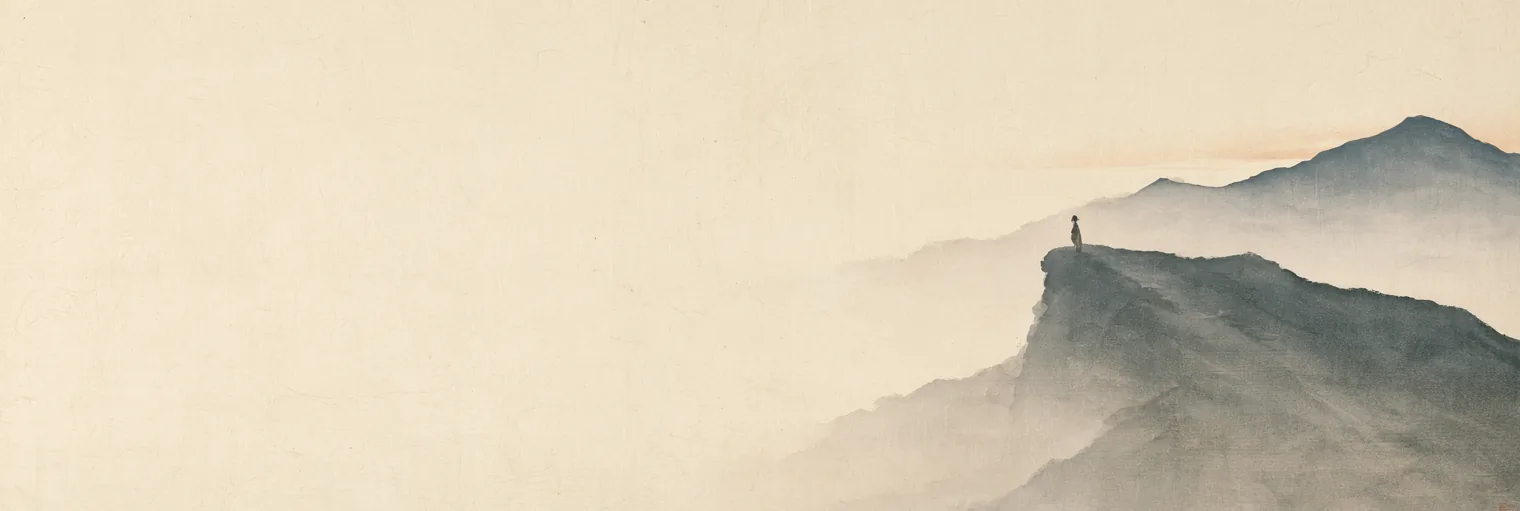
Korean Seondo (선도, 仙道) — often romanized Sundo — is Korea's own tradition of inner practice. The word at its center is seon (선, 仙), and the character is a small picture: a person (人) beside a mountain (山). Read it as a description rather than as a title, and it says what the whole tradition is about — a human being who has gone up to where the air is clear, and come back.
There is one thing to clear away before anything else, because it trips almost every English reader. This is not Korean Zen. Korea's Zen tradition is also romanized Seon, but it is written 禪, it came from China as part of Buddhism, and it is a different word entirely. The tradition in this article is 仙, and it is the one the rest of this site has been describing all along without giving it a name.
This article gives it the name, and traces it in order: what the word carries, where the tradition begins, how the line was carried through Goguryeo and Silla, what the records say about it afterward, and — the part that matters most here — what the practice actually asks a person to do.
What does the word seon mean?
Take the character apart first.
| Character | Sound | What it carries |
|---|---|---|
| 仙 | seon | a person beside a mountain — one who has withdrawn to the heights and become clear |
| 道 | do | a way, a road, a path that is walked |
So 선도 (仙道) is the way of the seon, and a person walking it is a seonin (선인, 仙人). In wider East Asian usage the same character is often translated immortal or transcendent, and Korean tradition uses that language too — sinseon (신선, 神仙), the divine seon.
The English word immortal imports a promise the Korean texts are much quieter about. What the character shows is not a person who will not die. It is a person who has gone somewhere thin and clear, stayed long enough to be changed by it, and is described afterward by where they have been. And this tradition is consistently more interested in the second half of that: not the going up, but the coming back down. Its founding phrase, after all, is Hongik Ingan — to broadly benefit all human beings — and no one benefits anybody from a summit.
Is Korean Seon the same as Korean Zen?
No — and it is worth spending a paragraph on this, because the collision is invisible in Korean and total in English.
Korean has two different words that both come out of a romanizer as seon.
| Written | Tradition | Where it comes from |
|---|---|---|
| 禪 | Seon Buddhism — Korea's branch of Chan and Zen | Buddhist; transmitted from China, part of a pan-Asian school |
| 仙 | Seondo / Sundo — the subject of this article | Korea's own name for its native path |
The character 禪 renders a Sanskrit word for meditative absorption. The character 仙 is the person-and-mountain. Search for "Korean Seon" in English and you will get the Buddhist one almost every time, which is why this article uses Seondo or Sundo wherever it can.
Two traditions living in one country for fifteen centuries borrow from each other — vocabulary, imagery, mountain hermitages. But they are two words, two lines, and two things.
Where does Korean Seon begin?
It begins in Gojoseon, and it begins with a person.
Dangun Wanggeom, the founding ancestor
Dangun Wanggeom, the founder of Korea's first kingdom, stands at the head of this tradition — its founding ancestor, and the figure every later account of Korean seon counts from.
The plainest evidence sits in Korea's oldest surviving chronicle. The Samguk Sagi (삼국사기, 三國史記), compiled in 1145, records in its Goguryeo annals that when King Dongcheon moved the court to Pyongyang in his twenty-first year (247 CE), a note was added about the place:
平壤者 本仙人王儉之宅也 "Pyongyang was originally the dwelling of the seonin Wanggeom." — Samguk Sagi, Goguryeo annals, King Dongcheon, year 21
Wanggeom is the second half of the name Dangun Wanggeom. Writing in the twelfth century about a third-century event, the chronicle reaches for seonin as the natural word for him — and does not stop to explain it, because it expects its readers to know.
What he did before he ruled is told in the Budoji (부도지, 符都誌), transmitted under the name of Bak Je-sang, where Dangun is called Imgeom. That text opens his story not with a throne but with training: he cultivated the way of Cheonung — Cheonung-ji-do (천웅지도, 天雄之道) — performed the rite of cleansing called gyebul (계불, 禊祓), and so received the three heavenly seals in succession. Only then does the account turn to plowing, silkworms, markets, and the great assembly.
Zexeda reads that way of Cheonung as the beginning of Korean Seon — the practice standing at the head of the line, before it had acquired any of its later names.
What the practice of Gojoseon was
The Budoji names the way of Cheonung and does not describe it. But this tradition did not leave its method unwritten. It is in the two scriptures Korea has carried alongside the founding story ever since.
The ground is the union of heaven, earth, and the human being. The Cheonbugyeong (천부경, 天符經), in eighty-one characters, says the one divides into three poles — cheon, ji, in, heaven, earth, and the human being — without the root ever being used up, and it closes by placing the human being where the other two meet: within the person, heaven and earth are one (人中天地一). That is not decoration on top of a practice. It is the reason a practice is possible: what you are working toward is already the ground you are standing on.
The method is three practices. The Samil Singo (삼일신고, 三一神誥), in three hundred and sixty-six characters, sets them down in its Truth Chapter:
- Ji-gam (지감, 止感) — stop reactive feeling. Not suppress it. Not board it.
- Jo-sik (조식, 調息) — make the breath even. Slow, quiet, smooth. Nothing counted, nothing forced.
- Geum-chok (금촉, 禁觸) — guard contact. Notice what reliably stirs you, and stop walking into it absentmindedly.
Taken together these are the three-method practice, and the scripture binds them with a single phrase: acting with one single intention (il-ui hwa-haeng, 일의화행, 一意化行). They are not three chores. They are one movement.
And the aim is a recovery, not an acquisition. What the three practices work on is the crooked mind — the sorting, grading, measuring habit that settled over a person and then began to feel like perception itself. What they recover is underneath it: the three truths (sam-jin, 삼진, 三眞), seong, myeong, jeong — cham-seong (True Nature), cham-myeong (True Vitality), cham-jeong (True Essence) — which the Truth Chapter says every person receives whole. Turn the false back and it becomes true (返妄卽眞), the great inner capacity unfolds, and the road ends at seongtong gongwan (seong-tong gong-wan), the nature opened and the work completed.
So the shape of Gojoseon's practice is complete and it is short: heaven, earth, and the human being as one; three practices; three truths recovered. Everything this site writes is downstream of those three lines.
Jabu Seonin, who left a calendar and a game
Dangun is not the only name Korean tradition keeps from those centuries. The Hwandan Gogi (환단고기), in the Samhan Gwangyeong Bongi chapter of its Taebaek Ilsa (태백일사 삼한관경본기), records a seon named Jabu Seonin (자부선인, 紫府仙人):
適以是時 紫府先生 造七回祭神之曆 進三皇內文於天陛 … 於是 作柶戱 以演桓易 盖神誌赫德所記 天符之遺意也 "At just that time Master Jabu made the calendar of the seven rounds of rites to the divine, and presented the Samhwang Naemun at the palace steps… Thereupon he made the game of yut in order to expound the Hwanyeok — this being, in sum, what Sinji Hyeokdeok had recorded: the meaning handed down from the Cheonbu." — Hwandan Gogi, Taebaek Ilsa, Samhan Gwangyeong Bongi
Read the last clause again, because it is the reason this figure belongs in an article about practice rather than in a footnote about folklore. The game was made to expound something, and what it expounds is traced to the Cheonbu (천부, 天符) — the same word that stands at the head of the Cheonbugyeong and inside Cheonbu-samin (천부삼인, 天符三印), the three heavenly seals. On this account a board that Korean families still set out at New Year is carrying, in the plainest possible form, the same principle the eighty-one characters carry.
The Sodo Gyeongjeon Bonhun chapter of the same work adds two more things about him. He is said to have measured the courses of sun and moon and worked out a chart of the seven governing bodies of heaven — the beginning of the seven-star calendar. And the text he presented, the Samhwang Naemun, he is said to have given to Xuanyuan so as to wash the mind and return to what is right (洗心歸義). A calendar, a game, and a text for washing the mind: that is the record.
Notice what kind of figure that makes him. Not a hermit who left the world — a man who worked out how the year moves, and left a game that ordinary people would go on playing for thousands of years without knowing what they were holding. That is the signature of this tradition from its first pages: the clearing happens inward, and what comes out of it is practical, shared, and unremarkable-looking.
How was the line carried forward?
Gojoseon ends. The practice does not. It shows up next in the two kingdoms that inherited its ground, and in both it appears under a name built from the same character.
The name is already there in Gojoseon itself. The Dangun Segi chapter of the Hwandan Gogi records that the eleventh Dangun, Dohae, ordered the five ga to choose the finest ground on twelve famous mountains and to establish the Gukseon Sodo (국선소도, 國仙蘇塗) — the sacred precinct of the seon of the country — planting altar trees around them. Gukseon. Twenty-odd centuries before Silla used the same word for its hwarang.
Goguryeo: the Jo-ui Seonin
Goguryeo had an office called the Jo-ui Seonin (조의선인, 皂衣先人 / 皂衣仙人) — the seon in dark robes. This is not a reconstruction. 조의 (皂衣) and 선인 (先人) appear as Goguryeo ranks in the histories, and the higher grade jo-ui daehyeong (조의두대형, 皂衣頭大兄) belonged to the group of ranks that handled state business, deliberated on government and the raising of troops, and conferred office.
How it was organized is described in the Goguryeo-guk Bongi chapter of the Taebaek Ilsa. The minister Eul Pa-so, it says, selected outstanding youths and made them seonin dorang (선인도랑, 仙人徒郞) — the seon company of youths. Those charged with teaching and transformation were called chamjeon (참전, 參佺), chosen to keep the precepts; those charged with the martial arts were called jo-ui (조의, 皂衣), who made discipline out of upright conduct and offered themselves for the common good. Two branches out of one body: the forming of people, and the defending of them.
The same chapter says the Jo-ui Seonin were selected from among those trained this way, and that they were what the people of the country looked up to and modeled themselves on — which is why, it adds, their standing was set equal to that of a royal envoy.
Shin Chae-ho (신채호, 1880–1936), the historian and independence activist, describes the institution in more detail than anyone, in his Joseon Sanggosa (조선상고사) — and he opens by saying that Goguryeo's strength began with the founding of the seonbae system. Seonbae (선배), he explains, is the native word written in Korean-reading characters as seonin — 先人 or 仙人. Members were chosen at the great rites of the third and tenth months through open contests of skill, and once chosen they lived together in one house: seated, they expounded the old records and worked at learning and the arts; going out, they explored the mountains and rivers, built walls, mended roads, and held classes for the people — giving themselves to the community and refusing no hardship. The one most outstanding in conduct, learning, and skill was taken as teacher. And he notes the thing that made the body unlike everything around it: while rank in Goguryeo generally came by birth, the seonbae were open regardless of high or low, and a person's place among them was won by learning and skill — which is why, he says, more able men came out of this body than out of any other.
Look at that list of activities, because it is the whole tradition in miniature and nothing in it is exotic: study, inner discipline, physical training, and public work nobody ordered. Note also that they explored the mountains and rivers — the same words the Samguk Sagi would use for the hwarang, a kingdom away.
Two figures are remembered in this line. Eulji Mundeok (을지문덕), who turned back an invasion the size of which nobody has ever quite believed. And Yeon Gaesomun (연개소문), of whom the Goguryeo-guk Bongi says plainly, quoting an older record: at the age of nine he was chosen as a Jo-ui Seonin. Shin Chae-ho also carries the folk story of his youth, Gatswindong (갓쉰동) — the child born to a minister who had reached fifty without children. Neither man is remembered as a mystic. Both are remembered as men who could hold a country, which is what this tradition expects clarity to be for.
What Eulji Mundeok said
And then there is the passage that makes this section more than a matter of names.
The Goguryeo-guk Bongi records words of Eulji Mundeok — the general — and they are not a general's words:
受三神一體氣 分得性命精 自在光明 昻然不動 有時以感 發而道乃通 是乃所以體行三物德慧力 化成三家心氣身 悅滿三途感息觸 要在日求念標 在世理化 靜修境途 弘益人間也 "Receiving the energy of the three divine in one, we obtain seong, myeong, and jeong as our portion. Abiding of ourselves in light, upright and unmoving, when the time comes we are moved — and it issues forth, and the Way opens through. This is how one embodies the three faculties, virtue, wisdom, and strength; transforms the three houses, mind, gi (기, 氣) — life energy — and body; and brings to gladness and fullness the three roads, feeling, breath, and contact. What matters is to seek daily the mark to be held in mind (염표, 念標), to govern the world with reason while living in it, to refine oneself quietly through the states and the roads, and to broadly benefit all human beings." — Hwandan Gogi, Taebaek Ilsa, Goguryeo-guk Bongi
Read that list again against everything this site has published. Seong, myeong, jeong — the three truths. Mind, gi, body — sam-mang (삼망, 三妄), the three delusions grown over them. Feeling, breath, contact — sam-do (삼도, 三途), the three roads. That is the architecture of the Samil Singo's Truth Chapter, named in order, in a soldier's mouth. His closing words — govern the world with reason while living in it, and broadly benefit all human beings — are Jaese Ihwa and Hongik Ingan, the last two phrases of the Yeompyomun.
Whatever else the Goguryeo record shows, it shows a man who commanded armies speaking the vocabulary of this practice as ordinary furniture. The clearing was not a specialism. It was what a certain kind of Korean was expected to know.
Silla: the hwarang, the seon of the country
In Silla the same thing appears under the name most readers know. The Samguk Sagi records the institution in the thirty-seventh year of King Jinheung, and records its false start honestly: two women, Nammo (남모) and Junjeong (준정), were first raised up as wonhwa (원화, 源花), the original flowers, and the arrangement ended when jealousy between them turned fatal. Afterward young men of good family were chosen, adorned, and called hwarang (화랑, 花郞).
They were also called gukseon (국선, 國仙) — the seon of the country — and seollang (선랑, 仙郞), seon youth. The word for the tradition is sitting inside the word for the institution. And the chronicle says King Jinheung held that to raise up the country one must first have Pungwoldo (풍월도, 風月道), the way of wind and moon.
What they did is given in nine characters:
相磨以道義 相悅以歌樂 遊娛山水無遠不至 "They sharpened one another with the Way and with what is right; they took delight together in song and music; they roamed the mountains and rivers, and there was no place too far for them to reach." — Samguk Sagi, Silla annals, King Jinheung, year 37
Set that beside Shin Chae-ho's account of the seonbae and the overlap is not subtle. Moral cultivation together. Music. Long journeys into wild country. Then, the chronicle adds, men of ability emerged from among them and entered the service of the state — the same order in both kingdoms: form the person first, and the usefulness follows.
Choe Chiwon gives it a name in writing
At the end of Silla the tradition finally gets written up, by the man best placed to do it. Choe Chiwon (최치원, 崔致遠), born in 857 and the most eminent scholar of his age, wrote the preface for the memorial stele of a hwarang named Nallang, and the Samguk Sagi preserves it:
國有玄妙之道 曰風流 設敎之源 備詳仙史 實乃包含三敎 接化群生 "There is in this country a profound and mysterious Way. It is called Pungnyu. The origin of this teaching is set out in full in the Seonsa. It truly contains the three teachings within it, and meets and transforms all living beings." — Choe Chiwon, preface to the stele of Nallang, as carried in the Samguk Sagi
Four things are done in twenty-four characters.
The Way is given its name in writing — Pungnyu (풍류, 風流), wind and flow, one of the names this tradition has traveled under alongside Pungwoldo and Seondo.
It is placed before the three teachings, not among them. Choe Chiwon was writing when Confucianism, Buddhism, and Daoism were all long established in Korea, and he was learned in all three. He says the Way contains them — that what arrived later was already held inside what was here.
Its purpose is stated in three characters — 接化群生, to meet and transform all living beings. Not to withdraw from them. The outward turn is in the tradition's oldest written self-description, a thousand years before anyone on this site wrote a line about the work completed.
And he points at a book. The origin of this teaching is set out in full in the Seonsa (선사, 仙史) — a history of the seon. He could expect his readers to know what he meant. No copy survives.
That missing book is worth saying plainly rather than filling in. A footpath is older than the map that shows it, and the map going missing does not close the path. What Choe Chiwon leaves us is a ninth-century scholar's testimony that the Way was here, that it had a name, and that its history had already been written down once.
Is Korean Seon the same as Chinese Daoism?
It is a fair question in English, where seon, sinseon, and immortal all sound like vocabulary borrowed from somewhere else. The short answer is no, and the reason is not a slogan.
Korean Seondo (한국선도) and Korean Daoism (한국도교) are not two names for one thing. They are two different concepts, and Korean researchers have written on exactly that difference. Korean Daoism is a category defined in relation to Chinese Daoism — the Korean portion of something whose center is elsewhere. Korean Seondo has its own center: its own founding ancestor, its own two scriptures, its own named method, and its own line of transmission through Goguryeo and Silla, all of it set out above.
Shared vocabulary is real and it proves less than it appears to. Characters like 仙 and 道 were the writing system available across East Asia, and a tradition that wants to be written down uses the characters that exist. Choe Chiwon, who knew Daoism thoroughly, did not describe Pungnyu as a Korean branch of it. He described it as the thing that already contained the three teachings, and he pointed for its origins not to any foreign source but to a Korean book.
So this article treats Korean Seon as what its own records treat it as: a tradition with a beginning of its own. What it shares with its neighbors it shares the way neighboring languages share words.
What did Korea's own records say about it later?
Centuries later, someone finally sat down to gather the whole thing into one book — and where he chose to begin is the most useful sentence he wrote.
Hong Man-jong (홍만종, 洪萬宗) compiled the Haedong Ijeok (해동이적, 海東異蹟) in 1666, collecting the scattered accounts of Korea's own seon figures into a single volume: thirty-eight of them, arranged by person and period, running from antiquity down to Gwak Jae-u, the volunteer commander of his own recent past. He did not simply transcribe what he found. He weighed it and set his own comments beside the accounts — the mark of a compiler rather than a devotee.
And he began at Dangun.
That decision is an argument he did not have to make in words. A compiler's first entry is where he thinks the thing starts, and Hong Man-jong put the head of Korea's seon tradition at the founder of his own country, then ran the line forward through Korean figures to a man who had died within living memory. By 1666, an educated Korean who had actually read the material took this tradition to begin at home, and everything after Dangun to be descent rather than import.
Set that beside the Budoji — Dangun cultivating the way of Cheonung before he received the three seals — and two accounts written centuries apart point at the same place.
His book is a compilation of transmitted accounts, gathered by a man who did not want them to disappear, and that is what it should be called. It records where the tradition placed its own head, carefully, four hundred years ago.
What does Korean Seon actually ask you to do?
Names, offices, and centuries are the outside of a tradition. This is the inside, and it has not changed since the Truth Chapter set it down.
The three practices are the whole method: ji-gam, stop reactive feeling; jo-sik, make the breath even; geum-chok, guard contact — carried with one single intention. What they clear is the covering; what they recover is the three truths you were given whole.
Notice what is missing from that. No initiation. No lineage. No prerequisite. No name of any organization. The instructions are three verbs, and they are available this afternoon.
Where Zexeda's work begins is the next question: what do those three look like in a life lived now? The scriptures state the method; they do not hand you a Tuesday morning. So this site takes what they actually wrote down and reconstructs it for the present, held in the shape Korea's founding story already supplies — the three seals of Dangun, sword, mirror, bell:
- The sword clears what has settled over the three truths, one specific thing at a time — and at the far end of that clearing it turns on the one holding it.
- The mirror keeps what has been recovered clear, through ji-gam, jo-sik, and geum-chok.
- The bell lets the clarity sound outward into ordinary life as Hongik Ingan.
Clear, keep, share — and the third is not optional, which is what Choe Chiwon's 接化群生 was already saying in the ninth century.
Zexeda calls that reconstruction the path to the One. It is a reconstruction, offered as one, and every text it is built from is in the open where anyone can read it.
Why does the mountain keep appearing?
Go back to the character. 仙 is a person beside a mountain, and once you have seen it, the mountain stops looking like scenery.
The Samguk Yusa ends Dangun's reign not with a tomb but with a mountain: he withdraws and becomes a mountain god (산신, 山神). The Samguk Sagi calls Wanggeom a seonin and gives him a dwelling. The hwarang roamed the mountains and rivers, with no place too far. Korea's oldest surviving stone altar of this tradition, the Chamseongdan (참성단, 塹星壇), stands near the summit of Mount Mani on Ganghwa Island. Even the sacred tree of the founding story stands on a peak.
Why? Because of what a mountain does to a person, and it is nothing mystical. It takes away the noise, the crowd, the errands, and most of your possessions. What is left is weather, effort, and whatever you brought up with you — which is the point, because what you brought up with you is the actual subject of the practice. A mountain is not a place with special properties. It is a place with fewer properties, and this tradition kept going there for the same reason people still do.
And its shape is not the climb. It is the round trip. Dangun goes up and becomes the mountain god of a country he founded. The seonbae came down from their hall to mend the roads. The hwarang came back from the peaks and served. Choe Chiwon's phrase for the whole Way is meets and transforms all living beings — which cannot be fulfilled above the tree line. Korean Seon sends people up for clarity and expects them back in the valley, which is why the third of its three seals is the one that has to make a sound.
What is Korean Seon not?
Four corrections, because each is common and each turns the subject into something else.
It is not a religion you join. There is no membership, no conversion, no congregation, and none of the texts above names an organization. Groups teaching related practices exist in Korea today; none of them is Korean Seon, and this site is not affiliated with any of them and asks no one to join anything.
It is not a promise of physical immortality. The word immortal comes with the English translation, not with the Korean texts. What the Samil Singo describes is a return to what was already given — and it says plainly that ordinary people run through birth, growth, decline, sickness, and death. Nothing here is medical, and nothing here suggests practice replaces medicine.
It is not a martial art, though it produced people who could fight. The seonbae trained in arms and the hwarang produced commanders, and Korean martial traditions have drawn on that memory ever since. But the training described is learning, inner discipline, music, and long journeys, and the method in the scriptures is feeling, breath, and contact. The fighting was downstream of the person, not the point of him.
It is not a certificate. No text in this tradition names anyone who confers attainment, and its stated destination — the nature opened and the work completed — has one condition attached and no examiner. Any arrangement where someone else decides whether you have arrived has added something the texts do not contain.
What can Korean Seon offer a reader today?
If you are meeting this tradition from outside Korea, three things travel, and none of them asks you to believe anything.
A practice that is stated, not hinted at. Many traditions describe a state and leave you to guess at the road. This one names three things to do, in plain words, in a text of three hundred and sixty-six characters, and has not changed them.
A path with the outward turn built in. Many contemplative traditions have to add service on afterward. This one has it in its oldest written sentence — meets and transforms all living beings — and in its destination, half of which is work completed out where other people are. It will not let inner work stay private.
A record of what it actually looked like. A calendar and a board game. Young men who studied, trained, and then repaired the roads. Commanders who held a country. Men who roamed the mountains and came back into service. Whatever else this tradition is, it has never been an escape from ordinary life, and the evidence for that is in the shape of the lives it produced.
Pause before boarding a reaction. Let the breath go slow and quiet. Be careful about what you walk into. Those are the three, they are ancient, they are written down, and they cost nothing. The mountain is optional. It always was.
Continue with Zexeda
If this tradition and its plain instructions are worth sitting with, the reading continues in the Zexeda newsletter — a quiet weekly letter that takes Korea's ancient wisdom one line, and one small practice, at a time. You are welcome to walk along.
New subscribers get a free PDF: A K-Drama Fan's Glossary of Korea's Ancient Words.
Key takeaways
- Korean Seondo (선도, 仙道), often written Sundo, is Korea's own tradition of inner practice — the way of the seon, a character written with a person beside a mountain.
- It is not Korean Zen. Korean Seon Buddhism is written 禪 and belongs to the Chan/Zen family; this tradition is 仙. Two words, identical only in romanization.
- It begins in Gojoseon with Dangun Wanggeom as its founding ancestor. The Samguk Sagi calls him the seonin Wanggeom; the Budoji says he cultivated the way of Cheonung (천웅지도) and performed the rite of cleansing before receiving the three heavenly seals.
- Its ground is the union of heaven, earth, and the human being — the three poles of the Cheonbugyeong, which ends within the person, heaven and earth are one (人中天地一).
- Its method is the three-method practice of the Samil Singo: ji-gam (stop reactive feeling), jo-sik (even the breath), geum-chok (guard contact), carried with one single intention — settling the crooked mind and recovering the three truths, seong, myeong, jeong.
- The Hwandan Gogi (Taebaek Ilsa, Samhan Gwangyeong Bongi) records Jabu Seonin (자부선인), who made the calendar of seven rounds of rites and then made the game of yut to expound the Hwanyeok — "the meaning handed down from the Cheonbu." A calendar and a board game, carrying the same principle as the Cheonbugyeong.
- In Goguryeo the line was carried by the Jo-ui Seonin (조의선인, 皂衣先人). The Taebaek Ilsa says Eul Pa-so formed selected youths into a seon company split between chamjeon (teaching) and jo-ui (martial arts), and that the Jo-ui Seonin were what the country looked up to. Shin Chae-ho's Joseon Sanggosa says Goguryeo's strength began with this system, describes members expounding the old records and working at learning indoors and exploring mountains and rivers, mending roads, and teaching the people outdoors — and notes entry was open regardless of birth. Yeon Gaesomun was chosen a Jo-ui Seonin at nine; Eulji Mundeok is remembered in the same line.
- Eulji Mundeok's recorded words name the whole system: receiving the three-in-one divine we obtain seong, myeong, jeong; this transforms the three houses mind, gi, body and fills the three roads feeling, breath, contact — to govern the world with reason while living in it and broadly benefit all human beings. That is the Samil Singo's Truth Chapter, named in order, by a general.
- In Silla the hwarang were also called gukseon (국선, 國仙), the seon of the country — a word already used in Gojoseon for the Gukseon Sodo: 相磨以道義 相悅以歌樂 遊娛山水無遠不至 — they sharpened one another with the Way and what is right, delighted together in song and music, and roamed the mountains and rivers with no place too far.
- Choe Chiwon named the Way in writing — Pungnyu (풍류) — said it contains the three teachings, gave its purpose as 接化群生, to meet and transform all living beings, and pointed to a Seonsa (선사, 仙史), a history of the seon that does not survive.
- Hong Man-jong's Haedong Ijeok (1666) gathered thirty-eight Korean seon figures with his own commentary — and began the roll at Dangun, treating everything after him as descent rather than import.
- Zexeda's work is to reconstruct that practice for a life lived now, held in the shape of the three seals — sword, mirror, bell: clear, keep, share. It is called the path to the One.
- It is not a religion you join, not a promise of physical immortality, not a martial art, and not something anyone can certify.
This article is for educational and reflective purposes and shares interpretations of Korea's ancient wisdom traditions. It is not medical, psychological, or professional advice.