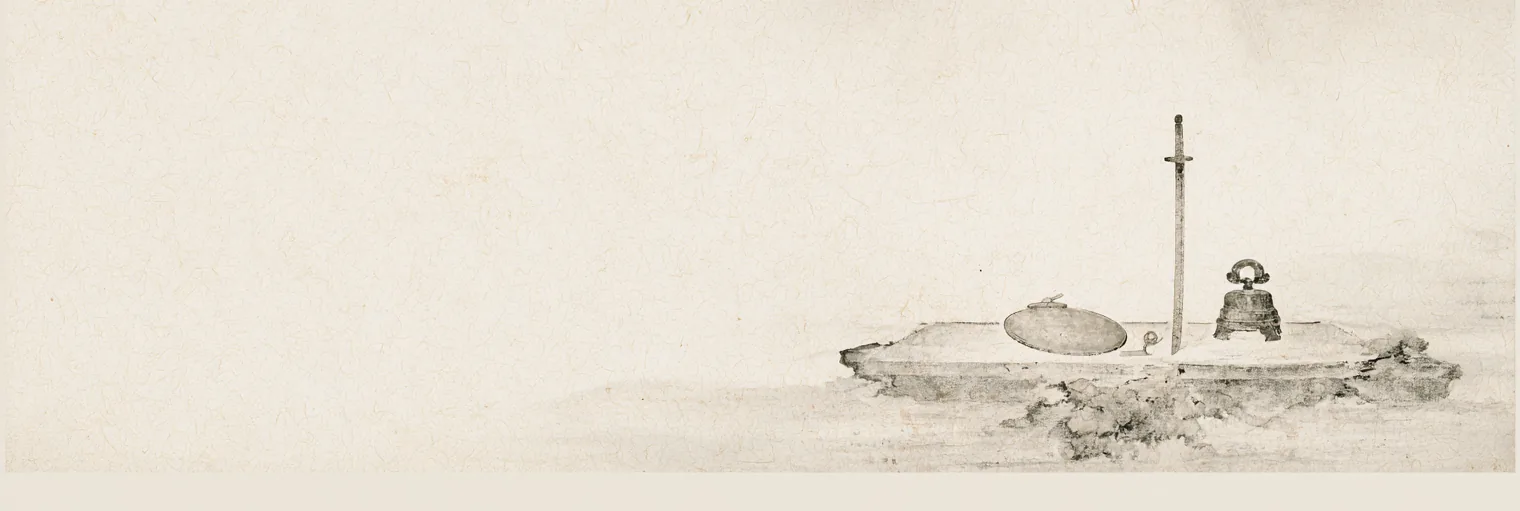
Korea's founding story says that when the first kingdom began, three sacred gifts came down from heaven. Tradition remembers them as a sword, a mirror, and a bell — the three seals of Dangun. Read as an inner path, they describe three steps that anyone can walk: the sword clears away the false layers that cover your original nature, the mirror keeps your recovered true self clear, and the bell carries that clarity into the world for the good of all.
That is the secret in one sentence: clear, keep, share. The rest of this article unfolds it slowly — where the story of the three seals comes from, why Korea's oldest scriptures say we need exactly three steps, and what each seal looks like in an ordinary life.
What are the three seals of Dangun?
The story begins before Dangun himself. According to the Samguk Yusa, a thirteenth-century Korean chronicle compiled by the monk Iryeon, the heavenly ruler Hwanin allowed his son Hwanung to descend to the human world. Before Hwanung came down to a mountain with three thousand followers, his father gave him three heavenly seals — in Korean, Cheonbuin (천부인, 天符印). Hwanung's son was Dangun, who founded Gojoseon, Korea's first kingdom, traditionally dated to 2333 BCE.
Here is the curious part: the old record tells us there were three seals, but it never says what they were. The sword, the mirror, and the bell come from later tradition and interpretation, which filled the silence with three objects that ancient East Asian cultures held sacred.
According to that tradition, the three are read as royal treasures — sacred objects that symbolized the authority of the ruling line.
This article, however, reads them through the eyes of spirituality:
- The sword (검, 劍) cuts. It clears away the layered false and reveals the true.
- The mirror (거울, 鏡) reflects. It restores the true just as it is, shining with its own light.
- The bell (방울, 鈴) rings. With one's nature opened (seongtong) and one's true life known (myeong), it sounds outward to broadly benefit the world.
You could treat these as museum pieces of mythology. Or you could notice something more fundamental — a depth that reads like a secret of the universe: cut, reflect, ring is a complete description of a spiritual path. Nothing is missing, and nothing is extra. That is the reading this article follows — not the seals as objects of royal power, but the seals as a map of inner practice handed down inside a founding story.
Why three steps? A map hidden in Korea's oldest scriptures
Why would the path need exactly three steps? The answer sits in two short Korean scriptures.
The first is the Cheonbugyeong (천부경, 天符經), a text of only eighty-one characters. It teaches that everything begins from the One — a One that began from nothing, so that "one" and "nothing" are not two — and that everything returns to that One in the end. Two of its lines matter most for our path. One says: "The use changes, but the root does not move" (用變不動本). Your moods, thoughts, and circumstances change endlessly — that is the use. But something in you has never moved — that is the root. The other line says: "The original mind is, at its root, the sun" (本心本太陽) — bright, whole, and shining before anything covered it.
The second scripture is the Samil Singo (삼일신고, 三一神誥), and especially its Truth Chapter, the Jinrihun. Its teaching can be summarized in one movement, like a story told in four lines:
- What you were given. Every person receives three true gifts — seong (성, true nature), myeong (명, true life), and jeong (정, true essence). These are called the three truths.
- What covered them. Ordinary people lose sight of the root, and three false layers take hold in its place — mind (심), energy (기), and body (신), each a clouded version of a truth. These are the three delusions: the mind sorts everything into good and bad, the energy turns clear and murky, the body swings between excess and lack.
- How the covering spreads. The three delusions open three roads — feeling, breath, and contact — which branch into eighteen states: joy, fear, sorrow, anger, craving, aversion, and the rest. Running along those roads, the scripture says, we fall into the suffering of birth, growth, decline, sickness, and death.
- The way back. The awakened ones stop reactive feeling (jigam, 지감), make the breath even (josik, 조식), and guard against harmful contact (geumchok, 금촉). Moving with one unified intention, they turn the false back into the true, their great inner capacity unfolds, and they arrive at seongtong gongwan (성통공완) — the opening of one's true nature and the completion of its work.
Now set the two pictures side by side. Something true was given. Something false grew over it. Therefore the way home needs three movements — clear the false, keep the true, complete the work — and Korea's founding story hands us three tools shaped for exactly those three movements. A sword to clear. A mirror to keep. A bell to complete. That is why three.
The sword: how do you clear what covers you?
The first seal is the sword, and the first surprise is that it is not a weapon. In this practice the sword is imagined as a sword made of light — light so bright that whatever it touches does not break but dissolves, the way morning fog dissolves in sunlight.
What does it dissolve? Three kinds of accumulation that every life collects:
- Old memories that still carry weight (업). Not memory as information, but memory that has settled deep and refuses to be forgotten — the argument from years ago that still tightens your chest, the act you regret that still stings when it surfaces.
- The habits built on those memories (습) — the automatic flinch, the well-worn reaction that fires before you choose it.
- The fixed images they leave behind (상) — "I am the one who always fails," "people always leave," the still pictures of yourself and the world that you mistake for facts.
Layer by layer, these three form the clouded mind, the murky energy, the driven body — the three delusions of the Samil Singo. The sword stage works on them directly, and it works specifically, not vaguely. You do not sit and think "may all my pain be gone." You recall one specific memory — a scene, a face, a moment that still carries charge. You let it become vivid. You let yourself feel what rises with it. And then you let the sword of light cut through the whole scene — the image and the feeling together — and watch both melt and vanish into brightness. What remains is not emptiness in a cold sense. It is space. Quiet — the space from before anything began. The original place.
Done patiently, memory by memory, habit by habit, image by image, the coverings thin — and what the scriptures call the three truths, your original nature, life, and essence, begin to show through, the way a window you forgot was a window starts letting in light.
One more thing should be said here, carefully, because it belongs to the deep end of this stage. The tradition points beyond even the clearing: in the end, the sword itself, and even the hand that swings it — the "I" who has been doing all this clearing — are allowed to melt and vanish into the light, because the original mind is, at its root, the sun (本心本太陽). What began as your tool and your effort turns out to be made of the very brightness it was clearing the way toward. If that sounds far away, let it be far away. A path is walked one step at a time, and no step is wasted. For now it is enough to know the direction the road runs. And even the image of the sun we picture — the physical sun — is, in the end, allowed to melt and vanish into that light. For light is the original place: the One that began, and the place of the Nothing that let it begin.
The mirror: how do you keep your true self clear?
Suppose the clearing has begun and something true has come into view. The work now changes character — and this is the second seal.
A mirror does two things. It shows what truly is, and it gathers dust. Both matter here. Even after real clearing, the residue of mind, energy, and body drifts back the way dust settles on glass: an old reaction resurfaces in traffic, a familiar craving knocks at a tired hour, a self-image you thought was dissolved reappears in a conversation. This is not failure. It is simply what residue does, and the mirror stage is the honest, unhurried answer to it.
The practice of the mirror is to hold your true self in view and keep the surface clean, using the three methods the Samil Singo names:
- Stop reactive feeling (jigam): when an old emotion flares, pause — not pushing it down, just not boarding that train of the deluded mind. Then take up the sword of light again and cut the train itself, letting it vanish. And in the place where the train of mind has vanished, the true nature (seong) reveals itself.
- Make the breath even (josik): let the breath become slow, quiet, and smooth — nothing technical. In that stillness, hold up to the mirror the image of "I" that still remains, and simply look at it. Then take up the sword of light again and cut that lingering image of "I," letting it vanish. In the place where the deluded energy and the self-image have vanished, the true life (myeong) becomes known.
- Guard contact (geumchok): notice which sights, sounds, and situations reliably stir the residue. Lift the body-sensations and contacts as they arise, set them apart, and reflect them in the mirror. Then take up the sword of light again and cut the residue of body and contact that surfaces on the mirror's face, letting it vanish. When you become free of body and contact, the true essence (jeong) can be preserved.
The scripture binds these three with one phrase: acting with one single intention (일의화행). They are not three chores but one movement — the will to stay true — expressed through feeling, breath, and contact at once. And it names the turn that happens as the polishing deepens: the false, turned back, becomes true (반망즉진). The clouded mind turns back toward true nature. The murky energy turns back toward true life. The driven body turns back toward true essence.
The Jinrihun describes the fruit of this keeping in three words: the wise open their nature, know their life, and preserve their essence — in Korean, seongtong (성통), myeongji (명지), jeongbo (정보). Not a one-time flash of insight, but a clarity that stays because it is tended. That is the mirror: not the moment you first see your true face, but the daily faithfulness that keeps it visible.
The bell: what is awakening for?
A sword can be sheathed and a mirror can hang on a wall, but a bell has only one purpose: to ring. A bell that never sounds is just a shape of metal. This is the third seal, and it answers the question every genuine path must face — what is awakening for?
The Samil Singo's answer comes in its final movement: when the false has turned true, great inner capacity unfolds (발대신기), and the practitioner arrives at seongtong gongwan — the nature opened and the work completed. Notice that the scripture does not stop at the opening. Half of the goal is gongwan, the completion of work, and the work is not private. It points straight back to the ideal that Korea's founding story attaches to Dangun's kingdom: Hongik Ingan (홍익인간) — to broadly benefit humanity — and Jaese Ihwa (재세이화), to bring truth into the world while living in it. Not escaping the world for a private peace, but standing inside ordinary life and letting clarity ring outward.
What does the bell sound like in practice? Rarely like anything grand. It sounds like patience that used to be impossible. Honest work done with utmost devotion, free of the thought of "self." A hard conversation held without the old sharpness. Attention given to someone no one else was hearing. The bell does not require robes, titles, or a stage; it requires a cleared and kept interior, because the sound of a bell is only as clear as the metal it is made of. That is why the bell is the third seal and not the first: the sword and the mirror are what make the ringing true.
How do the three seals work together in an ordinary life?
On paper the path looks like a straight line: first clear, then keep, then share. Lived, it is closer to a spiral. You clear something, keep it clear for a while, share what little steadiness you have — and then life hands you a deeper layer, and the sword is needed again. Returning to the sword after years is not going backward. It is the same three movements meeting you at a deeper turn of the spiral.
A single ordinary day can hold all three seals in miniature:
| Moment | Seal | The movement |
|---|---|---|
| Ten quiet minutes in the morning: one memory from the piled-up layers, dissolved in light | Sword | Clearing |
| Midday, when an old reaction flares: pause, even breath, careful contact | Mirror | Keeping |
| Evening, with family, colleagues, strangers: one act done for someone's genuine good | Bell | Sharing |
Small as that looks, it is the whole architecture — the same shape at one day's scale that seongtong gongwan describes at a life's scale.
And the far end of the road? The Cheonbugyeong closes with a quiet, astonishing image: "Within the person, heaven and earth are one" (人中天地一) — the one who has returned to the original mind becomes a place where heaven and earth meet. The three seals are how an ordinary person walks toward that: clearing what covers the brightness, keeping the brightness clear, and letting it ring for the good of all. You do not need to see the end of the road to take the first step. The first step is one memory, one breath, one small act — today.
Continue with Zexeda
If this map of the sword, the mirror, and the bell speaks to something in you, the journey continues in the Zexeda newsletter — a quiet weekly letter that walks these stages step by step, one practice at a time. You are welcome to walk along.
Key takeaways
- The three seals of Dangun (Cheonbusamin, 천부삼인 — the fuller Korean name for the Cheonbuin) are three heavenly gifts from Korea's founding story; the old record does not name them, and tradition remembers them as a sword, a mirror, and a bell.
- Read as an inner path, they map three movements: clear what is false (sword), keep what is true (mirror), and share the clarity for the good of all (bell).
- The map's logic comes from the Samil Singo: three truths given (nature, life, essence), three delusions covering them (mind, energy, body) — so the way home is clearing, keeping, completing.
- The sword of light dissolves charged memories, worn habits, and fixed self-images — specifically, one at a time — and points, in the end, beyond even the one who wields it.
- The mirror keeps the recovered true self clear through stopping reactive feeling, evening the breath, and guarding contact, done as one intention.
- The bell is the purpose of it all: Hongik Ingan — letting a cleared, kept interior ring outward to broadly benefit humanity, in the middle of ordinary life.
- The path is a spiral, not a line — and it begins with one memory, one breath, one small act.
This article is for educational and reflective purposes and shares interpretations of Korea's ancient wisdom traditions. It is not medical, psychological, or professional advice.