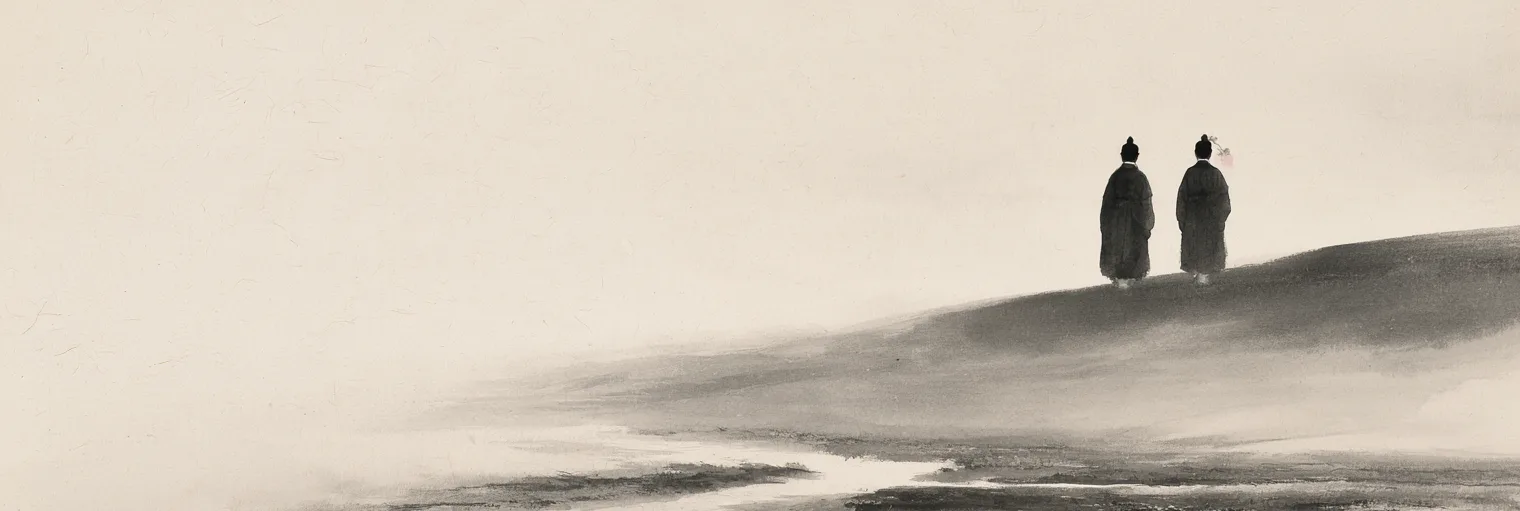
The hwarang (화랑, 花郞) — the flower youths — were real. They were young men of Silla, the southeastern of Korea's Three Kingdoms, chosen to lead bands of followers who trained, sang and traveled the mountains together. The Samguk Sagi (삼국사기, 三國史記), Korea's oldest surviving history, compiled in 1145, sets down how they began in its entry for 576, the thirty-seventh year of King Jinheung (진흥왕). It records that they sharpened one another with what is right, delighted together in song and music, and roamed the mountains and rivers with no place too far for them.
If you met them first on screen, in the KBS2 drama Hwarang, you met something the records would recognize, and something they would not. The records keep the beauty and the sword. They also keep the songs, the mountains, and the reason a king wanted these young men gathered in the first place, which had less to do with fighting than with finding out who a person really was.
Before any of that, though, there is a boy. The Samguk Sagi keeps his name, his age, and what he did with the reward a king gave him.
Who was the boy the chronicle remembers?
His name was Sadaham (사다함, 斯多含). The Samguk Sagi gives him a short biography of his own, the last in one of its volumes of lives, and every line of what follows comes from it.
He came of a family the record calls "true bone," a house of high and ancient nobility, descended in the seventh generation from King Naemul, an earlier king of Silla. The record describes him in two phrases: clear and fine in his bearing, upright in his will. People asked him to become a hwarang. The record says he agreed only because he could not refuse (不得已爲之). Followers came to him, a thousand of them, and he won the hearts of every one.
Then King Jinheung ordered his general Isabu (이사부) to attack the kingdom of Gara, which the record adds was also written Gaya. Sadaham was fifteen or sixteen. He asked to go. The king said he was too young. Sadaham asked again, and kept asking, and his will was so plainly fixed that the king gave in and made him a junior commander. Many of his followers went with him.
When the army reached the border, Sadaham asked the commander for leave to take his own men ahead, and went in first through a city gate the record calls Jeondallyang (旃檀梁). The record stops to explain the name: in the language of Gara, it says, a gate was called by the word written 梁. The people inside had not expected an army so suddenly. They panicked and could not hold the gate, the main force followed through behind him, and the kingdom fell.
Then comes the heart of the record. When the army came home, the king weighed up what each man had done and gave Sadaham three hundred people of Gara as his reward, as captives to keep. Sadaham took them, and set every one of them free. The record's words are 受已皆放, 無一留者 — he received them, released them all, and did not keep a single one.
The king offered him fields as well. Sadaham refused. The king pressed him. In the end Sadaham asked for a strip of barren land by a stream called Alcheon, and nothing more.
The biography ends with a friend. Sadaham and a young man named Mugwan (무관랑, 武官郞) had promised to be 死友, friends unto death. Mugwan fell ill and died. Sadaham wept for him with a grief the record calls extreme, and within seven days he was dead too. He was seventeen.
That is all the record says. It does not describe his face, give him a speech, or paint the battle. It keeps a refusal, a reward handed back, and a promise kept. Nearly fifteen centuries later that is still enough to answer the first question fans ask about the hwarang. They were not costumes. One of them has an age written next to his name.
So what did boys like Sadaham do, in the years when there was no war to ride out to?
What did the hwarang actually do?
To see that, go back to the king's problem. The Samguk Sagi's entry for 576 opens with it: the king and his ministers had no way of knowing people. They wanted to find the able and the honest, and they had no means of telling them apart. So they decided to let people gather in groups and spend time together, watch how they behaved, and pick out the good ones to bring into service.
The first attempt went wrong. Two young women, Nammo (남모) and Junjeong (준정), were chosen as the first leaders, the "original flowers," and more than three hundred followers gathered around them. The two grew jealous of each other. Junjeong lured Nammo to her house, made her drunk, and threw her into a river. Junjeong was put to death, and the followers fell out and scattered.
After that, the record says, the court chose handsome young men instead, adorned them, named them hwarang, and honored them. This time followers gathered like clouds. In the records, a band was a hwarang and the followers who came to him, and the record describes what all of them did in a single sentence:
或相磨以道義, 或相悅以歌樂, 遊娛山水, 無遠不至. "They sharpened one another with the Way and with what is right; they took delight together in song and music; they roamed the mountains and rivers, and there was no place too far for them to reach." — Samguk Sagi, Silla annals, King Jinheung, year 37 (576)
Read it slowly and it turns into a picture. Young men wearing down one another's rough edges over what a person ought to do, the way good friends do. Someone starting a song, and then everyone singing. And then walking: up a river valley, over a pass, toward a mountain they have only heard about, because no place was too far.
The record then says what the king got out of it. "Because of this they came to know who was crooked and who was upright, chose the good among them, and recommended them to the court." The mountains and the songs were the test. A person cannot hide what he is through a long journey on foot with friends.
The Samguk Sagi backs this with a sentence from an older book. It quotes Kim Dae-mun's Hwarang Segi (화랑세기, 花郞世記), a book of the hwarang's lives that no longer survives: "Wise ministers and loyal subjects came forth from here; fine generals and brave soldiers were born from this." The notes to the Samguk Sagi in the online database of Korea's National Institute of Korean History describe Kim Dae-mun as a Silla noble who governed a province in 704. A manuscript copied out by Bak Chang-hwa (박창화, 朴昌和) and presented as his book came to light in 1989. The sentence above is the one the Samguk Sagi itself kept.
The same notes explain how a band was made up: one hwarang, a Buddhist monk among the followers who guided and advised him, and anywhere from several hundred to more than a thousand followers, from the nobility down to ordinary people. The annotators write that training ran, in principle, for three years, and that the age was probably fifteen to eighteen.
Were they warriors, then? Some of them fought, and fought young. Sadaham went through a gate at fifteen or sixteen. The Samguk Sagi's biography of Kim Yu-sin (김유신) records that he became a hwarang at fifteen, that people gladly followed him, and that his band was called the Yonghwa Hyangdo (용화향도, 龍華香徒) — the characters read dragon, flower, incense, band. The same biography records that at seventeen he went alone into a stone cave on the central peak, Jungak. Kim Si-seup's Notes on the Jingsimnok add that the young Kim Yu-sin studied under a teacher descended from Bak Je-sang, Silla's loyal envoy. Kim Dae-mun's sentence names generals and soldiers outright. But look at the order the chronicle chose when it described them. It names what is right first, song and music second, and the mountains third. The fighters came out of that training.
Why were they called "flower" youths?
The name is two characters: 花, flower, and 郞, young man. Flower youths.
The Samguk Sagi says plainly why the name fit. After the false start with the two women, the court chose handsome young men and adorned them (取美貌男子, 粧飾之), and called them hwarang. The same entry quotes a Chinese record of Silla from the Tang dynasty, which the Samguk Sagi gives under the name of Linghu Cheng (영호징, 令狐澄). It shows the hwarang as a foreign eye saw them:
"They chose the good-looking among the sons of noble families, powdered their faces and adorned them, and named them hwarang. The people of the country all honored and served them."
Powdered faces and careful dress, on young men who also walked the mountains and went to war. Fans who know K-pop stage makeup may find the picture familiar. The record itself adds only one thing to it: the people of the country honored them.
That honor is the point of the flower. Zexeda reads the beauty in the entry for 576 as more than decoration. It belongs to someone chosen, set apart, and watched, who was expected to grow into the kind of person the country could trust. The flower marked the youth as someone the country was waiting on.
And the flower was not only a figure of speech. The record that carries this name furthest back, the Dangun Segi, puts a real flower in the youths' hair. That story belongs further down, where the hwarang's name turns out to be older than Silla.
What were the five rules of the hwarang?
If you search for the hwarang, you will quickly meet a list of five rules called the sesok ogye (세속오계, 世俗五戒), the five rules for life in the world. Korea's national encyclopedia, the Encyclopedia of Korean Culture, defines them as the five rules the hwarang had to keep. Where they come from is a small, quiet scene of its own.
The Samguk Sagi tells it in its biography of a young man named Gwisan (귀산). He and his friend Chuhang (추항) had grown up together. A Buddhist monk named Wongwang (원광) had come back from studying in China and was living at a temple called Gasil, honored by everyone. The two young men went to his door, gathered up their robes, and said to him: We are ordinary men of the world, ignorant and without learning. Please give us one word to keep as a rule for the rest of our lives.
Wongwang told them that the Buddhist precepts for those on the bodhisattva path numbered ten, and that men who served a king and a family might not be able to keep them. "But there are five rules for life in the world," he said:
- Serve the king with loyalty.
- Serve your parents with devotion.
- Keep faith with your friends.
- Do not retreat in battle.
- Be selective in taking life.
"Practice these," he told them, "and do not neglect them."
Wongwang explained the fifth. Choose the time: do not kill on the six monthly days of fasting, or in spring and summer. Choose the creature: do not kill the animals that work for you, the horse, the ox, the chicken and the dog, and do not kill small things whose meat would not make a single mouthful. The rule is not a ban. It asks a person to stop and choose.
The encyclopedia dates the meeting to 600. The biography itself never calls Gwisan and Chuhang hwarang; the encyclopedia is the one that ties the rules to the hwarang by name. What the Samguk Sagi does show will look familiar by now: two young friends, and a rule given for the whole of a life.
Hold on to the first three of those rules for a moment: loyalty, devotion, keeping faith. They are written with the characters 忠, 孝 and 信. You are about to see the same three characters again, in a much older place.
Where did the hwarang come from?
The Samguk Sagi tells us when Silla gave the hwarang their name and their honor. Other records tell of young men trained in much the same way, under some of the same names, long before Silla. To see them, walk backward.
Start at the end of Silla. Choe Chiwon (최치원, 崔致遠), born in 857 and the most learned man of his age, wrote a preface for the memorial stone of a hwarang named Nallang, and the Samguk Sagi preserves it inside the same entry for 576. It opens: "There is in this country a profound and mysterious Way. It is called Pungnyu" (풍류, 風流) — wind and flow. He wrote that it contains the three teachings within it, and that its purpose is 接化群生, to meet and transform all living beings. The full passage, and what it says about Korea's own tradition, is in what is Korean Seondo.
Go back further. The Samguk Yusa, Korea's other great early history, records that the hwarang were also called gukseon (국선, 國仙), the seon of the country, seon (仙) being the character for a person beside a mountain. The Dangun Segi, a chronicle of the Dangun rulers in the Hwandan Gogi (환단고기), the collection of Korean chronicles this site works from, uses that word far earlier. It records that the eleventh Dangun, Dohae, in 1891 BCE ordered the finest ground on twelve famous mountains set aside as Gukseon Sodo, sacred precincts of the seon of the country. The same year's entry keeps a proposal that a teacher of the young men of the state put to the ruler, and among its words are 登山而歌, 迎月而舞, 無遠不至: climbing the mountains and singing, greeting the moon and dancing, with no place too far to reach. The last four characters are the same four the Samguk Sagi uses for the hwarang.
Another chapter of the Hwandan Gogi, the Samsin Oje Bongi in the Taebaek Ilsa, records that beside every sodo a schoolhouse was always built, where unmarried young men studied reading, archery, riding, courtesy, song and music, and fighting with fists and the sword. Every sodo (소도, 蘇塗), it says, had its precepts: loyalty, filial devotion, trustworthiness, courage and kindness. In the original those are 忠, 孝, 信, 勇, 仁. Set them beside Wongwang's five rules and three of the characters are the same ones, in the same order.
The same chapter has more that will sound familiar. It lists six kinds of upright people, and the first four are 賢佐忠臣, 良將勇卒, wise ministers and loyal subjects, fine generals and brave soldiers: the same eight characters Kim Dae-mun used for the hwarang. It gives a rule for taking life, from the ruler down to ordinary people, in the same two parts Wongwang gave Gwisan and Chuhang: 擇時, choose the time, and 擇物, choose the creature. And it names the youths outright: 源花稱女郞, 男曰花郞, 又云天王郞, the young women were called the original flowers, and the young men hwarang, also youths of the Heavenly King. 源花, original flowers, is the same name the Samguk Sagi gives Nammo and Junjeong. The chapter adds that the ruler granted the youths a cap of bird feathers, and that the capping had its own ceremony.
And under the thirteenth Dangun, Heuldal, in 1763 BCE, the Dangun Segi records that many sodo were built and a flower called cheonjihwa was planted there. The young men who studied and practiced archery at those places went about with the flower tucked into their hair, and people called them cheonjihwarang (천지화랑, 天指花郞). The full story of the sodo and that flower is told on its own page. Here, look at the last two characters of the name: 花郞. Hwarang — by the Dangun Segi's dating, more than two thousand years before Silla used it.
The Gyuwon Sahwa, a history that traces Korea's way of teaching back to the age of Sinsi, the Divine City, lists gukseon among the old titles of office.
Lay the records end to end and the name reaches far behind Silla. Zexeda reads the hwarang as the Silla link in a line that runs from the cheonjihwarang of the Dangun rulers to the Pungnyu that Choe Chiwon named — the same line this site follows through Korea's own tradition of practice. In that reading, Silla did not invent the flower youths. It gave an old way a new court and a new honor.
In both records the training is a whole education. The Samguk Sagi names what is right, song and music, and the mountains and rivers. The Taebaek Ilsa puts reading first and fighting with fists and the sword last.
How much of the K-drama Hwarang is real history?
The drama most fans know is KBS2's Hwarang: The Poet Warrior Youth, which aired from December 2016 to February 2017. The drama tells its own story. The records it grew from are shorter, and you have now read most of them.
Here is what the records hold. There was a King Jinheung, and the Samguk Sagi records that in his reign the court looked for a way to know people and found it in bands of young men. The first leaders were two young women, and that ended in a death. After them, handsome young men were chosen, adorned, honored by the whole country, and named hwarang. They sang, they traveled the mountains and rivers, and they sharpened one another with what is right. Some went to war young. One of them freed the people he was given, and died at seventeen, seven days after his friend.
Whatever the drama added belongs to the drama. If the show sent you looking for the real hwarang, the records will give you something smaller and harder to forget: Sadaham, who refused the fields and asked for barren land, and who kept a promise to a friend all the way to the end.
What is left of the hwarang way today?
Go back once more to Choe Chiwon's four characters: 接化群生, to meet and transform all living beings. He wrote them about the Way the hwarang belonged to, and they say where that Way was meant to end up. Not on the mountaintop. Back among people.
The records show the hwarang making that return. The bands roamed the mountains, and the court took the good among them into its service. Sadaham went through a gate at fifteen or sixteen and came home with three hundred people who were now his to keep, and he let every one of them go. Zexeda reads this as the second half of Seongtong Gongwan (seong-tong gong-wan): gong-wan, the work completed, the part of a practice that is finished not inside a person but in what that person does for others. Clarity, in this tradition, is meant to come back down the mountain.
None of that requires a band, a uniform, or a king. The first step of it is the oldest word in the hwarang's own sentence: what is right. The record has friends sharpening one another with it. A person can begin the same work tonight, alone.
Sit down for ten minutes before bed. Walk back through your day until you find one small moment that still has a feeling attached, a flash of irritation or a little pride, and look at it as it was, without arguing with it, until it loosens and goes. It is not the mountains and rivers. It is a start on what they were for: a ten-minute Korean evening practice for beginners.
Continue with Zexeda
If you enjoy finding the real Korea behind the stories you love, the reading continues in the Zexeda newsletter — a quiet weekly letter on Korea's ancient wisdom, one story and one small practice at a time.
New subscribers get a free PDF: A K-Drama Fan's Glossary of Korea's Ancient Words.
Key takeaways
- The hwarang (화랑, 花郞), flower youths, were young men of Silla chosen to lead bands of followers. The Samguk Sagi (1145) sets down how they began in its entry for 576, the thirty-seventh year of King Jinheung.
- The court had no way of knowing people, so it let people gather in groups, watched how they behaved, and chose the good. The first leaders were two young women; after that failed, handsome young men were chosen and adorned.
- The record says they sharpened one another with what is right, delighted in song and music, and roamed the mountains and rivers with no place too far.
- Sadaham became a hwarang only because he could not refuse, had a thousand followers, went to war at fifteen or sixteen, set free the three hundred captives given to him, asked only for barren land, and died at seventeen, seven days after his friend Mugwan.
- Kim Dae-mun, quoted in the Samguk Sagi, wrote that wise ministers, loyal subjects, fine generals and brave soldiers came from among them. Kim Yu-sin became a hwarang at fifteen.
- A Tang Chinese record quoted in the Samguk Sagi says the hwarang were powdered and adorned and honored by the whole country.
- The Encyclopedia of Korean Culture calls the sesok ogye, five rules the monk Wongwang gave to Gwisan and Chuhang, the rules the hwarang had to keep. The key characters of their first three rules, 忠 孝 信, are also the first three of the precepts the Hwandan Gogi gives for the old sodo.
- The Dangun Segi records cheonjihwarang, youths with a flower in their hair, under the thirteenth Dangun. Zexeda reads the hwarang as the Silla link in a line from them to the Pungnyu Choe Chiwon named, whose purpose was to meet and transform all living beings.
This article is for educational and reflective purposes and shares interpretations of Korea's ancient wisdom traditions. It is not medical, psychological, or professional advice.