A mudang (무당, 巫堂) is a Korean shaman. Korea's national encyclopedia, the Encyclopedia of Korean Culture, defines a mudang in one line: a religious specialist who serves the spirits and leads the ritual called gut (굿). Say it closer to goot.
The same encyclopedia defines the gut in one line too. It is a ritual in three movements: the mudang invites the spirits, hosts them, and sees them off. Families ask for a gut to pray for good fortune, when someone in the house is ill, and when someone has died and needs help finding the way on.
Maybe you met the mudang on a screen. Hwa-rim, the shaman of the film Exhuma (2024), is one. The singers of KPop Demon Hunters (2025) were drawn from the same tradition, and Maggie Kang, who directed the film with Chris Appelhans, has said so. Both leave the same question behind. What does a real mudang actually do?
The short answer is this. A mudang invites the spirits in, looks after them, carries words both ways, and sees them home. Some gut are also held to drive sickness out and to keep misfortune away. The rest of this article shows you both.
What actually happens at a gut?
Picture a gut in Seoul, on a day a family has been waiting for.
The encyclopedia lists the steps of a gut, and the first comes before any music: choosing the day.
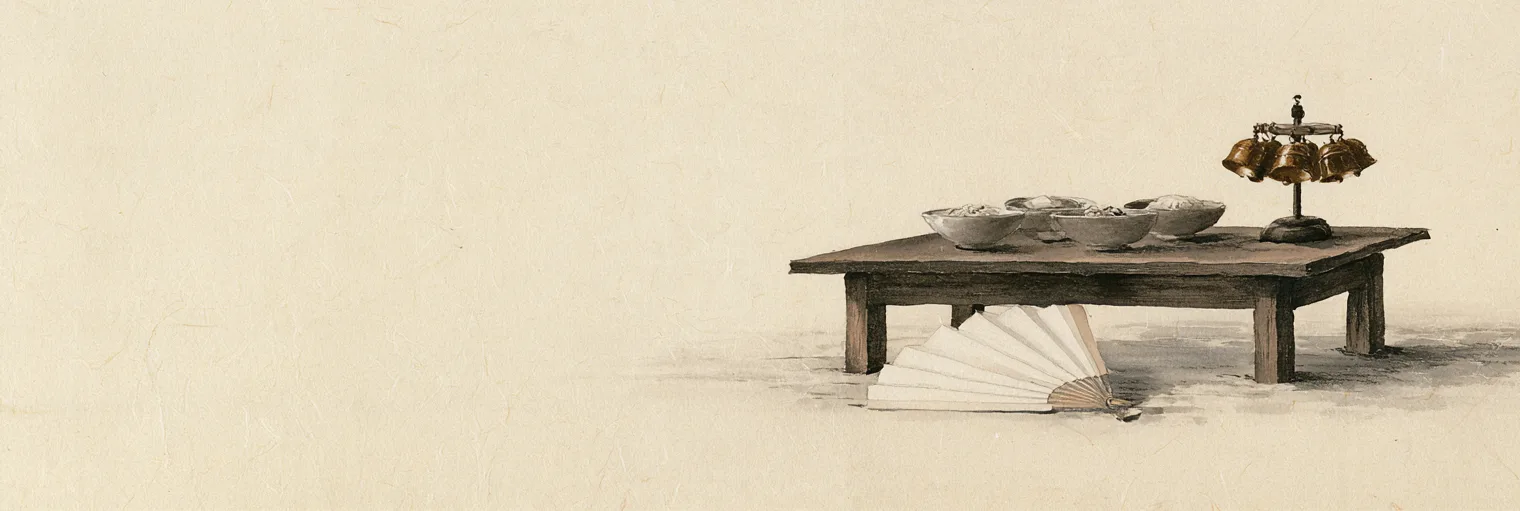
A table has been set and loaded with food. It is set the way you would set it for a guest you want to please, because that is exactly what is about to happen.
The musicians begin. For Seoul and the region just north of it, the encyclopedia names their instruments: an hourglass-shaped drum, a gong, small cymbals, a two-stringed fiddle, a reed pipe, and a bamboo flute.
Then the mudang stands up. Let us say she is a mansin (만신), the respectful word for a woman mudang. The robe she is wearing is not hers. The encyclopedia says it plainly: the costume of a mudang is the clothing of the spirit she is calling. In her hands are bells and a fan. These too, the encyclopedia says, are tools connected with the spirit, and so is the ritual blade a mudang sometimes carries.
She begins to sing and to dance.
First she invites. She sings the spirit in.
Then she hosts. She offers what is on the table. She entertains the guest with song and dance. She tells the spirit what this family is hoping for.
And then the spirit answers. The words come out of the mudang's mouth, but the family receives them as the spirit's own. Korean has a word for this moment: gongsu (공수). The National Folk Museum of Korea's dictionary of folk belief defines gongsu as the spoken part of the message a spirit gives to people through a mudang.
Last, she sees the guest off. A spirit who has come is not left to linger. Fed, entertained, and heard, the guest is sent home. Sending is as much a part of the gut as calling.
When it is over, nobody slips away. The encyclopedia describes the close of a gut as a time when the people who came eat and drink together, and dance and sing along with the mudang.
Hold on to one thing from this scene. A gut is built like a visit: a guest is invited, hosted, and seen off. That is the encyclopedia's own definition.
So who is this woman, and how did she come to stand there?
How does someone become a mudang?
There are two roads, and which one a mudang walked traditionally depended on where in Korea she was born. The folk museum's dictionary draws the line at the Han River, the river that runs through Seoul.
North of the river, the spirit chooses. The dictionary is direct: these mudang did not take up the work by their own wish. A spirit selected them.
The calling comes as an illness. Korean calls it sinbyeong (신병, 神病), "spirit sickness." The Encyclopedia of Korean Culture describes it as a religious experience that arrives through visions and through illness of mind and body. And the encyclopedia records what Koreans have believed about it: that it is healed only when the person receives the spirit and becomes a mudang.
That receiving is itself a gut, called naerim-gut (내림굿), the rite in which a person takes in the spirit that has come down on them and becomes a mudang. In it, for the first time, the spirit's words come out of the new mudang's mouth. Koreans call this first gongsu opening the gate of speech.
South of the river, the family hands it down. Here the work traditionally belonged to certain families, and their children learned the songs and the dances from an early age.
And not every mudang is a woman. Korean has a word for a man who does this work: baksu.
What is a gut for?
Now that you know who she is, look at why a family sends for her.
For good fortune. In central Korea a household holds a gut to ask for peace in the home, wealth, children who do well, and long lives for everyone under the roof.
For someone who is ill. The folk museum's dictionary lists gut held for the sick alongside those held for good fortune. The encyclopedia counts healing among the four most important things a mudang did, together with leading rituals, telling what is to come, and giving people a day of song and play. Angie Heo, a scholar of religion at the University of Chicago, described this side of the work to UChicago News. Shamans, she said, are "consulted if there's a problem with the spirit world." When someone comes in with a patient and says that someone has taken over her spirit, "these women will sing for hours while ringing bells and chanting to appease upset ghosts and spirits."
For a whole village. Some gut belong not to one house but to everyone who lives in the village. The encyclopedia gives their main purpose: to block misfortune from the village and to pray for a good harvest or a good catch.
And for the dead. The dictionary calls this one the representative gut of Korea. When someone dies, a gut is held to guide the soul to the world the dead go to. In Jeolla, the southwestern corner of Korea, it is called ssitgim-gut (씻김굿), "the washing gut," and two of its steps have names you can translate without help: the washing, and the clearing of the road.
The encyclopedia describes the clearing of the road. The soul, washed clean, is set on a long strip of cotton cloth that stands for the road to the next world, and it is pushed along. A road is being cleared for someone the family loved.
The encyclopedia records gut held for other purposes too. Among the gut for the sick it lists gut held to drive out smallpox. It records that people called the spirit who brought smallpox "the guest," and that when smallpox came they sent for a mudang. Of the rites for the dead held under Joseon, the dynasty that ruled Korea from 1392 to 1910, it writes that their most important purpose was not simply to comfort the dead. It was to undo the harmful force left by the death and send the soul on to the next world, so that no trouble would follow. The folk museum's dictionary, in its entry on the mudang, writes that mudang are able to commune with spirits, good and evil alike, and to handle them.
Joseon's own dealings with the mudang were never simple. The dynasty was run by Confucian scholar-officials, and they did not approve. The encyclopedia records that the government passed laws against the rituals and drove the mudang outside the walls of the capital. Yet when it needed rain, the same government appointed mudang of its own and called on them to lead the rain rites.
And today? The encyclopedia writes that mudang now work in the shade, out of public view. The folk museum's dictionary notes that some people now say musogin (무속인) in its place, because the old word has come to carry a note of disrespect. But the work has not stopped. The same dictionary records that more than sixty thousand gut a year are performed in Seoul alone.
What did Exhuma and KPop Demon Hunters take from the mudang?
Exhuma is a film by the director Jang Jae-hyun. It opened in Korea on February 22, 2024, and Kim Go-eun plays Lee Hwa-rim, a mudang.
KPop Demon Hunters came to Netflix on June 20, 2025, made by Sony Pictures Animation and directed by Maggie Kang and Chris Appelhans. Its heroes are Huntrix, three singers named Rumi, Mira, and Zoey. In the film their songs hold up a barrier the film calls the Honmoon, and they fight a boy band of demons called the Saja Boys, who serve a demon king named Gwi-Ma.
Kang has said where the idea came from. At a Netflix conference during the Busan International Film Festival in September 2025, Variety reported her words: "We have this amazing tradition, which is the mudang. It's Korean shamanism. So the idea of using music to, you know, and song to ward off demons. This is what the mudang did." Variety wrote that she "drew inspiration from gut," wrote of "rituals to protect communities from demons and evil spirits," and quoted her again: "In a way, they were really the first concerts in Korea."
So the song is real. The dance is real. The woman who stands between people and the spirit world is real, and so is her work of keeping harm away.
UChicago News asked Professor Heo whether the demon hunters are meant to be shamans. "I believe so," she answered, and then drew the line: "But shamans are not demon hunters, per se." In shamanism, she explained, "spirits are wandering, they're restless. Some spirits are evil, but sometimes they are just people who are displaced, who died bad or accidental deaths and were not properly buried." The mudang's work, in her words, is "finding a way to put that soul to rest." And the demon king Gwi-Ma, she said, is "a total invention. A pure evil being, there's no such thing in shamanism."
Now you can see what the film borrowed and what it built. The song and the warding off of demons come from the mudang, in Kang's own words. The dance is named in Variety's report and by Heo. The king of pure evil is, in Heo's words, an invention. And the encyclopedia describes every gut as sharing the same three steps: the spirit is invited, hosted, and sent off.
Is a mudang's road the same as Dangun's three seals?
No. Korea keeps a scripture called the Samil Singo, and its chapter called Sinhun (신훈, 神訓), the chapter on Haneunim (하느님), the Ultimate Heavenly Source, closes with one line. The translation below follows Zexeda's commentary on the original text.
聲氣願禱 絶親見 自性求子 降在爾腦 Calling out with the voice, exerting your energy, and praying your wishes to an absolute being outside yourself will never bring you face to face with Haneunim. Seek the seed of truth in your own nature. Haneunim has already come down and dwells in your brain.
A gut, in the encyclopedia's definition, invites the spirits, hosts them, and sees them off, and families hold one to pray for good fortune and drive out sickness. The Samil Singo says praying your wishes to an absolute being outside yourself never brings you face to face with Haneunim, and turns the reader to their own nature. Here the two roads part.
The encyclopedia calls a mudang's bells and blade tools connected with the spirit. Korea's founding story tells of Cheonbu-samin (천부삼인, 天符三印), the three heavenly seals, remembered as a sword, a mirror, and a bell. They look alike. Zexeda does not read them as the same thing. It reads the three seals of Dangun as three steps of an inner practice: clear what is false, keep what is true, and share it for the good of all.
Zexeda holds that Korean practice today should follow this teaching. Korean Seondo, Korea's own tradition of inner practice, reads this scripture, and this site's practice articles, such as how to clear karma, work the same way: the work is done in yourself, by you. The Dangun Segi, a chronicle of the Dangun rulers, gives the root of Korea's old rites to heaven as 感謝爲本, gratitude is the root. Not one of Korea's three oldest recorded festivals was held to ask heaven for anything.
Tonight, sit down for ten minutes, look back at one small scene from your day, and let it go: a ten-minute Korean evening practice for beginners.
Continue with Zexeda
If you enjoy finding the real Korea behind the stories you love, the reading continues in the Zexeda newsletter — a quiet weekly letter on Korea's ancient wisdom, one story and one small practice at a time.
Key takeaways
- A mudang (무당) is a Korean shaman. The Encyclopedia of Korean Culture defines a mudang as a religious specialist who serves the spirits and leads the ritual called gut (굿, said like goot).
- A gut has three movements: the mudang invites the spirits, hosts them, and sees them off. The encyclopedia also records gut held to drive out smallpox and to block misfortune from a village.
- The moment a spirit speaks through the mudang is called gongsu (공수).
- There are two roads to becoming a mudang. North of the Han River a spirit chooses the person through sinbyeong, "spirit sickness," and the rite called naerim-gut. South of it, families handed the work down.
- Families hold a gut for good fortune, for the sick, for a village, and for the dead. The ssitgim-gut of Jeolla, "the washing gut," sends a soul on to the next world.
- Joseon's government drove mudang out of the capital and also called on them to lead its rain rites. Today, the National Folk Museum of Korea's dictionary records more than sixty thousand gut a year in Seoul alone.
- KPop Demon Hunters took the mudang's song and dance, and Maggie Kang names the mudang's use of song "to ward off demons" as its source. Professor Angie Heo adds that "shamans are not demon hunters, per se," and that the demon king Gwi-Ma is "a total invention."
- The Samil Singo says that praying your wishes to an absolute being outside yourself never brings you face to face with Haneunim: seek the seed of truth in your own nature. Zexeda holds that Korean practice today should follow this, and does not read a mudang's tools as Dangun's three seals.
This article is for educational and reflective purposes and shares interpretations of Korea's ancient wisdom traditions. It is not medical, psychological, or professional advice.