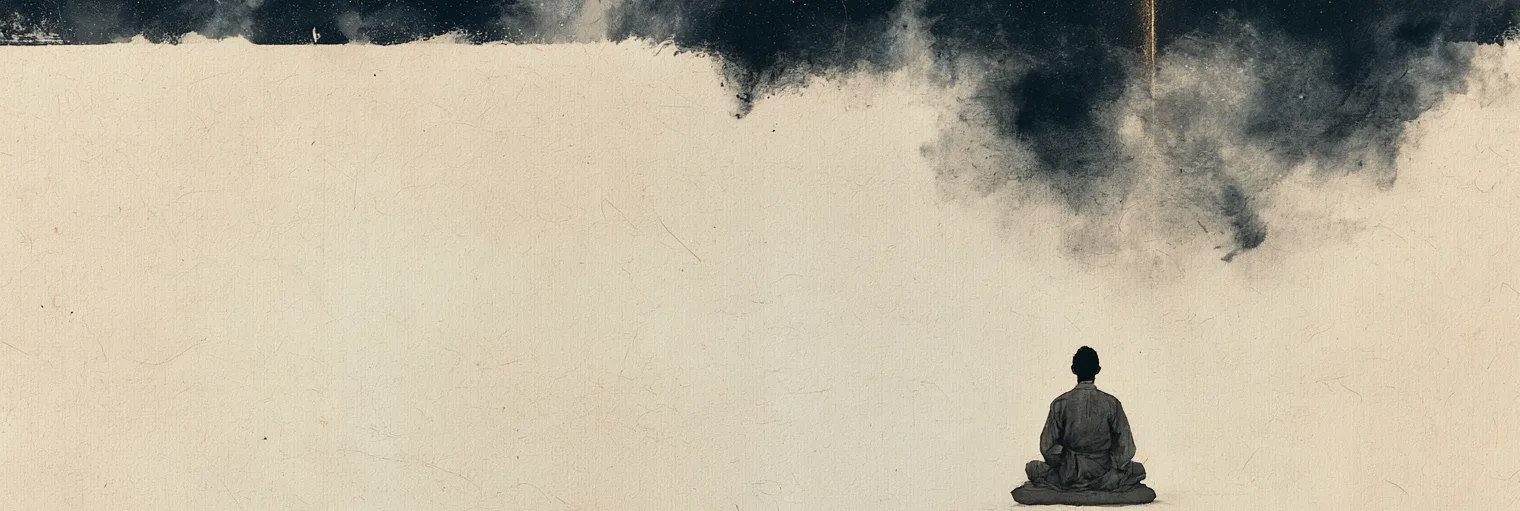
There is a memory most people carry that they have never told anyone. It comes back at three in the morning, or in the middle of an ordinary afternoon, and for a second your chest goes tight — the thing you did, the thing that was done to you, the thing you wanted and should not have. You push it back down. It waits. It always comes back.
Korean Buddhism has a phrase for the work of setting that weight down: eopjang somyeol (업장소멸) — melting away the curtain of karma. People who hear the phrase usually ask the same thing next. How? The answer this article gives is simple to say and long to do: karma is the memory your own life has left in you, and you clear it yourself — by walking back through your life one year at a time and erasing every scene that still carries a feeling, until you can look at it and feel nothing at all.
What does eopjang somyeol mean?
Take the phrase apart and it paints its own picture. Eop (업, 業) is karma. Jang (장, 障) is a hindrance — something that blocks the view, like a curtain. Somyeol (소멸, 消滅) means to melt away completely, leaving nothing behind. Korean Buddhism teaches that karma is made in three ways — with the body, with speech, and with the mind — and that layer after layer of it hangs between a person and awakening. Clear the curtain, the teaching goes, and the Buddha within can be seen.
Then comes the hard part. Nobody seems to agree on how. Should you recite scripture? Confess and repent? Pile up good deeds? Give to a temple? All of it at once? Ask ten people and you will hear ten answers. So before asking how to clear karma, it helps to ask what it actually is.
What is karma, really?
Karma is not a score kept somewhere in the sky. Karma is memory — the memory of the life you have lived. Every action, word, and thought you have ever had as "me," from the day you were born until now, leaves something behind: an image, a scene, a feeling, or all three pressed together. Some of it you remember clearly. Much of it sits below the surface, out of sight, still shaping you. Karma is the whole of it.
It is easier to recognize than to define. So here is what it looks like.
It is the secret — something you did without thinking, years ago, that you have never been able to tell anyone, and the years you have spent afraid of it coming out.
It is the pleasure you went back to in private — a night you still replay, a desire you would not admit to out loud, a closeness you were not supposed to have. Not the moment itself, but the charge that clings to its memory.
It is the betrayal you explained away — the parent, sibling, or friend you let down for your own gain, and the voice that said everyone does it, I had to survive, while you looked away from what it cost them. Some quieter part of you knows that every time you looked away, the shell called "me" grew a little harder.
It is also the good you did. This surprises people. You helped someone weaker than you and felt a warm glow: I did a good thing, and it will come back to me. You got up before everyone and went to bed after everyone, for years, for your family: I have sacrificed so much — why has nothing changed? The pride and the resentment are karma too.
And it is the help you postponed — a parent who was ill, a neighbor or coworker in trouble, and the thought: first I have to survive; first I pay off my own debts, then I'll help. Deep down you knew what you should do. The postponing, and the story you told yourself to make it acceptable, stayed with you.
Put all of that together and you have the answer. Karma is every memory, feeling, and choice that your actions, words, and thoughts have used to build a "me" — to give it shape, make it solid, and fix it in place as the character you are today. Every moment's fear, joy, sorrow, anger, craving, and aversion has turned into a picture, and the pictures have hardened into a shell. That shell is what the old phrase calls a curtain.
Why can't prayer or charity clear it for you?
Because karma lives in your memory, and nobody else can reach inside it.
A donation, a prayer, a moment of regret, a recited verse — none of these, on its own, touches the memory. And when they are used to avoid looking at it, they can make the weight heavier. The feeling of I have been forgiven, laid over a memory you have never actually faced, is like setting a large clay lid on top of a jar. The jar looks sealed. Everything inside is exactly as it was. Worse, the lid itself becomes one more thing to hold on to — a new layer of I am fine now resting on top of the old ones.
Only you can clear your karma, and there is a plain reason: only you know what is in the jar. You carry the memories. You feel the feelings. No one else, however kind or however holy, can see the scene you replay at three in the morning. That is not a burden. It is the good news. The one person who has the key is already here.
How do you clear karma? The practice, step by step
The method is simple to describe. Bring up every memory and feeling that your life has turned into a picture and that still lives in you today — and erase it. To erase it, you first have to see it honestly, exactly as it is. You will find, wrapped around many memories, the layers you built to protect yourself: the excuses, the looking away, the "I had no choice," the quiet hope of being repaid. You face each layer and break through it. What you meet on the other side can be hard to look at — scenes that are shameful, disgusting, unforgivable, embarrassing, frightening, or simply sad, a younger you who was pitiful or lost. Look anyway. Then let the scene go. It can go, because it is not real anymore. It is a picture your own feelings painted and kept.
Here is how to do it.
Make a room where nothing can reach you
Find a quiet space and a stretch of time — at least an hour or two — where nothing will interrupt you. If that is too much at first, begin with less, but keep the same amount of time, every day. No music. No sounds you can avoid. No people coming in. Phone off, or in another room. You are going to go a long way inward, and every interruption pulls you back to the start.
Sit so you can stay still for an hour or two
Sit on the floor with your legs crossed, the way Koreans sit at a low table — yangbandari, "the gentleman's cross-legged seat." Put a firm floor cushion or a folded blanket (a thick book works too) under your hips so your knees don't ache over a long sitting, and keep your back straight. You can sit against a wall, or on a chair or a firm sofa, but the floor is best if you can manage it. A chair's softness and edges keep calling your attention back to your body.
Keep your eyes half open, resting on a bare wall
You can close your eyes. But at the start, closed eyes tend to fill with a thousand stray thoughts, and you may not get one step forward. So try this first: let your eyes stay half open, the lids lowered, and rest your gaze on the wall in front of you. Choose a bare wall — no photos, no pictures, no pattern, nothing on it. Plain wallpaper is perfect. There should be nothing there to look at.
Imagine that you have died
Now imagine it, calmly and clearly: you have died. Your consciousness has slipped out of your body and is looking down at it — lying in a hospital bed, or already ash, or resting in the ground.
Then your consciousness begins to rise. It leaves your home, your town, your country. It keeps rising, and soon the blue Earth is below you, and your country is a shape on a map. Somewhere down there, your body lies still. You keep going, out into the sky, out into space. The Earth shrinks to a dot. Mars, Mercury, Venus — even the Sun — become far-off stars.
Yes. You have died, and what is left of you is awareness, floating in space. There are countless stars all around. And far away, in the middle of them, you can see a black hole — a dark, slowly turning spiral.
This is only imagination, and your body is sitting safely on its cushion the whole time. But from out here, your life looks different. It is finished. It is small. And you can look at it whole.
Walk back through your life, one year at a time
From that distance, start remembering. Begin with the moment you were born, and move forward one year at a time: age zero, age one, age two — all the way to the age you are now.
The earliest years may bring back very little. That is fine. Stay with each year a while, and let things come.
And then, suddenly, something does. Maybe it is your mother carrying you on her back on your very first day of school. A younger brother or sister, still in kindergarten, insisting on carrying your school bag for you. And the same mother, at the end of her patience the day you refused to go to school, dunking you in the bathtub as a punishment. Happy memories and frightening ones come tangled together. That is how it is. You don't sort them into good and bad. You just let them arrive.
Erase each scene until no feeling is left
When a scene comes up — an image of your younger self, a moving picture, a moment with a feeling fused to it — erase it.
Wipe it out. Burn it. Shatter it. Do it again, dozens of times if you have to, until the scene and its feeling stop coming back. If it simply will not go, pick it up — the scene, the feeling, the whole memory — and throw it into that black hole far out in space, where nothing that goes in ever comes out.
The means don't matter. An eraser, a fire, a hammer, a black hole: what matters is that the scene is erased. And the test for "erased" is exact. You keep going until the scene can come back into your mind and no feeling comes with it — no joy, fear, sorrow, anger, craving, or aversion — and no judgment either: not good, not bad, not "I was right," not "I was wrong." You stop when it looks like something that has nothing to do with you. Like a page from a stranger's life.
How long does each scene take?
For some people one scene clears in a minute. For others the same kind of scene takes a whole day. It depends on how thick that memory is, how deep it goes, and how much it still shapes the person you are now.
Walking once through your whole life, from age zero to today, might take one person a week, another three weeks, another a month. Don't measure yourself against anyone. What matters is sitting every day, at the same time, and doing it again.
Then go round again
When you reach your present age, go back to zero and begin again. This time you are watching for two things: new memories that didn't surface the first time, and old ones you were sure you had erased but that come back with their feeling still attached. Erase those too.
Then go round again. And again. Some people go round a few times; some, dozens. Eventually a moment arrives when the scenes no longer come up at all — or when they come up and there is simply nothing attached to them. No feeling, no verdict.
If a memory is too heavy to hold
Most memories can be met this way at your own pace. But a few may bring up more than you can hold on your own — panic, a racing heart, a grief that doesn't ease even after you open your eyes. If that happens, stop. Put both hands on the floor, open your eyes, look around the room, and breathe until you are back. Some wounds are better opened with a counselor or a doctor beside you, and choosing that is not stepping off the path. It is the path taking care of you.
What happens when karma begins to clear?
This is the point where the work starts to bear fruit, and it doesn't look the same for everyone.
Some people, somewhere along the way, find that the people they once hurt — with a deed, a word, or a thought — are suddenly close. They feel that other person's hurt and circumstances as if they were their own. Repentance comes by itself, without anyone asking for it. And then they stand up from the cushion, find the courage to go and see that person, and say sorry — really sorry, sometimes on their knees, sometimes in tears. Korean has a phrase for what happens in that moment: haewon sangsaeng (해원상생) — the grievance untied, so that both sides can live. That is what salvation looks like here. Not a god or a religion lifting it from you: you, saving you.
Others have spent their whole lives inside something that happened to them — a trauma from childhood, a terrible memory, a secret they could never speak. Through this practice, some of them find that they can finally set themselves free and forgive themselves. When that happens, the tears can come like a storm. And when the storm has passed, the shell — the curtain of karma — has let them go.
Neither of these is a promise, and neither comes on a schedule. They are what practitioners of this path have lived through when the work went deep enough. Your road will have its own shape.
Why a sword? The first seal of Dangun
Korea's founding story tells of three heavenly seals — Cheonbuin (천부인) — that the heavenly ruler Hwanin gave to his son Hwanung, so that he could go down and broadly benefit the human world. Hwanung's son was Dangun, Korea's founder. The old record never says what the three seals were; tradition remembers them as a sword, a mirror, and a bell, and Zexeda reads them as the three steps of an inner path — clear, keep, share.
The practice in this article is the first of those steps: the sword.
The sword is a picture of the power to clear your own karma. Every memory of the life you have lived, every feeling fixed to it, every verdict of good and bad — you cut them away with a sword made of sunlight. It is brighter than any explosion and faster than any blade in a film. It cuts through memory, feeling, and judgment in a single stroke, and what it cuts, it melts — or flings into the black hole, or the Sun, or the Earth, anywhere at all, so long as it is gone. Korea's eighty-one-character scripture, the Cheonbugyeong, says the original mind is, at its root, the Sun (本心本太陽). A sword of sunlight is that same brightness, picked up and put to work.
So let each of us carry one in our chest: the first of Dangun's three gifts, a sword of light bright enough to melt anything, like the Sun. And let us use it, one scene at a time, to clear the curtain away.
Clearing karma is salvation, and it is being forgiven. It is freedom from the "me" your memories built. And it is the first step on the road to becoming one with the One — the first stretch of the road to freedom. The deeper steps of this practice will come on Zexeda one at a time, in their own season.
Continue with Zexeda
If you would like company on this road, the Zexeda newsletter is a quiet weekly letter that walks the sword, the mirror, and the bell one small practice at a time. You are welcome to walk along.
Key takeaways
- Eopjang somyeol (업장소멸) is a Korean Buddhist phrase: eop is karma, jang a curtain or hindrance, somyeol to melt away completely — melting away the curtain your karma has woven.
- Karma is memory. It is every action, word, and thought you have lived as "me," with its feeling still attached — and together those memories have hardened into the character you call yourself.
- Good deeds leave karma too. The pride of having done good, and the resentment of sacrifices never repaid, are part of the curtain.
- No one can clear it for you. A prayer, a donation, or a recited verse laid over an unexamined memory is a lid on a jar — the contents stay the same. Only you know what is inside.
- The practice: a quiet room, an hour or two a day (less at first, but the same time every day), a straight back, half-open eyes on a bare wall. Imagine you have died and risen far into space. Walk back through your life one year at a time, and erase every scene that still carries a feeling.
- The test is exact: keep erasing until the scene can return with no joy, fear, sorrow, anger, craving, or aversion, and no verdict of good or bad — until it looks like a stranger's life.
- Repeat the whole circle, from birth to now, as many times as it takes. Daily consistency matters more than speed.
- When karma clears, some people find themselves repenting and apologizing for real; others finally forgive themselves. Either way, you are the one who does the saving.
- This is the sword — the first of Dangun's three seals: a sword of sunlight that cuts memory, feeling, and judgment away.
This article is for educational and reflective purposes and shares interpretations of Korea's ancient wisdom traditions. It is not medical, psychological, or professional advice.