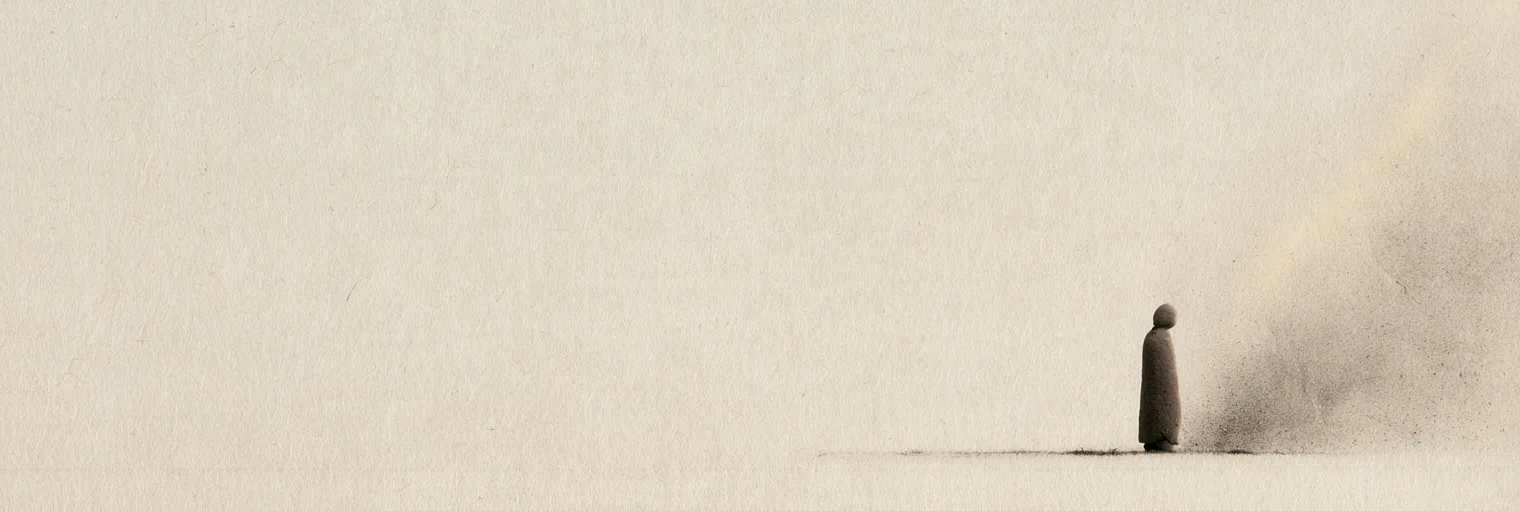
Have you ever stood at the bathroom mirror, brushing your teeth on an ordinary morning, and suddenly felt that the face looking back was a stranger's?
It lasts a second or two. The eyes are yours, the nose is yours, the tired skin under the eyes is yours, and yet something in you says, quietly and very clearly: that is not me. Then you wonder — is that shape in the glass really who I am? — and an even stranger question follows close behind it. Then who is the one asking?
That moment is not a glitch. Zexeda reads it as a brief meeting with your True Vitality — the life in you that was there before any picture of you was made. For one breath, the one who sees the face stepped back from the face. And then the day pulls you back. A message arrives, an old irritation rises, you are late. The familiar feelings and habits return, the person in the mirror becomes "me" again, and you walk out of the bathroom inside the same picture you walked in with.
This article is about that picture, and about how to put it down.
What is sang, the self you built?
Listen to the way people describe themselves.
I'm the kind of person who gets worked up easily. When I'm stressed, I need two burgers before I calm down. Or: I'm always measured and calm — I never eat more than I need, whatever happens. Or: I'm bright and positive. I only think happy thoughts, I feel for people who are struggling, and I love classical music and vegetarian food.
Each of those is a portrait. A temperament, a set of tastes, a way of reacting, a story about who this person is and always has been. And each of us carries one, and lives inside it, and defends it, and mostly never questions it.
The Korean word for that portrait is sang (상, 像). The character means an image or a figure — the way a statue in a temple is a figure. Zexeda uses it for something precise: the constructed self, the character you have built up and taken to be "I." It is a figure carved out of your own life, and over the years you have mistaken the figure for the one who carved it.
What is it carved from? From the two things the earlier practices on this path cleared. Your karma — the memory your mind keeps, every scene still carrying its fear, joy, pride, or shame. And your seup (습, 習), habit — the memory your body keeps, every reaction repeated until the body does it by itself. Karma and habit meet, fuse, and harden, and out of their meeting a new thing is born: a person with a shape, a personality, an atmosphere. A me.
But the me you were born as had no such shape. No baby comes into the world already "the kind of person who needs two burgers." That person was built. And what was built can be taken apart.
Where does the Samil Singo place it?
Korea's 366-character scripture, the Samil Singo, says in its Truth Chapter that every person receives three true things whole: cham-seong (True Nature), cham-myeong (True Vitality), and cham-jeong (True Essence). Of the second, it says:
眞命 無淸濁 "True Vitality has no clear and no murky."
Then it describes what grows over each of the three. Sam-mang (삼망, 三妄), the three delusions, take root — mind over nature, body over essence, and over vitality, gi (기, 氣), life energy:
氣 依命 有淸濁 淸壽濁夭 "Gi rests on vitality, but it comes to have clear and murky — the clear live long, the murky die young."
So the vitality itself is neither clear nor murky. It is simply alive. What becomes clear or murky is the gi that rests on it — and that clouded gi is gi-mang (기망, 氣妄), the gi delusion.
The scripture then names the road gi-mang walks. Of sam-do (삼도, 三途), the three roads — Gam (感, feeling), Sik (息, breath), and Chok (觸, contact) — gi-mang's road is Sik, breath, and it branches into six states:
息 芬爛寒熱震濕 Sik (breath): Bun (芬, fragrance), Ran (爛, foulness), Han (寒, cold), Yeol (熱, heat), Jin (震, parched trembling), and Seup (濕, damp).
That last seup is a different word from the seup of habit — same sound, different character.
Think of these not as weather but as the atmosphere a person carries. A breath that is sweet and a little giddy. A breath gone stale and murky. A breath that is cold and sinking. A breath that runs hot and rough. A breath whose moisture has dried up, so that the gi shakes roughly and nothing in you feels steady — a precarious state. A breath that is damp and heavy and pulls you down. Everyone knows someone who walks into a room and changes its air. Each of us carries an air of our own.
Here is how the picture forms. One of these atmospheres fuses with a feeling and a habit, and it repeats. It repeats for years. Slowly it piles up into an identity — I'm the gloomy one, I'm the hothead, I'm the anxious one — until you take it for the thing you simply are. That pile-up is sang.
Korea's eighty-one-character scripture, the Cheonbugyeong, sketches the same story at the scale of the cosmos. Its opening lines give the order in which things were given: heaven first, earth second, the human being third (天一一 地一二 人一三). Then each of the three opens into two (天二三 地二三 人二三). Zexeda reads that second line, on the human side, as the place where the trouble begins: the mind delusion and the body delusion meet, gi-mang gathers between them, and a self with a shape is built — a me standing where a whole, unshaped life once stood.
Why doesn't clearing karma and habit clear sang too?
You might expect the picture to fall away on its own once its materials are gone. It does not, for two reasons.
The first is that sang, once made, is a new thing. Flour and water become bread, and taking the flour back out of the bread is no longer possible; you have to deal with the bread. In the same way, karma and habit fused into a figure, and the figure has to be cleared as itself. Clearing what it was made from loosens it. It does not remove it.
The second is that karma and habit do not stop arising just because you cleared them once. You go on living. The mind delusion and the body delusion go on producing fresh scenes and fresh reactions every day, and those go on fusing into fresh images of who you are. That is why the practice has an order — karma first, habit second, sang third — and why none of it happens in one sitting.
And there is a deeper reason it is not easy. Clearing karma is letting go of memories. Clearing habit is letting go of what the body holds. Clearing sang is letting go of the one who was doing the letting go. It is taking you apart. Of the three cuts, this is the one the self resists most.
Yet it is worth it, because the figure is not real. There is no fixed "me" with a fixed shape that you were always meant to be. The Truth Chapter's picture of a life run by the three delusions is spare — it follows the roads and their eighteen states and ends in "birth, growth, decline, sickness, and death." A whole life spent inside a character you built, defending its shape, suffering its shape, is the hell that picture describes. When karma is cleared, and habit, and then sang, the gi delusion turns back toward True Vitality, and you step out of the character, out of the eighteen states, and out of the suffering they lead to.
How do you let go of sang? The practice, step by step
The method is simple to say and long to do. You look at the person you have been calling "me," honestly, and then you cut that person away with the same sword you have been using, until nothing of the picture is left.
At this first stage of the path, the method for sang is the same as for karma and habit: the sword.
Begin after karma and habit are mostly cleared
This practice comes third, not first. Begin it only once the karma practice and the body-memory practice have done most of their work — when the scenes of your life come up and little comes with them, and when the organs go cleanly under the blade. Sang is built from those two. If they are still thick, the picture of you will keep rebuilding itself out of them faster than you can cut it.
Set the room as before, and add a mirror
The same quiet room. The same time every day, an hour or two, or less at first. No one coming in, phone in another room. Sit on the floor with your legs crossed, a firm cushion under your hips, your back straight.
This time, one thing is added. If you can, stand a mirror against the wall in front of you, at the height where you can see your own face and body as you sit.
Look at the person in the mirror
Open your eyes and look. Not at your hair or your skin, but at the person. What kind of person is this? What character, what temperament, what shape do they have?
How do you describe yourself? Always bright and fragrant? Always dark, with a stale air about you? Always cool, with a cold edge? Always rough and quick to boil over? Always restless and giddy, never quite settled? Always heavy, sinking, damp?
Take your time. Let the answers come in your own words.
Ask where that person came from
Then ask the questions that loosen the picture.
Was I this person when I was a baby? Didn't my feelings and my habits make this shape? And where did those feelings and habits come from? Aren't they what is left of every choice my mind and my body ever made, piled up?
You are not looking for a perfect answer. You are gathering the picture together — seeing clearly what you have been calling "me," so that you know exactly what you are about to cut.
Close your eyes and call up "me"
Now close your eyes. Ask, who is the person called me? — and let an image come. Do not choose it. Take the first one that rises: a shape, a figure, a face, a character, a person with a certain air about them.
Cut it with the sword of sunlight
Take out the sword — the same sword of sunlight you used for karma and for the body, the first of Dangun's three seals. Cut the image of you.
The moment the blade touches it, the figure melts into the light and is gone, shape and all. Whatever afterimage is left, throw it into the black hole far out in space, the one from the karma practice, where nothing that goes in ever comes out.
Cut what comes with it
You will notice that the image does not come alone. With it come things attached to it: an event, another person, a particular time and place, a feeling. And, most of all, an atmosphere — an air, a texture, a sensation of what it is like to be that person.
The moment you see any of it, cut it with the sword of sunlight and throw what is left into the black hole.
Go on until no image of you is left
Then call up the next image of "me," and the next. Repeat the whole process until every shape and figure of yourself is gone. Leave nothing behind that came up with them: the feelings, the body, the strange insects some people met in the body practice, other people, places, atmospheres. All of it.
One day, the image of you no longer rises. Or if it does, it carries none of the six atmospheres: no fragrance, no foulness, no cold, no heat, no parched trembling, no damp. Nothing clear and nothing murky. Only you as pure life. When that is all that is left, the clearing of sang is complete.
How long does it take?
Some people reach that point in a few days. For others it takes weeks, or months. And while you work, leftover karma and leftover habit will rise again with the images of you. That is expected. Cut them along with everything else.
Keep going. The sword of sunlight is the first seal Dangun handed down, and it is there to be used until True Vitality is recovered. No god can do this in your place. Only you can put down the false self you made, and win your freedom back. Do not forget this.
If it brings up more than you can hold
Everything in this practice happens to a picture, and the life underneath it is untouched. But taking apart the picture you live inside can shake you. For a few people it brings a feeling of unreality: as if they were outside their body, or the world had gone flat and far away. If that happens and it does not ease when you open your eyes, stop. Put your hands on the floor. Look around the room and name what you see. Breathe until the room is back. If you live with dissociation, depersonalization, psychosis, or severe depression, go slowly, and let a counselor or doctor who knows you know that you are doing this practice. It is meant to set you free from a picture, not to cut you off from your life.
What happens when sang begins to clear?
When the picture is gone, the "me" stops holding you. You are free of it.
And you notice something you could not see before: you are watching yourself. There is the one who watches, and there is the one being watched. The one who watches is your true self. The one being watched is a shape: the form you have chosen to wear right now.
That changes how time feels. There is no past that exists somewhere on its own, and no future waiting somewhere on its own. The past and the future are both held inside the present. And this present is one you live with True Vitality recovered, wearing a shape you chose, not one you are trapped in.
Then something else begins. Once you have stepped out of your own false picture, you start to see other people's pictures too. You see the character a friend has built and is living inside, the shape a parent has carried all their life. You see it without judging it, because you know from the inside how it was made. Zexeda reads this as the first step toward the third of Dangun's seals, the one that turns everything inward into something lived out among other people.
None of this is a promise, and none of it keeps a schedule. It is what people on this path describe when the work went deep enough.
The third cut: from gi back to True Vitality
The three seals of Dangun — sword, mirror, and bell — are the shape of Zexeda's whole path, and the sword is its first stage: the clearing. The karma practice was the sword's first cut, turning the mind delusion back toward True Nature. The body practice was the second, turning the body delusion back toward True Essence. This practice is the third, turning the gi delusion back toward True Vitality. The Samil Singo's Truth Chapter calls the whole movement ban-mang jeuk-jin (반망즉진, 返妄卽眞): the false, turned back, becomes true.
Clearing karma frees you from the hell your mind built. Clearing seup frees you from the hell your body kept. Clearing sang frees you from the hell called "I."
With this, one full turn of the sword is complete. But it is one turn, not the end of the road. If you stop here, the three delusions go on working as you live, the eighteen states go on running, and before long you find yourself back where you began, in birth, growth, decline, sickness, and death. What comes after the sword is the mirror, the second stage of the path. That is where Zexeda will go next.
No god, no religion, no parent, no friend, no spouse can set you free in your place. Only you can free yourself, by turning the false back until the true is recovered.
Continue with Zexeda
If you would like company on this road, the Zexeda newsletter is a quiet weekly letter that walks the sword, the mirror, and the bell one small practice at a time. You are welcome to walk along.
New subscribers get a free PDF: A K-Drama Fan's Glossary of Korea's Ancient Words.
Key takeaways
- Sang (상, 像) means an image or a figure. Zexeda uses it for the constructed self: the character you have built up and taken to be "I," with its temperament, moods, tastes, and story.
- Sang is made from the other two. Karma, the memory of the mind, and seup, the memory of the body, fuse into a picture of a person, and that picture is something new.
- The Samil Singo places it in gi-mang, the gi delusion. Gi rests on True Vitality and comes to have clear and murky; True Vitality itself has neither. Its road is Sik, breath, with six states: fragrance, foulness, cold, heat, parched trembling, and damp.
- Clearing karma and habit does not clear sang by itself. Once made, it must be cleared as itself, and karma and habit keep arising in daily life. So the order is karma, then habit, then sang.
- The practice: begin once karma and habit are mostly cleared. Same room, same seat, a mirror on the wall in front of you. Look honestly at the person in it and ask where that person came from.
- Then close your eyes, call up the first image of "me," and cut it with the sword of sunlight. Throw what is left into the black hole. Cut everything that rises with it: events, people, places, feelings, and above all its atmosphere.
- Repeat until no image of you is left, or until what rises is only pure life, with nothing clear or murky about it. Days, weeks, or months.
- Stop if it brings up more than you can hold. Hands on the floor, eyes open, breathe. Go slowly and with support if you live with dissociation, psychosis, or severe depression.
- When sang clears, practitioners describe freedom from the "me," the discovery of the one who watches, a present that holds past and future, and the ability to see other people's pictures. These are what people have found, not promises.
- This is the third cut of the sword, the first of Dangun's three seals: karma frees the mind, seup frees the body, sang frees you from "I." One full turn of the sword is complete. The mirror comes next.
This article is for educational and reflective purposes and shares interpretations of Korea's ancient wisdom traditions. It is not medical, psychological, or professional advice.