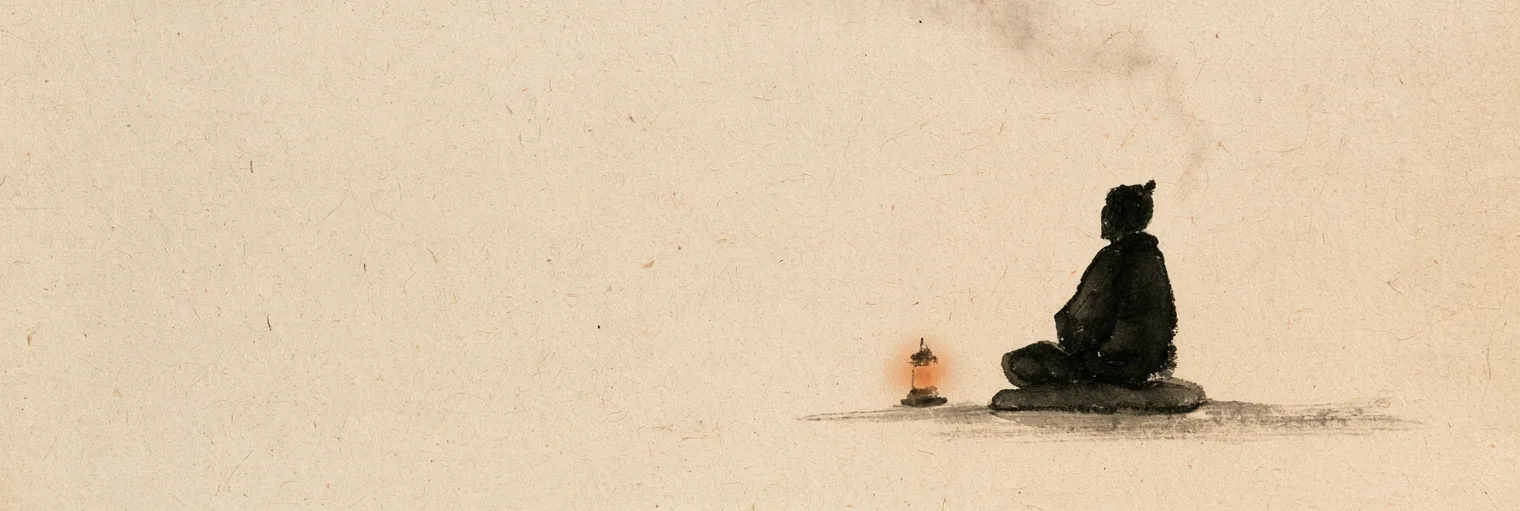
Korean meditation can begin tonight, in ten minutes, with nothing but a quiet corner and a bare wall. You sit down before bed, call back one small moment from your day that still has a feeling stuck to it, look at it without arguing, and let it go. Korea's old practice tradition has a two-syllable name for the heart of this — ji-gam (지감), stopping reactive feeling before it carries you off — and it is where that tradition begins. This article walks you through the ten minutes one step at a time, and tells you what the first few evenings are usually like.
Why does your day replay the moment you lie down?
The light is off. You were fine all evening. Now there is nothing left to look at, and the day starts playing back.
The thing you said in the meeting that came out wrong. The message a friend read at lunch and still has not answered. The face of a stranger on the train who looked at you a second too long. Each one arrives with its own small jolt — a hot face, a sinking stomach, a flash of I should have said — and your mind does what minds do. It argues with the scene. It rewrites it. It defends you. Then it plays the scene again.
Look at what is actually happening. The moment itself ended hours ago. What keeps coming back is a picture of it with a feeling attached, and it is the feeling that pulls you in.
On Zexeda, that pairing has a name. A scene with its feeling still attached is what we call karma — not a score kept somewhere in the sky, but the memory your own life leaves in you. The scenes from today are the newest layer of it, and the thinnest. They have had only a few hours to settle.
That is good news for a beginner. You do not have to start with the heaviest thing you carry. You can start with this afternoon.
What does Korea's tradition call this?
Korea has its own tradition of inner practice, called Seondo (선도). The name sounds like Korean Seon, the country's branch of Zen Buddhism, but it is a different path with its own texts.
Its method is written down in a very short scripture, the Samil Singo (삼일신고) — 366 characters in all, about a page. Its last chapter, the Truth Chapter, is the one about human beings, and its closing sentence names three practices. The first is only two characters long: 止感. Stop. Feeling. In Korean it is read ji-gam.
It is easy to hear that as feel nothing, and the scripture is not asking for a numb life. Ji-gam means you stop being carried.
Picture a train station at night. An old feeling pulls in and the doors open. Every evening you step on and ride it to the end of the line — the argument, the rewrite, the verdict on yourself at two in the morning. Ji-gam is staying on the platform. The train is there. You see it clearly, every window. You do not push it away, and you do not board. Most trains, when nobody boards them, pull out by themselves.
The tradition puts this practice first for a reason. The mind decides what everything means before you have finished noticing it, and while it is busy doing that, nothing underneath it can settle — which is why, as the article on the three truths explains, the work begins with the mind, and the first practice is ji-gam. Ten minutes in the evening is a small enough door to walk through.
How do you do it? The 10-minute evening practice, step by step
Everything below is done sitting up, before you get into bed. Bed is where the replay runs by itself. This is where you watch it on purpose.
-
Choose your ten minutes and keep them. Pick a time you can repeat — after you brush your teeth, before you lie down. Set a quiet timer for ten minutes so you never have to look at a clock. Put your phone in another room if you can, or face down and silent across the room. No music. What matters is sitting every evening, at the same time.
-
Sit so you can be still. Sit on the floor with your legs crossed, the way Koreans sit at a low table — it is called yangbandari, "the gentleman's cross-legged seat." Put a firm cushion or a folded blanket under your hips so your knees can drop and your back can straighten. If the floor is hard on you, a firm chair is fine, feet flat. Rest your hands on your thighs. Back straight, shoulders loose.
-
Rest your eyes on a bare wall. Let your eyes stay half open, the lids lowered, and rest your gaze on a plain stretch of wall — no photos, no pattern. Closed eyes tend to fill with a thousand stray thoughts at the start. There should be nothing on the wall to look at.
-
Take three slow breaths, then leave the breath alone. Let each out-breath be a little longer than the in-breath. After the third, stop managing it. Nothing counted, nothing held. The breath can find its own pace.
-
Walk back through today. Begin at the moment you woke up and move forward slowly: the morning, the way to work or school, midday, the afternoon, the evening. You are not hunting for anything. You are watching for the place where something catches — a small tightening, a warmth in the face, a flicker of irritation or of pleasure. Pleasant scenes count too; you do not sort them into good and bad. Stop at the first one that catches. For now, let it be something small: an everyday irritation, not the hardest thing in your life.
-
Look at the scene exactly as it was. Let it come clear, like a short video clip — the room, the faces, the words. Then give the feeling one plain word, silently. Embarrassed. Angry. Left out. Proud. One word, not a paragraph. Your mind will begin to make its case — I only said that because, she always does this — and when you hear it, you do not answer. You note that the argument has started, and you return to the picture. This is ji-gam: the train at the platform, and you looking at it.
-
Stay, and let it go. Keep looking for several slow breaths. Do nothing to the scene. A small scene that is watched without being argued with usually thins — the picture loses its color, the jolt gets softer. It can go, because it is not happening anymore. What is left is a picture your own feelings painted and kept. To check, call the scene back once. If it returns like a page from someone else's day — you can see it, but no feeling comes with it and no verdict either, neither good nor bad — it has gone. If it is still warm, leave it. It will be there tomorrow, and you will meet it again.
-
Stop when the timer sounds. If there is time after the first scene, walk on through the day and take a second one, perhaps a third. When the timer sounds, stop wherever you are, even in the middle of a scene. Unfold your legs, stand up, and go to bed. Do not grade the sitting.
Laid out by the clock, the ten minutes look roughly like this:
| Minutes | What you do |
|---|---|
| 0–1 | Sit, eyes half open on the wall, three slow breaths |
| 1–3 | Walk back through today until one scene catches |
| 3–10 | Look at it, name the feeling in one word, stay until it thins; then a second scene if there is time |
| At 10 | The timer sounds. Stop and stand up |
Notice what you were not asked to do. No special breathing. No place in the body to concentrate on. No calm to produce. You were asked to stop doing one thing — boarding the train. The quiet does not have to be made. It is what is already there when the arguing stops.
What are the first few evenings like?
What follows is what people who sit this way commonly meet. It is a description, not a schedule and not a promise, and your evenings will have their own shape.
On the first night you mostly board the train. You sit down to watch one scene, and three minutes later you find yourself planning tomorrow, or winning the argument you lost at lunch. That is not failing. The moment you notice you have boarded is the practice. Step off, and go back to the scene.
Some nights nothing catches. You walk through the day and it lies flat. That is fine. Stay with the day a little longer and let things come. If nothing does, sit out your ten minutes with the wall. The sitting at the same hour is the thing you are building.
A scene may also get louder before it gets quieter. When you stop arguing with it and really look, you start to see what the argument was covering — the excuse, the I had no choice, and under those, often something much simpler: I wanted them to like me. It can be uncomfortable to see. Look anyway.
And the same scene may come back the next evening. You were sure it had gone, and there it is with its feeling still attached. Meet it again, the same way.
Then, for some people, the pause starts turning up in the daytime. Somewhere in the first week or two they catch the jolt as it arrives — in the meeting, on the train — and name it while still standing in it. The evening's ten minutes have started to leak into the day.
Which memories should you leave alone for now?
This practice is built for the small scenes of an ordinary day. It is not the place for the heaviest things you carry — an old wound, a loss that is still raw, a memory that brings panic with it. If one of those rises while you are walking through your day, you do not have to look at it tonight. Let it pass, and choose a smaller scene.
If a scene does bring up more than you can hold — a racing heart, panic, a pain that does not ease even after you open your eyes — stop. Put both hands on the floor, open your eyes, look around the room, and breathe until you are back. Some wounds are better opened with a counselor or a doctor beside you, and choosing that is not stepping off the path. It is the path taking care of you.
What comes after the ten minutes?
Ten minutes with today is the first rung of a ladder.
The scenes you meet in the evening belong to today. Underneath them lie scenes of the same kind from last year, from your school days, from childhood — older, thicker, and still shaping what catches you now. Sometimes one of them rises up behind tonight's scene: the same feeling, in a much earlier room.
Korean Buddhism has a phrase for clearing all of it: eopjang somyeol (업장소멸), melting away the curtain of karma. The fuller practice on this site, How to Clear Karma, uses the same seat, the same bare wall, and the same honest looking — but it walks back through your whole life, one year at a time, for an hour or two a day.
There is no hurry to get there. When ten minutes have become an ordinary part of your evening, and you find you want to stay longer, it will be waiting.
Tonight there is only this: a cushion, a wall, ten minutes, and one small scene from an ordinary day. The train pulls in. You stay on the platform, and you watch it go.
Continue with Zexeda
If you would like a quiet companion for these evenings, the Zexeda newsletter is a weekly letter that brings one small practice from Korea's old wisdom at a time. You are welcome to read along.
Key takeaways
- Korean meditation can start with ten minutes in the evening — sitting up, before bed, at the same time every day.
- What replays at night is a picture with a feeling attached. On Zexeda that pairing is called karma: the memory your own life leaves in you. Today's scenes are its newest, thinnest layer.
- Ji-gam (지감, 止感) means stopping reactive feeling — not feeling nothing, but no longer being carried. The Truth Chapter of the Samil Singo names it first among its three practices.
- The practice: sit cross-legged or on a firm chair, eyes half open on a bare wall, three slow breaths. Walk back through your day, stop at one small scene, look at it as it was, name the feeling in one word, and watch without arguing until it thins.
- The test: call the scene back once. If it returns like a page from someone else's day, it has gone. If it is still warm, meet it again tomorrow.
- Boarding the train is not failing. Noticing that you boarded, and stepping off, is the practice.
- Keep it to small scenes. Heavy memories are not for this practice, and some are better opened with a counselor or doctor beside you.
- When you want to go deeper, the same looking is carried through your whole life in How to Clear Karma.
This article is for educational and reflective purposes and shares interpretations of Korea's ancient wisdom traditions. It is not medical, psychological, or professional advice.