You have done the work of the sword. You walked back through your life one year at a time and cut every scene that still had a feeling on it. You cut the habits your body kept. You cut the picture of "me." And for a while, the inside of you was as quiet as a room after snow.
Then one ordinary evening someone says a single word to you, in a certain tone, and before you have decided anything your chest is hot and your jaw is tight. The old anger is back. Or you pass a street you have not seen in years, and a sadness you were sure was gone rises like water into a cellar.
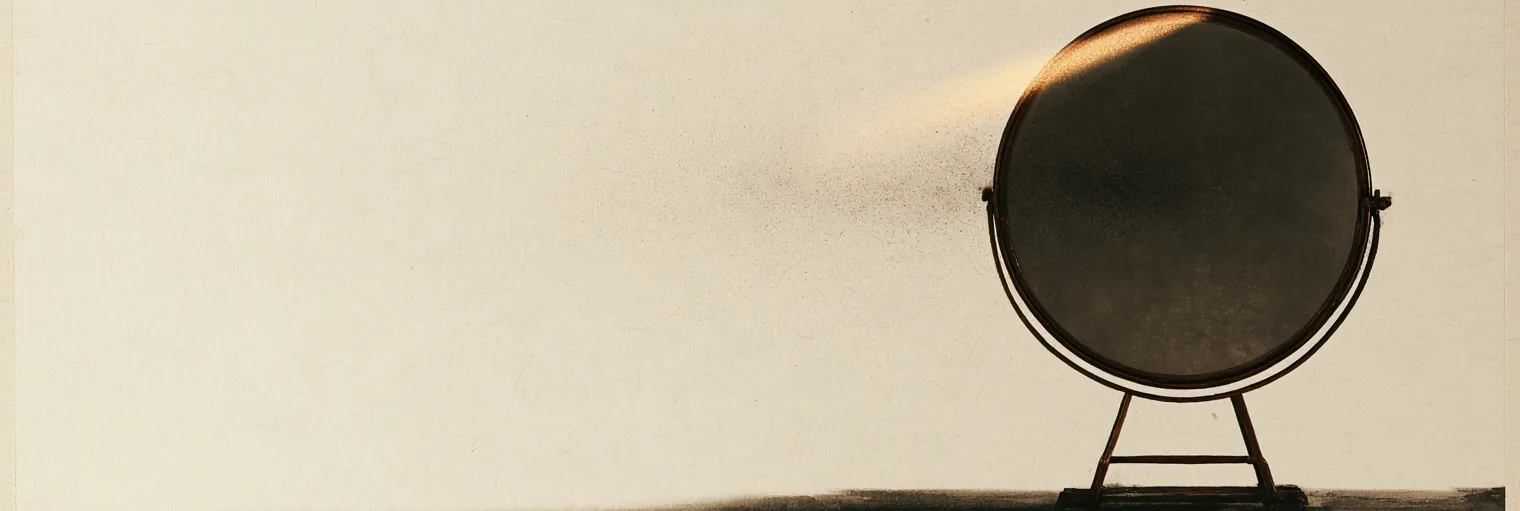
Nothing went wrong. A mirror does this. Leave a clean mirror in a room for a week and a film of dust settles on it. Leave it a season and it fogs. Leave it long enough and rust creeps in from the edge, until the face in it is hard to see. The sword cleared the glass. Now the glass has to be kept clear. That is the second of Dangun's three seals, the mirror, and this article is its first practice. Its name is ji-gam.
Where did the sword leave us?
Three practices on Zexeda have used the sword of sunlight, the first of the three seals that Korea's founding story says the heavenly ruler Hwanin gave to his son Hwanung, and that came down to Dangun. Clearing karma cut the memory of the mind. Clearing body memory cut the habits the body kept. Letting go of the self-image cut the picture of a person you had taken to be "I."
Korea's 366-character scripture, the Samil Singo, says in its Truth Chapter that every person receives three truths whole, and that three delusions grow over them. Zexeda reads the three things the sword cut as those three delusions, piled up over a lifetime. Karma (eop, 업) is the mind delusion piled up. Habit (seup, 습, 習) is the body delusion piled up. The self-image (sang, 상, 像, the constructed self) is the gi delusion piled up, and it is also what karma and habit make when they fuse.
Each cut did one thing, and the order mattered.
Karma went first. When it was cut, the mind that had piled it up saw that it was the delusion lying over your True Nature, and True Nature opened through. Zexeda names that with the Truth Chapter's word seong-tong (성통, 性通), the nature opened.
Habit went next. When it was cut, the body that had made it felt that it was the delusion lying over your True Essence, and True Essence was kept. Zexeda names that jeong-bo (정보, 精保), the essence preserved.
The self-image went last. When it was cut, you came to know that karma, habit, and the gi that carried them had all come from not knowing your True Vitality. Zexeda names that myeong-ji (명지, 命知), coming to know True Vitality.
With those three cuts, the three delusions were turned back and the three truths were recovered. The first three steps of the road were done, and you had taken one step onto the road of the awakened. Zexeda reads this as the way of Cheonung, which the Budoji says Dangun cultivated, practiced with the sword of the three seals.
But cutting the three delusions and recovering the three truths is not where the practice ends. Recovering the truth is one thing. Staying in it is another. For that you need the mirror, the seal Hwanin handed down through Hwanung to Dangun.
What is the mirror?
A mirror is truth. It shows what is in front of it, just as it is. It adds nothing and hides nothing. That is what truth is.
Even after karma, habit, and the self-image are cleared, and you have stepped out of the delusions of mind, gi, and body and recovered the truth, the mirror practice is still needed to stay there. The reason is simple. Dust settles again. Grime builds again. Rust comes back, and the truth cannot be seen in the glass.
Here is how that happens from the inside. You keep living. A memory of your life joins hands with one of the six feelings and rises. The moment it rises, your True Nature is no longer visible in the mirror, and you have slipped back into the mind, which is to say back into the delusion, and out of the truth.
To recover it, two things are done together. The first is the sword, as before: every day and every moment, the images and scenes that rise with a feeling attached are cut with the sword of sunlight. The second is new. It is ji-gam, the practice the Samil Singo sets down, which Zexeda reads as the practice Dangun left us.
What is ji-gam?
The word is two characters. Ji (지, 止) means to stop. Gam (감, 感) means feeling. Together, Zexeda gives them as stopping reactive feeling.
Where does feeling come from? The Truth Chapter draws the map. Your True Nature, which is the truth, and your mind, which is the delusion, meet. On the road that runs between them, the road the scripture calls feeling, six states rise again and again: Hui (喜, joy), Gu (懼, fear), Ae (哀, sorrow), No (怒, anger), Tam (貪, grasping craving), and Yeom (厭, aversive rejection). Six weathers, and a mind that never stops making them.
Ji-gam is this: you hold that mind, where the six keep rising, up to the mirror. You watch it. You see what each feeling really is. And then you let it go and let it disappear.
Two things need saying here. Ji-gam is not pushing a feeling down. And it is not pretending you do not feel it. It is watching a feeling so closely, and so honestly, that you understand it, and a feeling that is fully understood has nothing left to hold on to. It lets go of you.
How do you practice ji-gam? Step by step
The room is the one you have been using. The same quiet hour, the same cushion, the same straight back. What changes is what you do with what rises.
Keep the sword within reach
In the karma practice you walked back through your life one year at a time. Here you do not have to start that way again. The first sword practice already cleared most of the karma, so what remains flashes up and, most of the time, vanishes the moment you look at it.
But sometimes a memory rises with its feeling and does not vanish when you watch it. That tells you something plainly: the first sword practice, the clearing of karma, is not finished yet. Then you carry the two practices together, and you do not skip the first.
When an afterimage of a feeling or a memory stays, do not reach for the sword at once. Give it a moment. Watch it, the way you would watch something reflected in a mirror.
Watch, and it stops
Here is the heart of it. The moment a rising feeling or memory is seen, it stops. That stopping is ji-gam. Once it has stopped, most feelings and memories slide away or dissolve on their own.
If that does not happen, if the feeling keeps growing, or if you find you cannot watch it at all, then take out the sword of sunlight. Cut it without mercy. Throw it into the black hole far out in space, the one from the karma practice, where nothing that goes in ever comes out. Do it again, and again, as many times as it takes, until that memory no longer shows up with any feeling on it.
Call them up by feeling, not by year
In the mirror stage, the way you keep True Nature in view is not by calling up your karma year by year. You call it up by the six states, one feeling at a time.
Begin with joy
Call up a time in your life when you felt glad. Let the memory come with its image, its situation, the people who were there, the place. Then watch. Watch the you who felt that joy. Watch the other person. Watch the things that were part of it. Watch the feeling itself.
Keep watching until everything in it is understood: how you felt then, how the other person felt, what the things around you were doing to make the moment what it was. When all of it is understood and flows through, the feeling dissolves by itself, and the memory image fused with it dissolves too.
Sometimes the opposite happens. The feeling grows strong instead of fading. Then cut all of it with the sword of sunlight and throw it into the black hole. And throw the one swinging the sword in after it, sword and all.
When is joy finished?
When joy no longer rises, no longer shows itself, and no longer comes when called, the ji-gam of joy is complete. If it rises now and then, that is fine, as long as watching it brings understanding and it dissolves naturally, with no feeling left behind.
Then the other five, in order
Next comes fear, then sorrow, then anger, then Tam, then Yeom. You go through each one the same way, in that order. You keep going until nothing reflects in the mirror anymore.
How long does it take?
Days for some people. Months for others. The mirror practice of ji-gam is the practice of keeping your recovered True Nature in view, and it takes as long as it takes.
If it brings up more than you can hold
Watching an old feeling closely can bring it up strongly before it lets go. For most people that passes within the sitting. If a feeling keeps growing and will not go into the black hole, or if you find you cannot stop shaking, crying, or feeling far away from your own body after you open your eyes, stop for that day. Put your hands on the floor. Look around the room and name what you see. Breathe until the room is back. If you live with trauma, severe depression, or any condition in which strong feelings are hard to come back from, go slowly, and let a counselor or doctor who knows you know that you are doing this practice. It is meant to clear the mirror, not to break it.
What is the mirror, really?
The mirror is the True Nature that Haneunim (the Ultimate Heavenly Source) gave you. Everything is in it. Everything in it is one. Everything in it flows through everything else. It is the infinite consciousness of the universe, the nature of the universe itself.
That is why the practice is a mirror practice. You are not making something new. You are keeping clear something that was given to you whole.
The first gate
One day it happens, and you cannot say in advance which day. Everything becomes memory, and everything is understood. You can see every person's feeling, but it is not your feeling. It is simply seen. Then it passes. Like a mirror, everything shows just as it is, and nothing catches on anything. No feeling rises in you, and your True Nature flows through all of it.
When your karma, your feelings, your memories, and your mind have all been recovered to True Nature in this way, you have passed through the first gate of ji-gam.
No one can promise you that day, and no one can put it on a calendar. It is what people on this path describe when the watching has gone deep enough.
Widening the mirror
From here you step out of "me" and widen the gate one circle at a time. Zexeda leaves the details of these steps for another day and gives only the shape.
Leaving your own memories and feelings, take up the feelings of your family, your neighbors, your friends, your spouse, your lover, your coworkers, your workplace, your society, your nation, and practice the same way.
Then widen it to your pets, to plants, to the birds of the sky, the beasts of the land, the fish of the sea, to insects and worms, down to germs. Raise each one in the mirror and look.
Then widen it to things: trees, stones, water, soil, mountains, rivers, seas, stars, the moon. Raise each in the mirror and look.
Whatever feeling or memory rises, cut it with the sword of sunlight until nothing rises, and then watch again.
Everything is in the mirror, and nothing is there. True Nature flows through.
The mirror is the universe
The mirror is the universe. The mirror is the whole of consciousness. The mirror is the mind of Haneunim. The mirror is, from the beginning, our own True Nature.
When the mirror practice is complete, that is seong-tong, the nature opened through.
Ji-gam is the first of the mirror's three practices. The Samil Singo names three, and in the order Zexeda walks them, ji-gam comes first, then geum-chok (금촉, 禁觸), guarding contact, and then jo-sik (조식, 調息), making the breath even. The mind is worked first because it governs the other two. Those two practices are where Zexeda will go next.
Follow this practice by sound
A three-minute guided version of the first step: one small glad moment, watched until it passes. More recordings are on the Guided Practices page.
Continue with Zexeda
If you would like company on this road, the Zexeda newsletter is a quiet weekly letter that walks the sword, the mirror, and the bell one small practice at a time. You are welcome to walk along.
New subscribers get a free PDF: A K-Drama Fan's Glossary of Korea's Ancient Words.
Key takeaways
- The sword's three cuts cleared karma, habit, and the self-image, which Zexeda reads as the three delusions of the Samil Singo piled up: the mind delusion, the body delusion, and the gi delusion. Each cut recovered one truth: True Nature opened (seong-tong), True Essence preserved (jeong-bo), True Vitality come to be known (myeong-ji).
- Recovering the truth is not the end. A mirror shows things as they are, and that is what truth is, but a mirror also gathers dust, fog, and rust. The mirror, the second of Dangun's three seals, is the practice of keeping the recovered True Nature clear.
- Ji-gam (지감, 止感) means stopping reactive feeling. Six states rise on the road of feeling where True Nature meets the mind: joy, fear, sorrow, anger, grasping craving, and aversive rejection. Ji-gam holds that mind up to the mirror, watches, understands, and lets go.
- Watching is the stopping. The moment a rising feeling or memory is seen, it stops, and most then dissolve on their own. If one grows instead, the sword of sunlight cuts it and the black hole takes it, as many times as needed.
- The sword stays within reach. A memory that will not dissolve when watched means the karma practice is not finished, so the two are carried together.
- Call them up by feeling, not by year. Begin with joy. Watch the scene, yourself, the other person, the things, and the feeling, until all of it is understood and it dissolves. Then fear, sorrow, anger, Tam, Yeom, in that order.
- Each feeling is finished when it no longer rises, or when it rises and dissolves as soon as it is watched, with nothing left behind. Days for some, months for others.
- Stop for the day if it brings up more than you can hold. Hands on the floor, eyes open, breathe. Go slowly and with support if strong feelings are hard to come back from.
- The mirror is the True Nature Haneunim gave you, the consciousness of the universe, in which everything is one and flows through. The first gate is passed when your own karma, feelings, memories, and mind are recovered to it. Then the mirror widens, to the people in your life, to living things, to all things.
- When the mirror practice is complete, that is seong-tong. Ji-gam is its first practice. Geum-chok and jo-sik come next, in that order.
This article is for educational and reflective purposes and shares interpretations of Korea's ancient wisdom traditions. It is not medical, psychological, or professional advice.