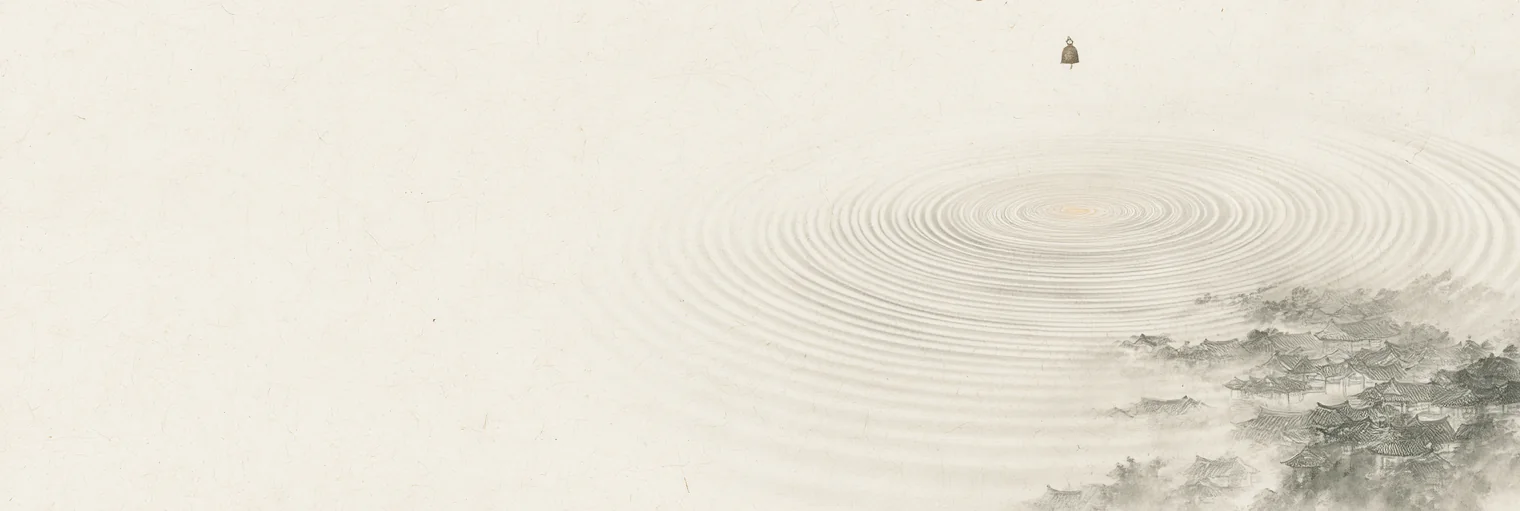
Hongik Ingan (홍익인간, 弘益人間) means to broadly benefit all human beings. Four characters, one sentence, no conditions attached. The phrase comes from the Samguk Yusa (삼국유사, 三國遺事), the thirteenth-century Korean chronicle, where it is the reason a heavenly prince is sent down to the human world — and it became the founding ideal of the kingdom his son established. It has never gone quiet since: it is named in Article 2 of South Korea's Framework Act on Education as the guiding ideal of the country's schooling.
That is the short answer. But if you stop there, you will almost certainly misread it — because Hongik Ingan is usually translated as a moral instruction ("be good to people") when in this tradition it is something stranger and more precise: the last of three movements, and the one that cannot be done first.
This article walks through the whole phrase slowly: what each of the four characters carries, where the words come from, the second phrase that always travels beside it, why the tradition puts it at the end of a path rather than the beginning, how it differs from altruism as most of us learned it, where it turns up in Korea today, and what it might look like in an ordinary week.
What does Hongik Ingan mean?
Read aloud, it is four syllables: hong-ik in-gan. Read character by character, it is a small piece of architecture.
| Character | Sound | What it carries |
|---|---|---|
| 弘 | hong | broad, wide — to make something wide |
| 益 | ik | benefit, gain, to increase |
| 人 | in | person, human being |
| 間 | gan | between, the space between |
弘益 (hongik) is therefore "broad benefit" — not a benefit narrowed to one household, one class, or one nation, but benefit widened. And 人間 (ingan) is the everyday Korean word for a human being, though its two characters literally say person and between — and in this phrase, that second character quietly does extra work.
So the plainest translation is the one used throughout this site: to broadly benefit all human beings. English versions vary — you will see "devotion to the welfare of humanity," "to live for the benefit of all mankind," and others — and they are all reaching for the same simple thing.
There is one further reading worth naming, and it is the reading Zexeda follows. Because 間 means between, the phrase can be heard as benefiting not only individual people but the space between people — what happens in the gap where two lives touch. That is not a mystical stretch. A person is rarely harmed by a stranger's private thoughts; people are harmed, and helped, in the between.
Notice, too, what the phrase does not say. It does not say our people. It does not say those who agree with us, or those who join us. A founding phrase with no boundary drawn inside it is not a common thing to find at the root of a national story.
Where does the phrase come from?
The words are older than any nation's slogan, and their source is a specific book.
The Samguk Yusa was compiled in the thirteenth century by the Buddhist monk Iryeon, and it carries the oldest surviving telling of Korea's founding story. In that account, Hwanin (환인, 桓因), the heavenly ruler, has a son named Hwanung (환웅, 桓雄) who keeps turning his attention toward the world below. The father, understanding his son's intent, looks down over the mountains — Samwi and Taebaek (삼위태백, 三危太伯) — and sees a place where human beings may be broadly benefited: Hongik Ingan. Only then does he give his son three heavenly seals (천부인, 天符印) and send him down to rule.
Read that sequence again, because everything about the phrase depends on it.
下視三危太伯可以弘益人間 "Looking down upon Samwi and Taebaek, he saw a place where human beings could be broadly benefited." — the Gii chapter of the Samguk Yusa, quoting the older record it calls the Gogi (古記)
The phrase is the reason, not the reward. The descent happens because human beings can be broadly benefited. The kingdom comes afterward: the country is the consequence, and the benefit of human beings is the cause. That is an unusual order for a founding story — most of them begin with a people, a place, or a victory, and add the ideals later.
Three things follow from this that are easy to miss:
It exists before the nation does. Hongik Ingan is spoken in the story before Joseon is founded, before a border is drawn, before there is anyone to call "us." Whatever else it is, it is not a national interest dressed up as a virtue.
It is aimed downward, not upward. Hwanung does not call people up to heaven. He comes down and takes charge of grain, life span, sickness, punishment, and the difference between good and evil — the record says he governed some three hundred and sixty affairs of the human world. The benefit in question is bread-and-weather benefit, not a promise about the afterlife.
It comes bundled with tools. In the same breath as the phrase, three seals are handed over. Later tradition remembers them as a sword, a mirror, and a bell, read here as a map of inner practice in the three seals of Dangun. Keep that pairing in mind; we will need it shortly. An ideal was given, and so was a method.
The phrase also appears in the transmitted stream of Korean tradition beyond the Samguk Yusa. The Hwandan Gogi (환단고기) carries, in its Dangun Segi (단군세기) chapter, a short teaching text called the Yeompyomun (염표문) that the eleventh Dangun, Dohae, is said to have had carved in stone. Its closing four phrases run:
一神降衷 性通光明 在世理化 弘益人間 "The one God descends into the center; the nature is opened and made bright; living in the world, one transforms it by principle; and human beings are broadly benefited." — the Yeompyomun of the eleventh Dangun, Dohae, as carried in the Dangun Segi chapter of the Hwandan Gogi
Sit with the order of those four phrases for a moment. Descent. Nature opened. World transformed. Human beings benefited. Hongik Ingan is the fourth item on a list of four. We will come back to this, because it is the heart of the article.
What is Jaese Ihwa, the phrase that comes with it?
Hongik Ingan almost never travels alone. Its companion is Jaese Ihwa (재세이화, 在世理化) — governing the world with reason while living in it.
Again, character by character:
- 在 (jae) — to be present, to dwell
- 世 (se) — the world, this age
- 理 (i) — principle, the order that is already in things; also reason
- 化 (hwa) — to transform, to bring about change
So: dwelling in the world, transforming it according to principle. In the Samguk Yusa this phrase names Hwanung's manner of rule, right after the list of ordinary matters he takes charge of. If Hongik Ingan says what for, Jaese Ihwa says where and how. In the Hwandan Gogi the two arrive in the same breath as the instruction that gives Korea's October holiday its name — open heaven, establish the teaching, govern in the world by reason — which is why the opening of heaven and this phrase are really one sentence broken in half.
Two words in it deserve a second look.
在世 — while living in it. Not withdrawing to a cave to keep one's hands clean, and not waiting for a better world elsewhere. The transformation happens in the same world that contains traffic, illness, deadlines, and difficult relatives. This is a quiet but decisive commitment, and it shapes the whole tradition: an awakening that requires you to leave ordinary life would fail this phrase on its first word.
理化 — by principle, not by force. I (理) is the grain already running through things — the way a carpenter reads the grain of wood rather than fighting it. To transform by principle is to work with what is already true rather than to impose a scheme on top of it. Nothing in the phrase suggests conquest, conversion, or pressure. That absence is not an accident.
Put the pair together and you get a complete stance:
| Phrase | What it answers | In one line |
|---|---|---|
| 弘益人間 Hongik Ingan | What is it for? | To broadly benefit all human beings |
| 在世理化 Jaese Ihwa | Where, and how? | Inside ordinary life, by principle rather than force |
A purpose without a place becomes sentiment. A method without a purpose becomes management. The two together describe something a person could actually live.
Why does Hongik Ingan come last, and not first?
Here is where this article parts company with most explanations of the phrase — and where the Korean tradition says something genuinely its own.
Hongik Ingan is usually presented as a starting instruction. In Korean Seondo, the practice tradition this site follows, it is the third movement of three, and the two before it are inward. Look again at the tools that arrived with the phrase. A sword, a mirror, and a bell — and they are not interchangeable.
| Stage | Seal | What is done | What comes of it |
|---|---|---|---|
| First | Sword | Clear away what is false — the charged memories, worn habits, and fixed images that cover your original nature | The three truths — nature, life, essence — come back into view |
| Second | Mirror | Keep the recovered true self clear: stop reactive feeling, make the breath even, guard contact | Seongtong (nature opened), myeongji (life known), jeongbo (essence preserved) |
| Third | Bell | Let the clarity sound outward into ordinary life | Hongik Ingan · Jaese Ihwa |
The three truths recovered in the first two stages — seong, myeong, and jeong — have their own article.
The full sequence is laid out step by step in the three seals of Dangun, and its logic comes from the Samil Singo, Korea's scripture of the three and the one. Its Truth Chapter ends with one unbroken line of movement: the false, turned back, becomes true (반망즉진); great inner capacity unfolds (발대신기); and the path arrives at seongtong gongwan (성통공완, 性通功完) — the nature opened, and the work completed.
Notice that the scripture does not stop at the opening. Half of its destination is gongwan — the work completed — and work is not completed inside a private experience. It is completed out in the world, among people. So the question "what is awakening for?" already has its answer inside the goal itself.
Which brings us to the sentence at the center of this whole site: what a person does once they have reached seongtong gongwan — the nature opened and the work completed — is Hongik Ingan. Hongik Ingan is the sound the bell makes.
Why should the order matter so much? Because of what a bell is. A sword can be sheathed and a mirror can hang on a wall, but a bell has exactly one purpose — to ring — and here is the part that decides everything: the sound of a bell is only as clear as the metal it is made of. Cast a bell out of cracked, unmixed metal and it will still ring. It will just ring badly, and everyone will hear it.
That is not a poetic flourish. It describes something most of us have seen up close. Help offered from an interior that has not been cleared tends to hurt the one giving it as much as the one receiving it, because of everything that comes along with it: the wish to be seen helping, the quiet expectation of gratitude, the need to be the one who rescues, an old wound looking for a place to be useful. It is possible to exhaust yourself doing good and leave everyone around you subtly heavier. The tradition's answer is not to help less. It is to clear the metal.
So the benefit rings outward — not as a duty added on top, but as what naturally happens next. Reversed, the phrase quietly turns into strain. Kept in its order, it stops being a demand and becomes a description.
One caution here, because this is easy to twist. The order is about the source of the ringing, not about earning permission to ring. Nothing in this tradition says you must be finished before you may be kind. Small kindness is available on the worst day of your life, and the tradition's own examples of Hongik Ingan are almost embarrassingly ordinary. What the order says is where the unforced version comes from. Practice and benefit grow together, the way a hand and the thing it is learning to do grow together; the sequence describes a direction of flow, not a locked gate.
Is Hongik Ingan just another word for altruism?
They point at the same generous impulse — and any tradition that produced words like altruism, philanthropy, charity, and agape is clearly working the same ground. This is not a competition, and Hongik Ingan is not improved by disparaging anything else. But the phrases are built differently, and the difference is worth seeing clearly.
Altruism, as most of us learned it, begins with a choice against yourself. Its usual shape is: my interest points this way, yours points that way, and I choose yours. Something is given up. That is a real and admirable thing, and it is also why altruism has a well-documented failure mode — the exhausted helper, the depleted caregiver, the volunteer who quietly resents the people they serve. If the fuel is subtraction, the tank runs down.
Hongik Ingan, in this tradition, begins with a recovery. Its shape is: the covering over my original nature is cleared, and what was underneath begins to shine; and what shines does not shine at anybody in particular. The Cheonbugyeong, Korea's eighty-one-character scripture, gives the reason such a thing is possible at all in one line: "within the person, heaven and earth are one" (人中天地一). If that is true of you, it is true of the person in front of you as well. Benefiting them is not a transfer from my side of the ledger to theirs. There was never a ledger.
Here is the comparison laid side by side:
| Altruism as commonly framed | Hongik Ingan in this tradition | |
|---|---|---|
| Where it starts | A decision to put another first | A recovery of one's own original nature |
| What it costs | Something given up | Nothing subtracted; what was covered is uncovered |
| What powers it | Will, principle, compassion | Clarity that has become natural |
| Its typical failure | Depletion, quiet resentment | Stalling in inner work and never ringing at all |
| Its scope | Whoever is in front of me | 人間 — human beings, without a boundary drawn |
Look at that fourth row honestly, because it names this tradition's own danger. If altruism can collapse into exhaustion, an inward path can collapse into permanent self-improvement — a life of clearing and polishing that never sounds a note for anybody. The phrase Hongik Ingan exists precisely to prevent that. It is the tradition's built-in refusal to let awakening become a private hobby.
And one more thing should be said plainly, because it is often misunderstood in the other direction: Hongik Ingan is not sacrifice, and it is not a claim of superiority over anyone. It says human beings, broadly. A person practicing it has no one to look down on, since the ground of the whole idea is that the same brightness is under everybody.
Where does Hongik Ingan appear in Korea today?
An ancient phrase can survive as an ornament. This one did something rarer: it got written into law.
In education law. South Korea's Framework Act on Education names Hongik Ingan as the ideal of education — Article 2 of the Act sets out that education, under the ideal of Hongik Ingan, is to cultivate character in every citizen, develop the ability to live an independent life, and equip people to contribute to the development of a democratic state and to the common prosperity of all humanity. Whatever a Korean student thinks about it, the first principle written above their entire schooling is a phrase from a founding story.
One correction worth making, since the claim circulates widely: the phrase is often said to be in the Constitution. It is not — the law it is actually written into is the education framework.
In schools themselves. Hongik Ingan appears on school gates, in mottos, in ethics and history textbooks, and in the speeches that open school years. Korean children generally meet the phrase long before they meet the story it came from.
On the calendar. Every October 3, South Korea observes Gaecheonjeol (개천절, 開天節) — the day the heavens opened, known in English as National Foundation Day — commemorating the founding described in the story of Dangun. The holiday keeps the whole sequence in public memory: a descent undertaken so that human beings might be broadly benefited. The other holiday that carries the phrase without naming it is Chuseok: the year's first grain is offered before anyone eats, and only then does the table turn toward the people sitting at it — receive, acknowledge the source, then feed everyone within reach.
In ordinary speech. The phrase is used in Korean the way a shared reference is used anywhere — in editorials, in company mission statements, in commencement addresses, sometimes sincerely and sometimes as filler. That is what happens to a phrase that has been around for a long time. It does not make the phrase smaller; it makes it common property.
And in a university name. Hongik University in Seoul — famous for its art and design programs — takes its name from the same two characters. Even the neighborhood nickname Hongdae carries them.
What would Hongik Ingan look like in an ordinary week?
If Hongik Ingan is the third movement, a fair question is what that looks like on a Wednesday, in a life with a job and a commute and not much spare energy. The tradition's answer is consistently modest.
It rarely looks like a campaign. It looks like:
- Patience where you used to have none — the reaction that would once have fired, simply not firing.
- Ordinary work done with full attention, without the thought of "me" attached to it. Whatever your work is, it touches people; that is a large enough field for a lifetime.
- A hard conversation held without the old sharpness — the point still made, the blade left out of it.
- Attention given to someone no one else was listening to.
- Something explained clearly to a person who was confused, and then dropped — no follow-up, no ownership of their conclusion.
- A small thing put right that nobody will trace back to you: the litter picked up, the chair pushed in, the door held.
Three notes on how the tradition holds this, because the tone matters as much as the list.
It is not announced. Once benefit becomes an identity — I am one who benefits humanity — the metal has picked up a new coating, and the bell's tone changes. The tradition is unusually quiet about this: the clearest ringing tends to be unnoticed, including by the one doing it.
It is not a quota. Nothing here asks you to fill a weekly total of good deeds. That would only add one more measurement to a mind that is already measuring, which is exactly what the earlier stages were clearing away. If a list of good acts starts to feel like an assignment, that feeling is worth examining before the list is extended.
It is not somewhere else. 在世 — in the world. Not in a better job, a quieter country, or a future season when you are finally ready. The people your week already contains are the human beings the phrase is talking about.
And if you want the practical side of the earlier stages — what the sword and the mirror actually involve on an ordinary morning — that is the subject of the three seals of Dangun.
Continue with Zexeda
If this phrase has caught something in you, the reading continues in the Zexeda newsletter — a quiet weekly letter that takes Korea's ancient wisdom one idea, and one small practice, at a time. You are welcome to walk along.
Key takeaways
- Hongik Ingan (홍익인간, 弘益人間) means to broadly benefit all human beings — hong (弘) broad, ik (益) benefit, ingan (人間) the human world, written with the characters for person and between.
- It comes from the Samguk Yusa, the chronicle carrying the oldest surviving account of Korea's founding, where it is the reason the heavenly prince is sent down — the kingdom is the consequence, not the source.
- The phrase draws no boundary: not our people, not our followers, but human beings.
- Its companion is Jaese Ihwa (재세이화, 在世理化) — governing the world with reason while living in it. Hongik Ingan says what for; Jaese Ihwa says where and how: inside ordinary life, by principle rather than force.
- In this tradition it is the third of three movements, not the first: the sword clears what is false, the mirror keeps what is true, and the bell rings the clarity outward — the sequence set out in the three seals of Dangun.
- The Samil Singo supplies the logic: its Truth Chapter ends at seongtong gongwan — the nature opened and the work completed — and the completion of work happens in the world. What a person does once they have reached seongtong gongwan is Hongik Ingan.
- Why the order matters: the sound of a bell is only as clear as the metal it is made of. Benefit offered from an uncleared interior still rings, but it rings with everything else that is in there.
- The order concerns the source of the ringing, not permission to ring. Small kindness is always available; the sequence describes where the unforced version comes from.
- It is not the same shape as altruism: altruism usually begins with something given up, while Hongik Ingan begins with a recovery — and the Cheonbugyeong gives the reason in one line, "within the person, heaven and earth are one" (人中天地一).
- It is still in force: South Korea's Framework Act on Education names Hongik Ingan as the ideal of national education (Article 2), and October 3 (Gaecheonjeol / National Foundation Day) keeps the founding in public memory. It is not, despite the common claim, in the Constitution.
- In an ordinary week it looks small and mostly unnoticed — patience, full attention, a hard conversation without the old sharpness, something put right that nobody traces back to you.
This article is for educational and reflective purposes and shares interpretations of Korea's ancient wisdom traditions. It is not medical, psychological, or professional advice.