A dokkaebi (도깨비) is the goblin of Korean folktales: a being that comes out at night in the shape of a person or an animal, loves a trick, and now and then leaves someone rich. Korea's national encyclopedia, the Encyclopedia of Korean Culture, defines it in one line as a spirit in the shape of an animal or a person.
The encyclopedia then sets the dokkaebi apart from the ghosts of the dead. Unlike the spirits that a person's soul becomes after death, it writes, a dokkaebi comes from natural things such as trees and stones, and often from things that people have used.
English calls it the Korean goblin. The National Folk Museum of Korea's dictionary uses a bigger word: a deity who plays rough tricks on people and also helps them. Some villages honored it as their guardian, the dictionary writes, and others drove it out as the spirit that brings sickness.
Maybe you met the word on a screen, in the drama Goblin (Korean title Dokkaebi). The old stories care less about the dokkaebi's face than about one question. What happens when a person meets one?
The short answer: it depends on who walks in.
What happens when someone meets a dokkaebi?
One dokkaebi story is told all over Korea, the encyclopedia says, and it starts on a hillside.
A good-hearted man is out cutting firewood when a hazelnut comes rolling toward him. He picks it up. This one, he says, he will take home to his father. Another rolls up, and that one is for his mother. The third he keeps for himself.
The sun goes down before he is home, so he goes into an empty house to sleep. Then a crowd of dokkaebi comes in. They are carrying clubs. They rap the clubs, and everything they wish for comes out.
Koreans call this club the dokkaebi bangmangi (도깨비방망이). Bangmangi is simply the Korean word for a club.
The man is hiding and watching. He bites down on one of his hazelnuts.
Crack.
The dokkaebi are so startled by the sound that they drop their clubs and run. The man goes home with a club, and from then on he lives well.
A neighbor hears about it and goes out to cut wood himself. In many tellings he is the man's brother. A hazelnut rolls toward him too. The first one he keeps for himself. The next is for his wife. His parents come last. Then the same empty house, the same night visitors, and the same sound.
Crack.
This time nobody runs. The dokkaebi take him for the thief who stole their club, and they beat him soundly.
Put the two nights next to each other. The nuts, the house, and the sound are the same. What the story changes is the order in which each man picks up three hazelnuts. The encyclopedia calls it a tale with a strong lesson: the kind man finds luck, and the man who copies his moves only to get the luck is punished.
So the dokkaebi gives with one hand and beats with the other. And in the whole story, nobody says what they look like.
What does a dokkaebi look like?
The encyclopedia's answer is that you cannot pin it down. The dokkaebi keeps changing, it writes, so it cannot be described as one fixed form. It shows up as a child, a giant, an old man, a young woman. Some dokkaebi can be seen, like the ones that are a fire moving through the dark. Others are only a sound: a bowl breaking, a horse's hooves, a roof tile cracking.
Both reference works write that the dokkaebi comes out at night, and also by day when a drizzle or a fog makes the day dark. It turns up on mountain paths, in abandoned houses, and around wells nobody uses. When the rooster crows at dawn, the encyclopedia writes, it disappears.
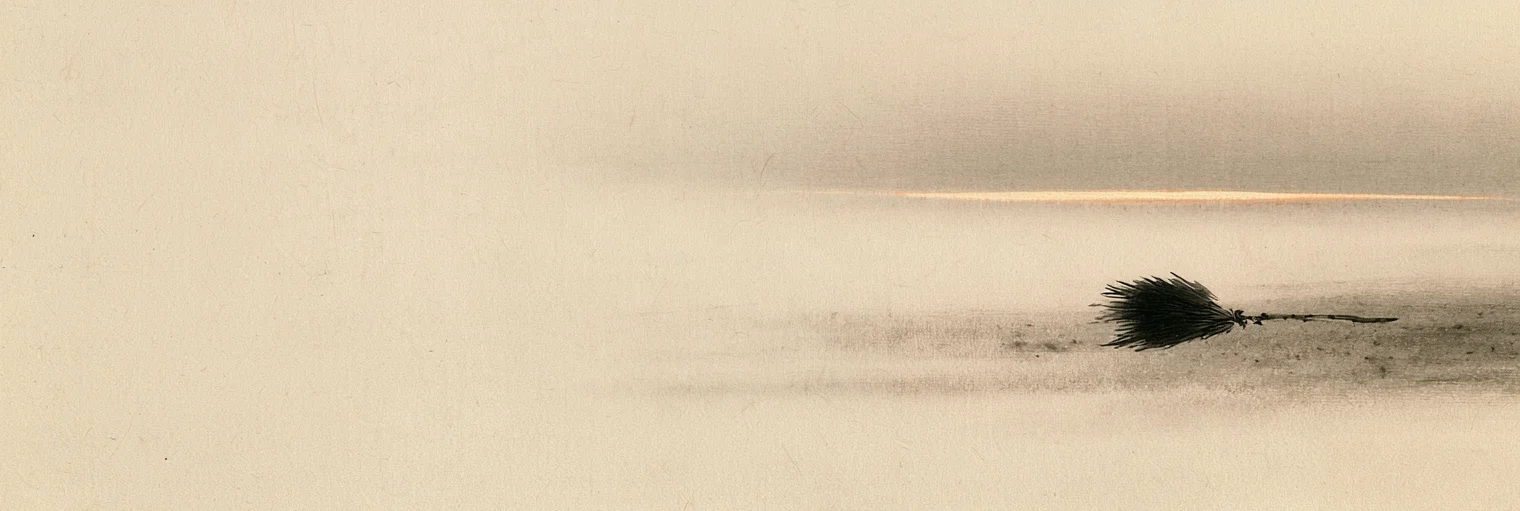
Both works name the things it comes from, and the folk museum's dictionary lists them: a broom, a fire poker, a winnowing basket, a pestle, a sieve, things people used every day and then threw away.
The encyclopedia tells a story that shows it. A man is walking home late at night from the market. A giant steps out in front of him, as tall as one of the carved guardian posts that stand at the entrance to a Korean village, and challenges him to ssireum (씨름), Korean wrestling. The two grapple almost until daybreak. At last the man stabs the giant in the neck and kills it. He runs home, gathers his neighbors, and brings them back to the spot.
There is no giant. There is a flail, a farm tool for threshing grain, or a broom. It is too worn out to use, and it is lying where someone threw it away, with a sliver of wood stuck in its neck.
Where the encyclopedia does describe a body, it is one of these: wild loose hair, or a single leg that the dokkaebi hops along on, or a figure so tall that its head stands above the clouds. That description has no horns in it.
Today's pictures tell it differently. The dokkaebi Koreans commonly picture has horns on its head and a spiked club in its hand. The folklorist Kim Jong-dae, who wrote several of the folk museum dictionary's entries on the dokkaebi, says that picture came from the school readers issued while Korea was under Japanese colonial rule (1910–1945). The readers printed a tale about an old man with a lump, he says, and the drawings that came with it showed the oni of Japanese folklore, which then settled in as the dokkaebi's face. The dictionary's main entry on the dokkaebi, written by another scholar, describes roof tiles showing a fearsome figure with horns, glaring eyes, and long sharp teeth, and writes that these tiles are presumed to depict the dokkaebi.
Are dokkaebi good or evil?
The encyclopedia lists four habits of the dokkaebi. It loves spiteful pranks. It has no cunning and is slow, so people use it to get rich. It is forgetful, and still it pays back what it borrows. And it loves singing, dancing, and games.
At a house in the middle of a feast, a dokkaebi crumples the lid of the cauldron down inside the cauldron and sets the ox on the roof. In another tale a dokkaebi borrows money from a poor man. It pays the money back, forgets that it has, and brings the money again the next evening, and the evening after that, until the poor man has bought land and become rich.
Sometimes the greed is on the human side. The encyclopedia tells of a man who comes by a dokkaebi's gamtu (감투), an old Korean cap made without a brim. He puts it on and finds that nobody can see him. So he wears it to the market and starts taking what belongs to other people.
One day, in a crowded spot, the ember of a passerby's tobacco burns a hole in the cap. His wife patches it with a scrap of red cloth. The people of the market learn to wait for that scrap of red, and when it appears they all jump on it at once.
The club went home with a man who thought of his father first, and it brought him a good life. The cap went to the market on the head of a man who wanted what other people had, and it brought the whole market down on him. Both things were the dokkaebi's. What each one did depended on the hand that held it.
The encyclopedia sums it up in one sentence. The dokkaebi shows people a good side and a bad side, it is not vicious enough to kill anyone, and it is dull enough to be tricked into letting people use its powers.
People also dealt with the dokkaebi outside of stories, and the folk museum's dictionary shows the same two hands there. Along the coast, fishing households made offerings to it. In Julpo, in Buan on the west coast, they called the dokkaebi Kim seobang, roughly "Mr. Kim," and asked Kim seobang under the water and Bak seobang on top of the water to gather plenty of fish into their weir. The encyclopedia explains the name: Kim is the only family name a dokkaebi knows. People believed its favorite foods were memilmuk (메밀묵), buckwheat jelly, and dishes of sorghum, and set those out for it.
Other villages took the dokkaebi for the spirit that spreads epidemics, and there the rite ran the other way. People called it a dokkaebi gut. A gut is the ritual that a mudang, a Korean shaman, usually leads. This one, the dictionary writes, was led by ordinary villagers, the women above all, and they beat on metal household tools to drive the dokkaebi out. The dokkaebi a village faced and the dokkaebi a household prayed to, the dictionary writes, are complete opposites.
In these records the dokkaebi gives, beats, gets fooled, and pays the same debt again and again. What changes from one account to the next is the person, or the village, that meets it.
How old are the dokkaebi stories?
The word is at least as old as the fifteenth century. The National Institute of Korean Language's open dictionary traces it back to dotgabi (돗가비). Its earliest example comes from the Seokbo Sangjeol (석보상절), a book of 1447, in a line that speaks of calling on dotgabi to ask for blessings and a longer life.
An older book tells a story. The Samguk Yusa, a Korean chronicle compiled in the thirteenth century, tells of a boy named Bihyeong, raised in the palace by King Jinpyeong of Silla, one of the three kingdoms of early Korea. Every night he flew over the fortress to a riverbank in the west, where the king's soldiers watched him lead a crowd of spirits at play. When the temple bells rang at dawn, the crowd scattered and Bihyeong went home. The king asked him to have them build a bridge. They cut the stone and built a great bridge in a single night, and it was named Gwigyo, the Spirits' Bridge.
The Samguk Yusa is written in classical Chinese, and the word it uses for Bihyeong's crowd is gwi (鬼), ghosts or spirits. The encyclopedia reads this as the first dokkaebi story set down in writing.
Who is Chiu, the name on Korea's old Dano charm?
Step into a Korean house of the Joseon dynasty (1392–1897) on Dano, the fifth day of the fifth lunar month. A charm in red letters hangs on the beam above the door. Yun Gi, a scholar of that time, put it in a poem as the thing that turns harm away. Yi Gyu-gyeong, who compiled an encyclopedia in the nineteenth century, copied out the words of a Dano charm. It calls on the spirit of Chiu (치우, 蚩尤), of the copper head and the iron forehead, and orders the four hundred and four sicknesses to vanish at once.
Inside those houses lived the being this article has been following. Yi Ik, a scholar of the eighteenth century, wrote in his Seongho Saseol that when one of the things troubling a household is startled into showing what it really is, it is always some old thing, a broom or a pestle. His guess was that gathered gi (기, 氣), life energy, has no shape of its own, and can make trouble only once it settles on something people have handled for years. Koreans, he adds, call it dokgak, "one leg," and every one of them says its family name is Kim.
So one house held both: a broom that would not lie still, and above the door a frightening name set to keep sickness out. Whose name was it?
Korea's old chronicles answer. The Gyuwon Sahwa, a Korean history whose preface is dated 1675, places Chiu in Sinsi, the settlement that Hwanung opened in the age Koreans call Baedal, before Dangun founded the first Korean kingdom. There Chiu serves the ruler of Sinsi. He drives wind, thunder, cloud, and fog, and his family makes weapons for generations. He digs metal out of a mountain for swords, armor, spears, and great bows, and twice in battle he raises a great fog in which the army facing him loses its way.
Bugaeja, the book's author, quotes an old Chinese text on the copper head: Chiu was the first to make armor and helmets, and people who had never seen such things took them for a head of copper and a forehead of iron. He adds that jiwi, the word of his own day for a master craftsman, is Chiu's name worn down by use.
The Hwandan Gogi, the collection of Korean chronicles this site works from, counts Chiu among the later rulers of Sinsi, each of whom it calls Hwanung. Its Samseong Gi names him Jaoji Hwanung and gives him a copper head and an iron forehead, great fogs, and forges where iron was cast into weapons. The whole world feared him, it says, and called him Chiu Cheonwang, the Heavenly King Chiu. Its Taebaek Ilsa records that before one battle his likeness was shown around to the heads of the clans, and that a later age honored his image beside those of Hwanung and Dangun.
None of these records uses the word dokkaebi. Zexeda reads them beside the village stories because fog and a forge turn up in both. The folk museum's dictionary has the dokkaebi come out in thick fog, and it records forge households that kept a dokkaebi to watch over the work.
Under the charm and under the goblin, Zexeda reads one root: a fearsome face set against sickness and harm. Some villages gave that guarding work to the dokkaebi, and others feared it as the sickness itself. Which of the two a frightening face becomes depends, once again, on who is standing in front of it.
What did the K-drama keep from the old stories?
Goblin (Korean title Dokkaebi) ran on tvN from December 2, 2016, to January 21, 2017. The actor Gong Yoo played the dokkaebi, and Lee Dong-wook played a jeoseung saja, Korea's messenger of the dead.
While the drama was still airing, Kim Jong-dae told a Korean weekly magazine that it looked to him like an imagined character with the dokkaebi's name put on it. After the last episode, he told a Korean news outlet that the Korean dokkaebi is close to the one in the drama, a being friendly to people.
Then came KPop Demon Hunters. UChicago News asked Angie Heo of the University of Chicago Divinity School about the beings in that film. She answered that "goblins and water demons are supernatural beings," and went on: "They're playful. They're not even necessarily bad."
So the screen gives the dokkaebi a face, and a new one each time. The old stories never settled on one.
What is left of the dokkaebi when morning comes?
Go back to the road at the end of that long night. The neighbors arrive, and the giant is gone. What they find on the ground is a worn-out flail, or a worn-out broom.
The encyclopedia writes that the things most likely to turn into dokkaebi are the ones that carry the marks of a person's hands, and that people in the countryside often burned such things.
An old Korean book has a line that sits close to that fire. The Budoji, handed down under the name of Bak Je-sang of Silla, records four rules that it gives as Hwanung's. The second is about the things a person has piled up: do not let their old grime give birth to gwi (勿使陳垢生鬼), the word the Samguk Yusa used for Bihyeong's crowd. Zexeda reads the two side by side. The villages burned what was worn out, and the Budoji asks a person to clear out what they have gathered before the grime sets.
The story of the club, the encyclopedia notes, went into children's storybooks and elementary school textbooks. What those children hear is a story about two nights that look alike. The dokkaebi did not change between them. The man who walked into the house did.
It is a small thing to carry out of an old story. Tonight, sit down for ten minutes, look back at one small scene from your day, and let it go: a ten-minute Korean evening practice for beginners.
Continue with Zexeda
If you enjoy finding the real Korea behind the stories you love, the reading continues in the Zexeda newsletter — a quiet weekly letter on Korea's ancient wisdom, one story and one small practice at a time.
New subscribers get a free PDF: A K-Drama Fan's Glossary of Korea's Ancient Words.
Key takeaways
- A dokkaebi (도깨비) is the goblin of Korean folktales. The Encyclopedia of Korean Culture defines it as a spirit in the shape of an animal or a person, and writes that it comes from natural things and from things people have used.
- In the tale of the dokkaebi bangmangi, the dokkaebi's club, a kind man goes home with the club and lives well, and the neighbor who copies him is beaten as a thief.
- The dokkaebi has no fixed shape. In one story the giant a man wrestled all night turns out to be a worn-out flail or broom.
- Where the encyclopedia describes the dokkaebi's body, it gives loose hair, a single leg, or a head above the clouds. That description has no horns in it.
- The records give it two hands. Fishing households made offerings to it, and other villages beat on metal tools to drive it out.
- The word goes back to dotgabi in a book of 1447, and the encyclopedia reads the Samguk Yusa's story of Bihyeong as the first dokkaebi story set down in writing.
- The Gyuwon Sahwa and the Hwandan Gogi record Chiu, a maker of iron weapons, and a Joseon charm called on his spirit against sickness. Zexeda reads the charm and the dokkaebi as growing from one root: a fearsome face set against harm.
This article is for educational and reflective purposes and shares interpretations of Korea's ancient wisdom traditions. It is not medical, psychological, or professional advice.