The jeoseung saja (저승사자) is the messenger who comes for you when you die. Korea's national encyclopedia, the Encyclopedia of Korean Culture, defines him in one line: the go-between who is said to take a person to jeoseung when they die.
The name comes apart into two words. Jeoseung (저승) is the world of the dead, which the encyclopedia defines as the afterworld where a person's soul is believed to go and live after death. Saja (사자, 使者) means messenger, someone sent on an errand. Put them together and you have the messenger from the world of the dead.
English calls him the Korean grim reaper. English dictionaries define the Grim Reaper as death, imagined as a skeleton holding a scythe. The Korean sources describe the jeoseung saja as a messenger carrying out an order. Somebody sent him. The encyclopedia writes that the old names for the court of the dead picture that world with government offices like the ones in this world, and that the messenger's job is to bring the dead before its ten kings. He does not usually come alone, either. The National Folk Museum of Korea's dictionary records that the messengers are usually three.
Maybe you met him on a screen: the man in the black suit and black fedora in the drama Goblin (Korean title Dokkaebi), or the boy band called the Saja Boys in KPop Demon Hunters. Both leave the same question behind. What did a Korean family do when a visitor like this came for one of their own?
The short answer is this. They feared him, and they fed him.
What did a Korean family do when he came?
Picture a Korean house on the day someone in it has just died.
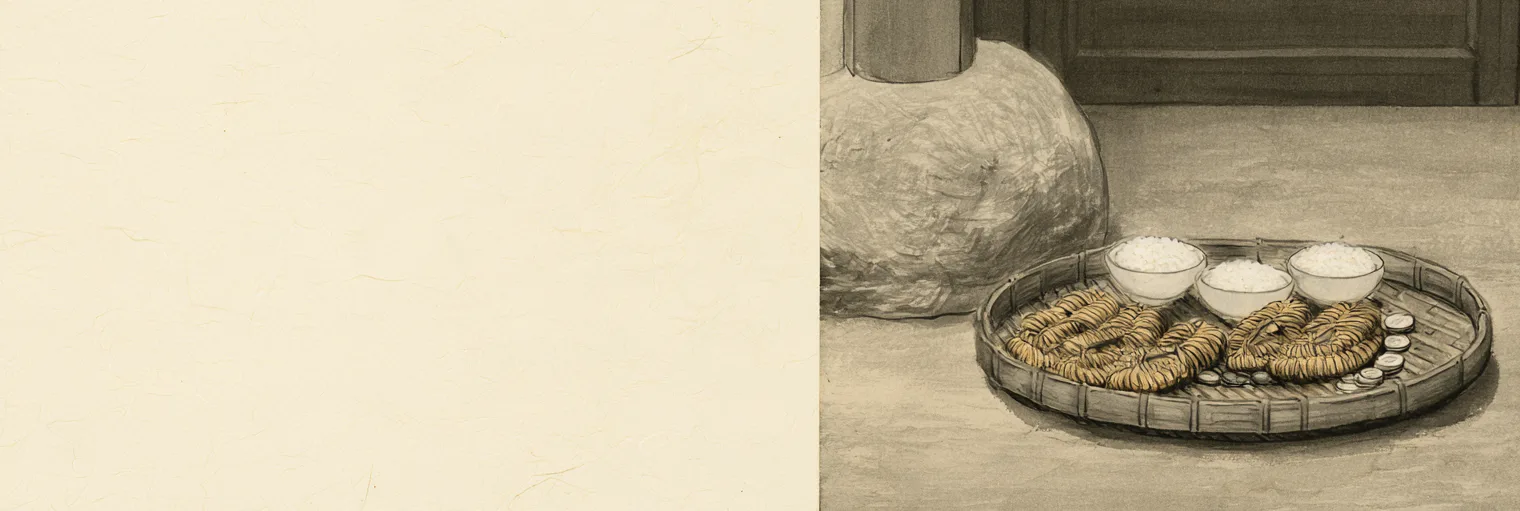
The encyclopedia records what happens next. Right after the death, the household sets out a meal for the messenger to eat, and it sets it outside the gate. Koreans call this meal saja-bap (사자밥), "the messengers' meal."
The folk museum's dictionary describes the table. The family thinks that three messengers are coming to take the soul away, so everything on it comes in threes: three bowls of rice, three coins, three pairs of straw sandals. They are laid on a straw mat, in a wicker tray, or on a table. In Seoul, the dictionary says, they go into a wicker tray, and the tray is set right beside the gate, on the outside.
Then the mourners bow twice before it, and they wail. That day the family also calls the soul back. Some families do it before they set the table, and others do it standing in front of the table.
Where the table goes depends on where in Korea you are. In Busan, the port city in the southeast, it is set in the yard, facing the gate. In southern Gyeonggi Province, the encyclopedia records, a family might lay a winnowing basket on top of a wooden mortar and put the rice, the straw sandals, and the coins in the basket. And in the city of Gwangju, the dictionary says, people cut the heels off the straw sandals before setting them out. They did it, people say, to slow the steps of the messenger who was leading the dead away.
Not every household did this. The dictionary notes that the old manuals of ritual say nothing about a table for the messengers, so families who lived as gentry did not set one. Ordinary people did, and widely. Until the 1980s most Korean funerals were held at home, and most homes set the table. Since the 1990s, as funerals have moved to funeral halls, far fewer people do.
The dictionary also says what the table is for. The living call the departing soul back to try to hold on to it. For the soul that does not come back, they turn to the messengers and ask them to take it carefully, all the way to jeoseung. The table, the dictionary says, is the funeral step that grew out of that feeling.
The encyclopedia's entry on Korean funerals records a line from the song that is sung whenever the funeral bier, the decorated frame that carries the coffin, begins to move. The line says that jeoseung was supposed to be far away, and here it is, right outside the gate.
So look again at what is on that tray, just outside the gate. Rice, coins, shoes, three of each, for the three who have come to take someone away.
Why are there three of them?
The folk museum's dictionary says it plainly: the messengers are usually three, and people called them just that, "the three messengers." The encyclopedia reckons the same number, and points to a gut, the ritual led by a mudang, a Korean shaman. In the gut for the dead of Hwanghae, a province in the west of the peninsula that is now in North Korea, three plates of rice, three pairs of straw sandals, and three sets of spoon and chopsticks are laid out for them.
The three turn up in Korea's old stories too. The folk museum's dictionary records a folktale about a man who treated the messengers well and had his life made longer for it. In the tale, three messengers arrive at dawn, eat the food he has set out, and share out the shoes among themselves.
Three guests, then, fed and given shoes. But they have come to do a job.
Is he cruel or kind?
The encyclopedia's entry on jeoseung describes the ten kings of Buddhist belief, and then it describes how their order is carried out. Two messengers, the one on duty for the day and the one on duty for the month, receive the kings' order and come to this world. They find the person's house. They call out the person's name, all three syllables of it. They bind the person in iron chains and drag them away.
The encyclopedia says of the messenger that his look is fearsome and rough, because he is the one who takes the dead before the ten kings. A professor of folklore at Andong National University told the broadcaster SBS in 2018 that the messenger of the gut is mostly portrayed as a frightening and strict being.
Now the other side, and it comes from the same people.
The encyclopedia's very next sentence reads: but not every messenger is frightening. The folk museum's dictionary writes that there are bad messengers and there are good ones too. And the same professor went on to tell SBS that at times the messenger also plays the go-between, speaking on the dead person's behalf the feelings of the one who is leaving for jeoseung.
Then there is what happens in the gut itself. The encyclopedia describes the scene. The family holding the gut blocks the messenger who has come to seize the dead. The messenger turns spiteful and makes trouble. The family hands him money and soothes him. It becomes a kind of play-fight, the encyclopedia writes, and for a moment the heavy air of a rite for the dead turns to laughter. The Hwanghae gut for the dead has a scene called "the messenger play," and the encyclopedia calls it the highlight of that gut.
The scene has a rule about place. The messenger is always hosted in the yard. The encyclopedia gives the reason: let him into the room and he will come in and not want to leave. The encyclopedia quotes Hwanghae mudang as saying that a bad messenger is full of spite, and that if he stays behind in a house, trouble follows. So the messenger is hateful, the encyclopedia writes, and yet he is hosted, not coldly, in the manner his rank calls for, out in the yard.
Korea's old stories show the same man. The encyclopedia tells of Dongbang Sak, who was born to die young, talked the messenger round, and lived three thousand years. The folk museum's dictionary records tales in which the messenger makes a mistake and someone with the same name, or nearly the same name, dies and then comes back to life. And on Jeju, Korea's southern island, there are gut that include a song telling how a living man named Gangnim became a messenger for a king of jeoseung. The encyclopedia writes that it is sung to ask the messenger not to treat the dead harshly, and to take them gently all the way.
Put the two sides next to each other. The messenger in these records is someone under orders, and what he has been ordered to do is frightening. The family could still ask him to go gently. That is what the table at the gate asks.
Where does the black hat come from?
A black coat, a black hat, a white face. Two reference works say where that picture comes from.
The encyclopedia writes that the image of the messenger, by way of a television drama called Jeonseol-ui Gohyang (전설의 고향), carries the air of a figure in a black durumagi, a long Korean overcoat, wearing a gat and white makeup. The title means roughly "the hometown of legends." It was a KBS drama that began in 1977. The encyclopedia goes on: the messenger in the black durumagi is an image that built up as Koreans experienced it, and experienced it again, in their culture and in their unconscious.
The folk museum's dictionary uses a stronger verb. Today's image of the messenger, it writes, was stamped on people's minds through that drama, where he wore a black durumagi and a gat, with his face made up pale to give a gloomy mood. This look was not made up from nothing, it adds, because it resembles the messenger that ordinary people have seen in dreams and visions.
As for the gat, the folk museum's dictionary calls it the standard hat that grown men of Joseon, the dynasty that ruled Korea from 1392 to 1910, wore when they went out. It was lacquered black, and it was made from horsehair or from bamboo split as fine as hair.
Both works then say the same thing about the gut. There, the messenger looks different. The encyclopedia writes that the messenger who appears in a gut has the look of a foot soldier. The folk museum's dictionary is more exact: a low-ranking guard of the Joseon era, who can look spiteful, unlike the dignified figure in the drama.
So Korea has pictured this man in more than one set of clothes. And in 2016, the dictionary notes, a drama on the channel tvN gave him one more: a black suit and a black fedora.
What does "saja" mean on screen?
That drama was Goblin (Korean title Dokkaebi). It ran on tvN from December 2, 2016, to January 21, 2017, and the actor Lee Dong-wook played a jeoseung saja.
Then, on June 20, 2025, KPop Demon Hunters arrived on Netflix with a boy band of demons called the Saja Boys. Angie Heo, who teaches the anthropology and sociology of religion at the University of Chicago Divinity School, explained the name to UChicago News: "Saja means lion, but it also means messenger." In the same interview she said, "the Grim Reaper is not evil."
The folk museum's dictionary writes of the picture Koreans keep of him: the messenger as a guide who leads the dead so that they arrive safely, the one who walks the road to jeoseung beside you.
The screen gave him a black hat. The old Korean house gave him rice.
How does the Cheonbugyeong write about the end?
The messenger's story gives the end a face. Someone arrives, calls a name, and a family sets rice by the gate.
Korea also keeps a scripture of eighty-one characters called the Cheonbugyeong, and its last line is about ending. The translation below follows Zexeda's commentary on the original text.
一終無終一 It ends in the One — a One that ends in Mu.
Mu (무, 無), the source before all things. Zexeda reads the line this way: everything ends in the One, and that One returns to Mu. The scripture's first line says the same thing from the other side, It begins from the One — a One that began from Mu, so the last line is the first line turned around. The end is written as a return to where everything began.
A second scripture, the Samil Singo, has a chapter called Sinhun (신훈, 神訓), the chapter on Haneunim (하느님), the Ultimate Heavenly Source. It says that praying your wishes to an absolute being outside yourself will never bring you face to face with Haneunim, and that the seed of truth is to be sought in your own nature. The article on the mudang sets that passage out in full.
The table at the gate and the last line of the Cheonbugyeong are two different things, and Zexeda does not read one into the other. The first belongs to Korea's funeral customs, told here in the words of the people who recorded them. The second is where Zexeda does its own reading, and that reading starts small.
Tonight, sit down for ten minutes, look back at one small scene from your day, and let it go.
Continue with Zexeda
If you enjoy finding the real Korea behind the stories you love, the reading continues in the Zexeda newsletter — a quiet weekly letter on Korea's ancient wisdom, one story and one small practice at a time.
Key takeaways
- The jeoseung saja (저승사자) is, in the Encyclopedia of Korean Culture's definition, the go-between said to take a person to jeoseung, the world of the dead, when they die.
- He is a messenger under orders. The encyclopedia writes that he brings the dead before the ten kings of that world, and the folk museum's dictionary records that the messengers are usually three.
- When someone died, a Korean family set saja-bap, "the messengers' meal," outside the gate: three bowls of rice, three coins, three pairs of straw sandals.
- The records give him two sides. In the encyclopedia's account of the ten kings, two messengers call a person's name and drag them away in iron chains. The same encyclopedia writes that not every messenger is frightening.
- The black durumagi, gat, and white face are the image the folk museum's dictionary says was stamped on Korean minds by the KBS drama Jeonseol-ui Gohyang. In a gut, it says, he is a low-ranking guard of the Joseon era.
- The Cheonbugyeong writes the end in one line: It ends in the One — a One that ends in Mu. Zexeda does not read the messengers' table into it.
This article is for educational and reflective purposes and shares interpretations of Korea's ancient wisdom traditions. It is not medical, psychological, or professional advice.