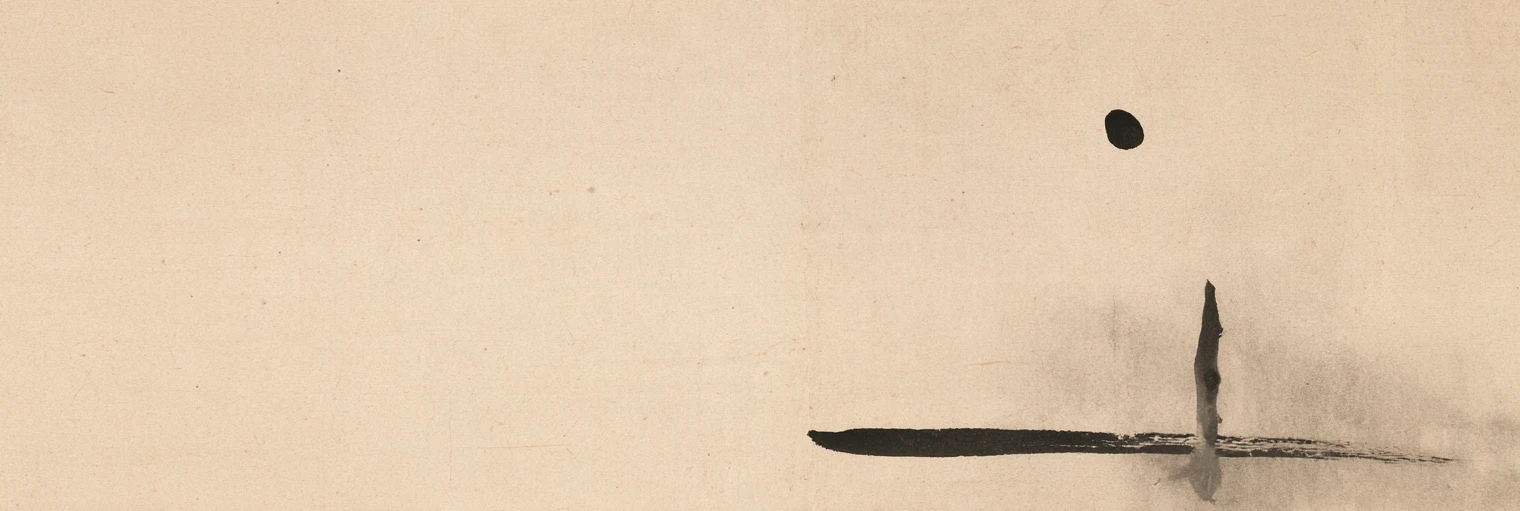
Every syllable you read in Korean is made of the same three ideas: heaven, earth and the human being. They sit inside the shapes of the vowels: a dot for heaven, a flat line for earth, and an upright line for the person standing between them. That is not a modern reading. It is what King Sejong's own explanatory book, the Hunminjeongeum Haerye of 1446, says in so many words.
And there is an older record that opens with the same three marks. The Danggun Segi says that in 2181 BCE the third Dangun had a set of 38 letters made. Today, on Hangul Day, we read both together.
Why did a king make an alphabet?
For centuries, Koreans spoke Korean and wrote Chinese. A farmer could say anything he liked to his neighbour, but he could not write a word of it down. Writing belonged to the few who had spent years learning thousands of characters made for a different language.
King Sejong, the fourth king of the Joseon dynasty, decided that this had to change. His minister Jeong In-ji wrote the afterword to the book that explained the new letters, and he put the reason in one sentence:
有天地自然之聲, 則必有天地自然之文.
Where there is a natural sound of heaven and earth, there must be a natural writing of heaven and earth.
— Jeong In-ji, afterword, Hunminjeongeum Haerye (1446)
He dates the making to "the winter of the year gyehae" — 1443 — when the king "created twenty-eight letters of correct sounds, set out the rules briefly to show them, and named it Hunminjeongeum": the correct sounds for teaching the people. The explanatory book, the Haerye, followed in 1446. Hangul Day, October 9, was fixed from the date at the book's close, the first ten days of the ninth month of that year.
The question for a king was practical. The question for us is stranger: what did he draw?
What does the Haerye say each letter is?
It says it plainly, and it begins with the mouth.
The chapter on how the letters were made — the Jejahae — states that the 28 letters "each copy their own shape." The five basic consonants are portraits of the body making the sound:
- ㄱ copies the tongue root closing the throat
- ㄴ copies the tongue touching the roof of the mouth
- ㅁ copies the mouth
- ㅅ copies the teeth
- ㅇ copies the throat
Every other consonant is built from these by adding a stroke. Then the book turns to the vowels, and it stops talking about the body and starts talking about the sky:
ㆍ舌縮而聲深, 天開於子也. 形之圓, 象乎天也. The tongue draws back and the sound is deep — heaven opening. The shape is round, copying heaven.
ㅡ舌小縮而聲不深不淺, 地闢於丑也. 形之平, 象乎地也. The tongue draws back a little and the sound is neither deep nor shallow — earth opening. The shape is flat, copying earth.
ㅣ舌不縮而聲淺, 人生於寅也. 形之立, 象乎人也. The tongue does not draw back and the sound is shallow — the human being being born. The shape is standing, copying the human being.
— Hunminjeongeum Haerye, Jejahae
(The dot, called arae-a, is no longer used in modern Korean, but the other two vowels and everything built from it are in every Korean word today.)
Then the book says what these three are for: "By copying heaven, earth and the human being, the way of the three powers is complete." It adds that heaven comes first among the three, just as the dot comes first among the three base vowels. And it shows how the rest of the vowels are made by joining them. ㅗ is the dot joined to the flat line, and the book says it takes the meaning of heaven and earth first meeting. ㅏ is the upright line joined to the dot, and the book says it takes the meaning of the working of heaven and earth showing itself in things, and waiting for the human being to complete it.
Read that last phrase again. In the book's own account, the person is the one who completes the meeting of heaven and earth.
Who was Eulboreuk, and what is Garimto?
Now go back more than three thousand years, to a different book.
The Danggun Segi (단군세기, 檀君世紀) is the chapter of the Hwandan Gogi that walks through the reigns of the forty-seven Danguns, the rulers of Korea's first kingdom. Its entry for the third Dangun, Garuk (가륵, 嘉勒), tells of a court official named Eulboreuk (을보륵, 乙普勒), whom the chronicle titles samnang. In Garuk's first year the Dangun summoned him and asked about the way of the spirit and the way of rulers, and he answered at length. In the second year, the chronicle records something else:
時俗尙不一, 方言相殊, 雖有象形表意之眞書, 十家之邑語多不通, 百里之國字難相解. 於是, 命三郞乙普勒, 譔正音三十八字. 是爲加臨土.
The customs of the time were still not one, and the speech of each region differed. Even though there was a true script that showed meaning by copying shapes, in a town of ten households the speech often did not carry across, and in a country of a hundred li the writing was hard to read. So he commanded the samnang Eulboreuk to compose thirty-eight letters of correct sound. These were Garimto.
— Hwandan Gogi, Danggun Segi, third Dangun Garuk, year 2 (2181 BCE by the chronicle's count)
Listen to the problem it describes. People who live a few miles apart cannot read one another. There is a writing that draws pictures of things, but it does not carry the sound of the voice. So a script is made by sound — "correct sound," 正音, the very two characters that begin the title of King Sejong's book 3,600 years later.
The chronicle then prints the 38 letters. In the edition in this site's library, the table opens with a dot, an upright stroke, and a flat stroke. The same book spells the name two ways — Garimto (加臨土) here and Garimda (加臨多) in its later chapter on the sacred sodo ritual grounds — and in that later chapter, right after saying that one breath holds three spirits, it adds that the origin of letters holds the meaning of containing, gathering, holding and returning.
What do the two records share?
Put the two books next to each other and the same shape appears in both.
A problem. Sound has no writing, and people cannot read one another. In the Danggun Segi it is a country whose towns cannot understand each other's script. In the Haerye it is a country whose farmers cannot write their own words.
A method. Make the letters from sound — from the real organs and breath of speech.
A set of three. The oldest Korean scriptures are built on it. The Cheonbugyeong — Korea's 81-character scripture — gives the order heaven first, earth second, the human being third (天一一 地一二 人一三). The Danggun Segi's own chapter on the sodo grounds says that one breath holds three spirits. And the Haerye's vowels — the round, the flat, and the standing — are that set drawn as three strokes.
Zexeda reads these as one thread. The Haerye does not mention Garimto, and its authors explain their three vowels in the language of yin, yang and the five phases. The Danggun Segi does not say what the 38 letters looked like beyond the table it prints. But a reader who knows the Cheonbugyeong will find nothing foreign in a script whose first marks are a dot, an upright and a flat stroke — and will notice that when Sejong's court made its alphabet, it began from the same three.
Sejong's own critics saw an old script in his letters. When a group of scholars led by Choe Man-ri sent the king a memorial against the new alphabet in 1444, they granted that the letter shapes copied the ancient seal script — and objected that the way the letters were sounded and joined had no precedent. Jeong In-ji's afterword says the same of the shapes: they copy forms, and the letters imitate ancient seal script (象形而字倣古篆).
What does this leave us?
Here is the part of the story you can do yourself.
Write the letter ㅏ, the a in han (한), Korea (한국) and hangul (한글). It is an upright line — a person — with a small dot at its side. By the Haerye's own reading, that is the working of heaven and earth, waiting for the human being to complete it. Write ㅗ and you have the dot resting on the flat line: heaven and earth meeting for the first time.
Every syllable of Korean you will ever read is built the same way. A person between sky and ground, with the sounds of the mouth around them.
Whether you read Garimto as the older script or the older idea, the lesson of Hangul Day stays the same. A people who could not write their own voice decided that writing should begin from the same place their oldest scriptures did — and then taught it to everyone. Hangul comes with its makers' own book, which says why every letter looks the way it does. The reasons are right there on the page: heaven is round, earth is flat, and the person stands.
Continue with Zexeda
If a line like heaven is round, earth is flat, and the person stands has stayed with you, the reading continues in the Zexeda newsletter — a quiet weekly letter that takes Korea's ancient wisdom one line, and one small practice, at a time. You are welcome to walk along.
Key takeaways
- King Sejong had Hangul made in the winter of 1443; the explanatory book, the Hunminjeongeum Haerye, followed in 1446. Hangul Day, October 9, is fixed from the date at its close.
- The five basic consonants copy the organs of speech: the tongue root closing the throat (ㄱ), the tongue at the palate (ㄴ), the mouth (ㅁ), the teeth (ㅅ) and the throat (ㅇ).
- The three base vowels copy heaven, earth and the human being: the round dot (ㆍ), the flat line (ㅡ) and the upright line (ㅣ). The book says that by copying them, "the way of the three powers is complete."
- The other vowels are built by joining the three: ㅗ takes the meaning of heaven and earth first meeting; ㅏ, of the working of heaven and earth waiting for the human being to complete it.
- The Danggun Segi records that in 2181 BCE (by the chronicle's count), in the second year of the third Dangun Garuk, the official Eulboreuk composed 38 letters called Garimto, because speech and writing differed town to town.
- The table printed in the Hwandan Gogi opens with a dot, an upright stroke and a flat stroke — the same three marks the Haerye names as heaven, earth and the human being. The Haerye does not mention Garimto; Zexeda reads the two records together.
This article is for educational and reflective purposes and shares interpretations of Korea's ancient wisdom traditions. It is not medical, psychological, or professional advice.