Koreans were called the white-clad people — baegui minjok (백의민족, 白衣民族), a phrase you will also see translated as the white-clothed people. The name is easy to explain and easy to get wrong. The usual guesses are that white was cheap, or plain, or a colour of mourning. But Korea's own texts have an answer, and it is stranger and older than any of those: the earliest white in this story is not cloth at all. It is grass.
One man tore up a handful of it, tied it around his body, and made a promise. Everything else — a yearly rite, a boy sent to pray, a whole country in undyed cotton, and finally the name of a people — hangs off that one gesture.
Why is everyone wearing white?
Start with what you have probably already seen. If you know one Korean word for clothing it is hanbok, and the hanbok that turns up in photographs and on stage is usually a bright thing — deep reds, jade greens, a skirt like a bell. Then you watch a Korean historical drama, and something else is going on in the background. The ministers are in colour. The people behind them are in white. Farmers, mothers, village elders, a crowd on a road: white, and not the white of a special occasion, but the white of every ordinary day.
It is easy to reach for a practical reason. Undyed cloth is cheaper than dyed cloth. But cheapness explains one poor household. It does not explain why a colour became a national description, and it does not explain what the oldest Korean account of white actually shows you, which is a man in a field with no cloth in his hands at all.
Outsiders noticed the white early, and one of them left behind the detail that gives the game away. The Sanguozhi (삼국지, 三國志), a Chinese history compiled in the third century, describes Buyeo — a kingdom on the northern plains, older than the Three Kingdoms that came after it — in a single sentence that has two halves:
在國衣尙白, 白布大袂, 袍·袴, 履革鞜. 出國則尙繒繡錦罽. "At home their clothing honours white: white hemp, wide sleeves, robe and trousers, leather shoes. Going abroad, they favour silk, embroidery, brocade and felted wool." — Sanguozhi, Wei shu 30, Account of the Eastern Barbarians, Buyeo
Read those two halves next to each other. White was not the clothing they wore to be seen in. When they went out to be looked at by foreigners they put on brocade, the way anyone dresses up. White was what they wore at home, among their own — which is to say, white was never a display. It was the clothing of being where you belong.
The same Chinese history says of Goguryeo that its people were clean, and of the Byeonjin states in the south that their clothing was clean and plain; the later Suishu records that the people of Silla honoured white in the colour of their clothes. The habit did not stop with antiquity either. When the envoy Xu Jing visited Goryeo in 1123, he wrote in the Gaoli tujing that the king wore a black headband and a white ramie robe, and so looked no different from his people.
That is the outside view, and it is consistent for a thousand years. But it tells you that, not why. There is a Korean text that records where the habit begins, and what appears in it is not a robe.
An old man and a handful of white grass
The text is the Budoji (부도지, 符都誌), transmitted under the name of Bak Je-sang (박제상) of Silla. It opens long before any kingdom, in a walled city where the Budoji says people first lived, fed by a spring that ran with something the text calls milk.
Two sentences of background are all you need, because this part belongs to another article. One day a man called Jiso (지소, 支巢) went to the spring, gave up his turn five times over to the people behind him, climbed back up faint with hunger, and ate grapes off the vine at his railing. He liked what it did to him and said so, and others tried it, and something in people changed — hearing, sleep, temper, the way a body ends. The Budoji calls that the trouble of the five tastes. Jiso caused it. Remember his name, because the man this article is about did not.
Then the walls broke. People who had left the city came back and dug under the foundations to reach the spring, and the spring ran out four ways and turned to hard ground. Inside, the milk dried up. People began snatching at grass and fruit, and the clear thing the city had been became muddy.
Somebody had to answer for it. The one who stepped forward was the eldest person there.
黃穹氏ㅣ爲諸人之長故로 乃束身白茅하고 謝於麻故之前하야 自負五味之責하여 立誓復本之約이러라. "Because Hwanggung was the eldest of them all, he bound white grass about his body, made his apology before Mago, took the responsibility for the five tastes upon himself, and swore the vow of going back to the origin." — Budoji, chapter 8
Four things are happening in that one sentence, and each of them is easy to skid past.
He was the eldest — that is the whole reason given. Not the guilty one, not the ruler, not the priest. The text says because he was the eldest of them all, and everything that follows comes out of that. Hwanggung (황궁, 黃穹) — not to be confused with Hwanung, the sky-figure of Korea's founding story, who belongs to a later chapter of this tradition — carried a wrong he had not committed, because he was the grown-up in the room.
He apologised before Mago (마고, 麻姑), the ancestral figure at the head of the Budoji's account, and then took the responsibility onto himself in so many words.
He swore bokbon (복본, 復本) — going back to what we came from. This is the load-bearing word of the whole tradition, and it turns up everywhere in Dangun's story, usually in the longer form undo the delusion and go back to the origin. Here it is spoken for the first time, by an old man, out loud.
And he bound white grass about his body. Not on his head, and not over his shoulders as a garment. 束身 — bound the body. He tied the promise on.
What happened immediately afterwards tells you how seriously he meant it. He handed out tokens, taught people how to feed themselves on arrowroot, and sent them out through the four gates of the city — one household east, one west, one south. He took the last direction himself.
黃穹氏ㅣ率眷出北間之門하야 去天山洲하니 天山洲는 大寒大險之地라. 此는 黃穹氏ㅣ自進難하야 忍苦復本之盟誓러라. "Hwanggung led his household out through the northern gate and went to Cheonsanju, and Cheonsanju was a land of great cold and great danger. This was Hwanggung: going into hardship of his own accord, an oath to endure it until the going back was done." — Budoji, chapter 8
Nobody assigned him the cold. He picked it. And the Budoji keeps him to it: in the next chapter but one, when he reaches that land, the first thing he does is swear the same vow again and tell the people with him to get to work.
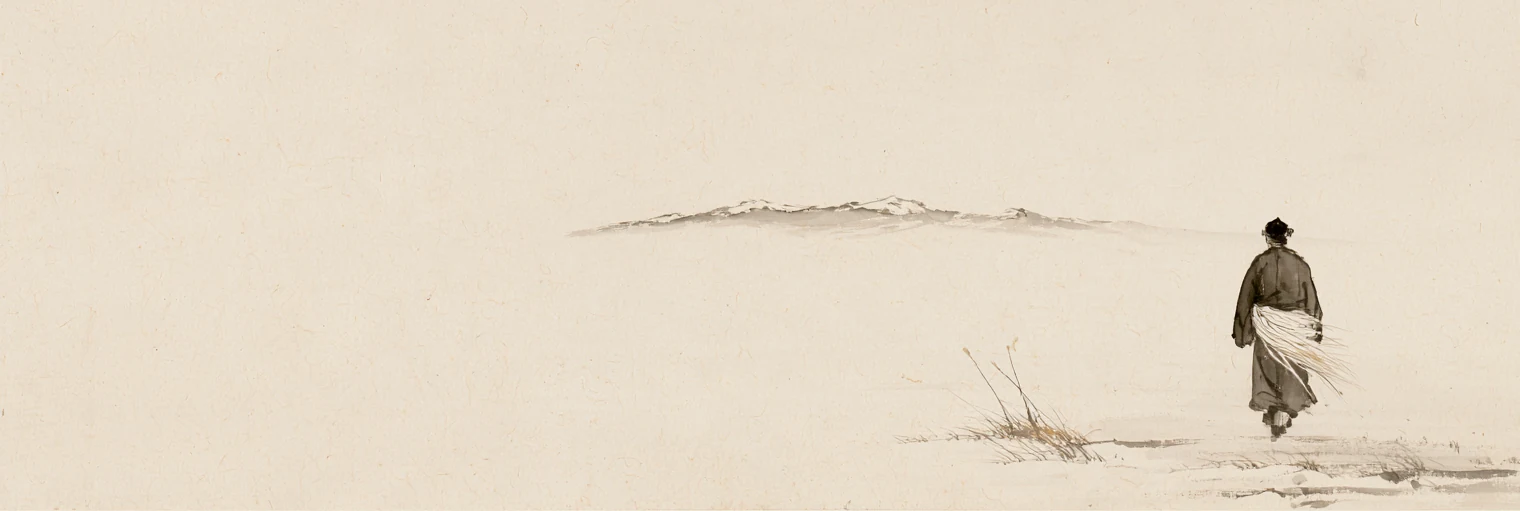
So here is the picture to hold on to. An old man with dry grass tied round his middle, apologising for something he did not do, walking north into the snow while everyone else goes somewhere warmer.
Not cloth, but a plant — and the rule underneath it
The word in the original is 백모 (白茅), white grass. It is cogongrass, an ordinary field grass whose flower heads open silvery white, and you can pull up a handful of it in about four seconds. There is no weaving in this scene, no dyeing, no tailor and no ceremony robe. There is a man reaching down and taking hold of whatever was growing next to him that was white.
That is why this detail matters more than it looks. The white came first and the clothes came later. Cloth is what a promise made of grass turned into, once there were looms and centuries. Read it the other way round — white robes first, meaning invented afterwards — and you get a colour preference. Read it in the order the text gives it, and you get a vow with a piece of grass tied round it.
And the colour was not arbitrary, because in these records white is what you choose when you are handing something upward. The Gyuwonsahwa (규원사화, 揆園史話), a history of Korea's earliest ages, says that for the yearly offering to heaven a white ox was picked in advance and kept under care until the day, and traces the name of Baekdu — white head, the mountain on Korea's northern border — back to that offering; this site's article on Korea's oldest festivals follows that whole day in detail. Even the mountain kept the theme: the Hwandan Gogi notes that Baekdu has had white deer, white pheasants and white hawks on it from of old.
A white animal for the sky. A white head on the mountain. White grass tied round a man who is about to promise something. In these texts white is not a taste. It is the colour of the direction you are facing.
A thousand years later, the vow had a date
Now jump forward. Silla was the southeastern of Korea's Three Kingdoms — Goguryeo, Baekje and Silla, who divided the peninsula between them for most of the first millennium — and its first ruler was Hyeokgeose (혁거세, 赫居世).
The Budoji devotes a chapter to what he did. He revived the old market-and-rite system, built a sacred precinct on a southern Taebaek mountain with an altar at its centre and guard-altars at the four quarters, and performed a rite of cleansing there; this site's article on Chuseok follows that paragraph, and readers of Korean Seondo will know the rite by its Korean name. Then comes the line this article has been walking toward.
"Every year in the tenth month he held the white-robe rite, and this was to follow the meaning of Hwanggung binding white grass about his body." — Budoji, chapter 29
Read it twice, because it does something no other line in Korean literature does. It gives the reason for wearing white, and the reason is not comfort, thrift, mourning or taste. It is inheritance. The rite has a name — baegui-je (백의제, 白衣祭), the white-robe rite — and the text explains it by pointing back across roughly a thousand years of its own story to a man in a field with grass around his waist. The phrase it uses, 속신백모지의 (束身白茅之義), is the meaning of binding white grass about the body: the same four characters that appear in chapter 8, carried forward on purpose.
Notice also when he held it: the tenth month — the month in which Korea's old kingdoms stopped work and made their great offering to heaven. The white and the thanksgiving were on the same day.
A child in white, sent to speak to the sky
One more record, and it comes from a completely different direction.
The Danggun Segi (단군세기, 檀君世紀) is the chronicle that lists the Dangun rulers one at a time — because Dangun in this tradition is not one man but a line of them, forty-seven in all. Its entry for the first year of the twenty-eighth ruler is two clauses long.
庚戌, 元年(BC971) 帝有疾, 使白衣童子禱天, 尋瘉. "First year, the year gyeongsul. The ruler fell ill, and a boy dressed in white was set to pray to heaven; he soon recovered." — Hwandan Gogi, Danggun Segi, twenty-eighth Dangun, Haemo
That is the entire entry. It does not say why the boy was in white, and it does not need to. What it shows is that in a text from a different line of transmission than the Budoji, when somebody had to be sent to stand between a people and the sky, the one detail worth recording about him was the colour of what he had on.
White was not a fashion in these records. It was a position.
The government that organised parades against a colour
By the twentieth century the white had been on Korean backs for as long as anybody had been writing things down. The clearest evidence of what it had come to mean is not a text at all. It is a flag, and it was made by people who wanted the white gone.
Under Japanese rule the colonial government ran a campaign called saekbok jangnyeo (색복장려, 色服奬勵) — the promotion of coloured clothing. Its stated case was practical and modern-sounding: white shows dirt, washing it costs time and labour, and dyed clothing is cheaper, more rational and more modern. The machinery behind that argument was not modest. Through the 1930s handbills went out house to house and were pressed on crowds at market; schools sent notices home with the children; dye was bought in bulk, communal dyeing stations were set up and dyeing classes were held. Processions moved through markets, villages and city streets behind a band and a flag, joined by county and township officials, school and religious groups, and local worthies. Alongside all of that ran the blunt end of it: people in white were refused entry to government offices, cut out of rationing, and had dye or ink thrown at them on market days. The campaign ran into the 1940s.
One of those flags survives. It is black cotton with a single word cut out of it in white — 색복, coloured clothing — and it is now held at the National Women's History Exhibition Hall in Goyang, registered as national heritage in 2014.
Sit with the shape of that. A government organised parades to stop people wearing a colour. Whatever white was by then, it was not a laundry preference.
The Korean writer Yu Chang-seon made that point at the time, in a two-part essay called Baegui-go — a study of white clothing — in the Dong-a Ilbo on 2 and 7 April 1934. Colonial scholars were then explaining Korean white as backward dyeing technology, poverty, state clothing controls, or a nation habituated to mourning. Yu answered them on their own ground. Korea had used dyes of many kinds from early on, he wrote, so it would not have worn something so plain without a reason to. White is not the thrifty choice at all — it is the expensive one to keep, which is precisely why a campaign was needed to talk people out of it. And if state prohibition were the cause, that made no sense either: looking only at the decrees, white had been the thing repeatedly banned.
What is left today
The name sits at the end of that whole line. Baegui minjok is three words: baek (백, 白) white, ui (의, 衣) clothing, minjok (민족, 民族) a people. A people of white clothes. In English it comes out as the white-clad people, and sometimes as the white-clothed people; both are the same Korean phrase. It was never a costume anyone was assigned. It is a description that stuck to a habit — what Korean writing calls baegui hosang (백의호상, 白衣好尙), the preferring of white — and under occupation people wore that habit deliberately, as a way of showing plainly who they were.
None of that changed where the white came from. It was a plant before it was a fabric, and a promise before it was a name.
And the promise is the part that survived best, because it went home with people. The state altar became a low table in a family room, and the tenth-month rite became the ordinary Korean instinct to put on something clean before you bow to somebody who is no longer here — which is what a Chuseok morning still looks like.
So here is the small thing to take from a four-thousand-year-old handful of grass.
Tomorrow morning you will put something on. Before you choose it, settle one question that has nothing to do with how it looks: what do you intend to be facing today? Then get dressed as though that were the reason. Nothing happens because of the clothes. That is the point — Hwanggung's grass did not keep him warm and did not make him grand. It made a promise visible, first of all to the man wearing it.
Readers of the Samil Singo will recognise the shape of what he swore. Banmang jeukjin — the false, turned back, becomes true. Going back is not a journey to some other place. It is a turn made where you are standing, in whatever you happen to have on.
Continue with Zexeda
If you would like to keep reading in this direction, the Zexeda newsletter is a quiet weekly letter that takes Korea's ancient wisdom one line, and one small practice, at a time. You are welcome to walk along.
Key takeaways
- Koreans were called baegui minjok (백의민족, 白衣民族) — the white-clad people, also rendered the white-clothed people. The words are simply white + clothing + a people.
- Outsiders recorded the white early — and recorded when Koreans did not wear it.* The third-century Sanguozhi says of *Buyeo: 在國衣尙白 — at home their clothing honours white — but 出國則尙繒繡錦罽, going abroad, they favour silk, embroidery and brocade. White was not the clothing you dressed up in. It was what you wore among your own.
- The oldest Korean record of white is not about clothing. The Budoji (부도지, 符都誌), chapter 8, describes 백모 (白茅), white grass — the field grass known in English as cogongrass — being torn up and tied on.
- The man who tied it on was Hwanggung (황궁, 黃穹), and the reason the text gives is that he was the eldest: 爲諸人之長故. The trouble had been caused by someone else, a man called Jiso. Hwanggung answered for it because he was the grown-up.
- 束身白茅 means bound white grass about the body — not the head, and not worn as a robe. What he tied on was a promise.
- The promise was bokbon (복본, 復本), going back to what we came from — the same vow that runs through Dangun's story as undo the delusion and go back to the origin.
- He then chose the hardest direction for himself: the Budoji says the northern land he walked into was 大寒大險之地, a place of great cold and great danger, and that he went into hardship of his own accord.
- A thousand years later the vow had a date. Budoji chapter 29 records Hyeokgeose, the first ruler of Silla, holding the white-robe rite (백의제, 白衣祭) every year in the tenth month — and states the reason: it followed 속신백모지의, the meaning of binding white grass about the body.
- White is the colour of what goes upward in these texts. The Gyuwonsahwa records a white ox chosen and kept for the yearly offering to heaven, and traces the name Baekdu, white head, to it — the day itself is in Korea's oldest festivals.
- A second, independent witness. The Danggun Segi entry for the twenty-eighth Dangun, Haemo, records that when the ruler fell ill a boy dressed in white (白衣童子) was set to pray to heaven. The record does not explain the colour, which is exactly why it is worth having.
- A colonial government campaigned to end it. Under Japanese rule the saekbok jangnyeo (색복장려, 色服奬勵) campaign pushed dyed clothing through the 1930s with handbills, dyeing classes and processions behind a band and a flag, while people in white were refused entry to government offices, cut out of rationing, and had dye or ink thrown at them at market. In the Dong-a Ilbo of 2 and 7 April 1934, Yu Chang-seon answered the colonial explanations directly: white was never the thrifty choice — keeping it white was the costly one, which is why a campaign was needed to talk people out of it.
- So white was not about being clean. It was what a vow looked like from the outside — a plant before it was a fabric, and a promise before it was the name of a people.
This article is for educational and reflective purposes and shares interpretations of Korea's ancient wisdom traditions. It is not medical, psychological, or professional advice.