The Korean flag is called the taegeukgi (태극기, 太極旗) — gi simply means flag. It has three parts, and each one has a meaning. A white field stands for brightness, purity and a people who have long loved peace. The red-and-blue circle in the middle, the taegeuk, stands for the harmony of yin and yang (eum and yang in Korean), the two forces that make and move all things. The four black trigrams in the corners stand for the sky (or heaven), earth, water and fire.
That is how South Korea's Ministry of the Interior and Safety explains it on its official page about the national flag. Its explanation is the official one, and this article follows it closely.
You have probably seen the flag already — waved in a concert crowd, raised over an Olympic podium, printed on the first page of a Korean textbook. What the official explanation does not show you is a scene: the flag being made, by one man, on a ship. The circle and the trigrams are very old. The flag is young. It was drawn in the 1880s, when Korea needed a face to show the world, and the people who drew it chose to put balance on that face.
Who made the first Korean flag?
The ministry tells the story from a travel record.
In 1882, King Gojong, who ruled Korea at the time, sent an envoy to Japan named Park Yeong-hyo. Park kept a record of the mission, the Sahwagiryak. According to that record, as the ministry gives it, in September 1882 Park made a flag on board the ship. In the middle he put the taegeuk circle. Around it he drew trigrams — not all eight of the old set, but four: geon, gon, gam and ri. He flew the flag from the 25th of that month, and on October 3 he reported to the government at home what he had done.
Korea's national encyclopedia, the Encyclopedia of Korean Culture, fills in a little more. It writes that Park sailed on the Meiji Maru, talked the design over with the ship's British captain, and had the flag made in three sizes: large, medium and small.
So the first flag whose making we can follow in the records was not handed down from a distant age. A man on his way to a foreign capital needed something to fly, and he decided what it would show.
Why did Korea need a flag at all in 1882? The ministry gives the reason. Countries had begun to use national flags as modern states grew, and the direct occasion for Korea's was a treaty: the treaty of friendship and trade with the United States, signed on May 22, 1882. No exact record survives of the flag raised at that signing, the ministry writes. It then records the claim that a flag printed in Flags of Maritime Nations, a book made by the U.S. Navy's Bureau of Navigation and brought to light in 2004, shows the original form of the flag used at the ceremony.
The design that lasted is the one Park flew: a circle, and four trigrams around it.
What does the circle in the middle mean?
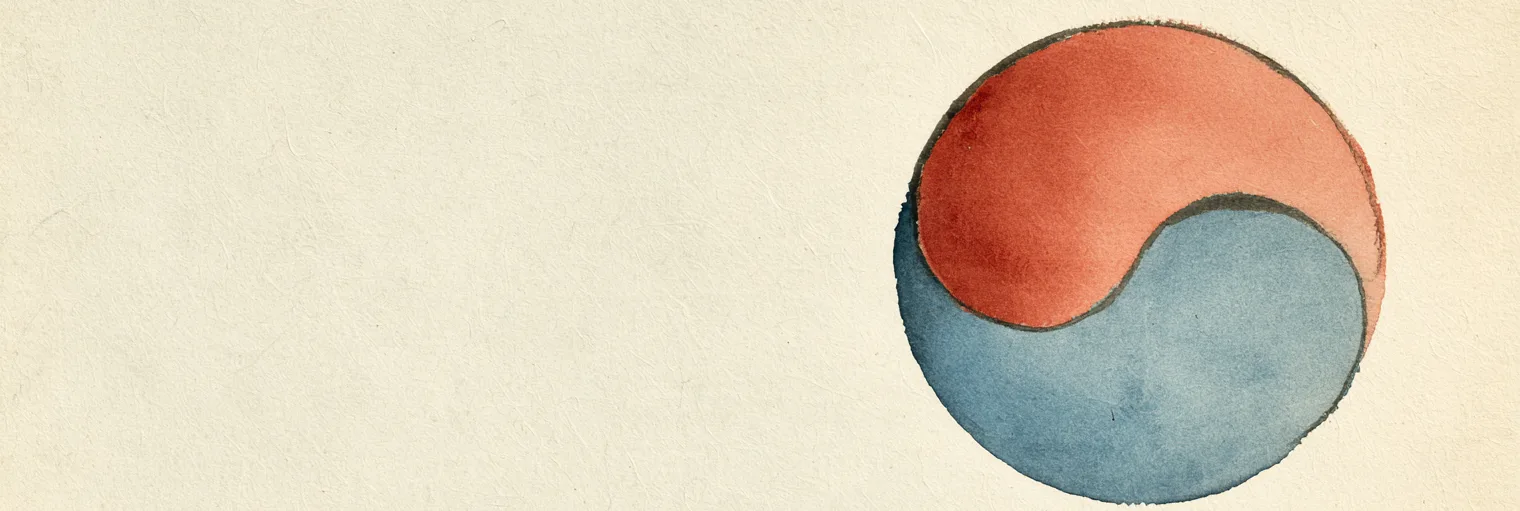
Look at the center of the flag. It is a single circle, split by an S-shaped line into two halves, and each half curls into the other like two commas chasing each other's tails. The encyclopedia records that the red half sits on top and the blue half below. The scholar who wrote its entry on the flag reads that order plainly: red is yang and sits above, blue is yin and sits below, because heaven is above and earth is below.
The circle is the taegeuk (태극, 太極). The two characters mean great and ultimate.
The ministry explains it in one sentence: the taegeuk stands for the harmony of yin (blue) and yang (red), and pictures the truth of nature that all things come into being and grow through the interplay of the two.
Notice what the circle does not show. Neither half is winning. The red does not push the blue off the edge; each reaches into the other's side and is held there. Korea's national encyclopedia describes yin and yang as an old frame for explaining all kinds of things in the world, and the circle draws that idea as a single shape. It is a picture of a relationship, not of a contest.
What do the four black bars mean?
The black bars in the corners are trigrams — signs made of three lines stacked on top of each other. Some lines are whole, some are broken in the middle. You can read each one by eye:
| Trigram | Name | Lines | Official meaning | Place on the flag |
|---|---|---|---|---|
| ☰ | geon (건, 乾) | three whole lines | the sky, or heaven | upper left |
| ☷ | gon (곤, 坤) | three broken lines | earth | lower right |
| ☵ | gam (감, 坎) | broken, whole, broken | water | upper right |
| ☲ | ri (이, 離) | whole, broken, whole | fire | lower left |
The meanings come from the ministry: geon stands for heaven, gon for earth, gam for water, and ri for fire. The places come from the encyclopedia, which sets out how the flag is drawn.
The ministry also explains what the lines are doing. The four trigrams, it writes, show yin and yang changing into each other and growing, through combinations of broken and unbroken lines. A whole line is yang; a broken line is yin. And the four, the ministry adds, keep a unified harmony around the circle at the center.
Now look at where each trigram sits, and you can see that harmony for yourself. Heaven in the upper left looks diagonally across the circle at earth in the lower right. Water in the upper right looks across at fire in the lower left. And each pair is a perfect reversal. Heaven's three whole lines become earth's three broken ones. Water's broken–whole–broken becomes fire's whole–broken–whole. Every line flips.
Zexeda reads the corners as saying again, in lines, what the circle says in color. Two halves of the circle hold each other in the middle; two pairs of opposites face each other across the corners. Nothing on the flag stands alone, and nothing has an enemy.
Where did the symbols come from?
The ideas behind the circle and the trigrams are much older than Korea's flag. The word taegeuk and the eight trigrams come from the Book of Changes, the old Chinese classic known in English as the I Ching.
The Encyclopedia of Korean Culture traces the word taegeuk to a commentary in that book, which says that in change there is the taegeuk, and that it gives birth to the two forms — yin and yang. From those two the unfolding goes on to four images, and then to the eight trigrams. The encyclopedia's entry on the flag adds that the Book of Changes uses the word but draws no picture of it. In China the drawn pattern appears in the Song dynasty, with the thinker Zhou Dunyi (1017–1073), who wrote a book explaining the taegeuk diagram.
The same entry then turns to Korea. It records a taegeuk figure among the stone carvings of Gameunsa, a temple of Unified Silla, the Silla kingdom in the years after the Three Kingdoms, near its capital, Gyeongju. Korea's national heritage agency records that King Sinmun completed the temple in 682, carrying out the wish of his father, King Munmu. The entry on the flag also records a taegeuk pattern cut clearly into the lid of the stone coffin of Heo Jae, an official who died in 1144.
The ministry puts the same thought more simply: the flag was built around a taegeuk pattern that Korean ancestors had long used and loved in everyday life.
That gives the honest shape of the story. The ideas were shared across East Asia, and they were at home in Korea for centuries before any flag. What the flag did was choose. Out of the eight trigrams, the ministry records, the flag drew four — heaven, earth, water and fire — set them around a single circle, and laid the whole thing on white.
Why is the Korean flag white?
The ministry explains the white field in its own words: it stands for brightness and purity, and for a people who have long loved peace.
White has a long story of its own in Korea — you can read about the white clothes Koreans once wore. The flag's white is the ground everything else stands on. The circle and the trigrams are drawn onto it, and the space around them is left open and clean.
When did the taegeukgi become Korea's flag?
The ship was in 1882. The proclamation came the next year. On March 6, 1883, the ministry records, King Gojong proclaimed the taegeuk-and-four-trigram flag the national flag by royal order.
The order did not say exactly how to draw it. So for decades, the ministry writes, many different versions of the flag were in use. On June 29, 1942, Korea's Provisional Government, the government in exile, issued a unified style to bring the versions together, but it never became widely known among ordinary people.
When the government of the Republic of Korea was established on August 15, 1948, the need for one standard grew. In January 1949 the government formed a committee to correct the flag, and on October 15, 1949, it fixed and announced the rules for making it. The flag you see today follows those rules. The government's English-language page on the flag adds that the Act on the Flag of the Republic of Korea was enacted in 2007.
Today the flag goes up on Korea's national holidays — on National Foundation Day every October 3, for example, offices and schools close and flags go up.
What can the flag teach us about balance?
Go back to the man on the ship in 1882. He could have put almost anything on that cloth. What went on it was a circle where two halves hold each other, and four signs that each face their opposite without trying to cancel it.
Zexeda reads that circle beside a line of the Korean scripture called the Cheonbugyeong, 天二三 地二三 人二三, in which each of the three has already opened into two — heaven as day and night, earth as sea and land, the human being as woman and man — and the two in each pair work on each other until the three take shape, while the one root they all grow from never runs out.
You can try the circle on a small scale tonight. Sit down for ten minutes, look back at one moment from your day when you felt pulled between two sides, and hold both halves in view without letting either one win. If you would like a simple way to begin, here is a ten-minute Korean evening practice for beginners.
Continue with Zexeda
If you enjoy finding the meaning behind the Korea you already love, the reading continues in the Zexeda newsletter — a quiet weekly letter on Korea's ancient wisdom, one story and one small practice at a time.
New subscribers get a free PDF: A K-Drama Fan's Glossary of Korea's Ancient Words.
Key takeaways
- The Korean flag, the taegeukgi, has three parts: a white field, a red-and-blue circle (the taegeuk), and four black trigrams.
- South Korea's Ministry of the Interior and Safety explains that the white stands for brightness, purity and a love of peace, and the circle for the harmony of yin (blue) and yang (red).
- The four trigrams are geon, gon, gam and ri — heaven, earth, water and fire. Each sits diagonally across from its opposite, and every line flips between the two.
- The word taegeuk and the trigrams come from the Book of Changes (I Ching). The flag drew four of the eight trigrams.
- The ministry records that the envoy Park Yeong-hyo flew the design aboard ship in 1882; King Gojong proclaimed it the national flag on March 6, 1883; its exact construction was fixed on October 15, 1949.
- Zexeda reads the circle beside the Cheonbugyeong's line on heaven, earth and the human being, each opened into two, growing from one root that never runs out.
This article is for educational and reflective purposes and shares interpretations of Korea's ancient wisdom traditions. It is not medical, psychological, or professional advice.