Buyeo (부여, 夫餘) is the name that carried Korea's first kingdom into its later ones. The Danggun Segi records that in 425 BCE the forty-fourth ruler of Dangun's Joseon renamed his state Dae Buyeo — Great Buyeo — and from that name came North Buyeo, then Goguryeo, and centuries later a Baekje that called itself South Buyeo and a Balhae that said it kept the customs of Buyeo.
So the answer to the question in the title is a little different from the one you might expect. Buyeo was not one more country standing in a gap between two others. It was the last name of the kingdom before, and the first name the kingdoms after chose to claim. This article follows that name from the moment it was given to the moment it was carved into stone.
What does a stone in Ji'an say?
Start with the stone, because it is still standing.
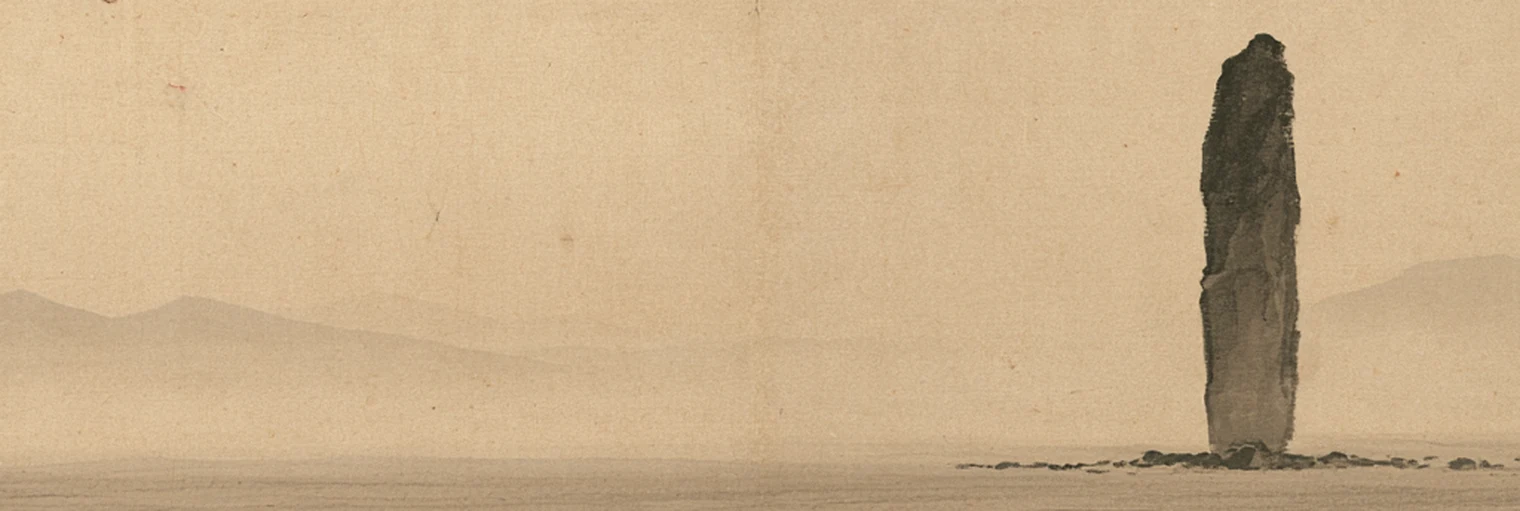
In Ji'an, a city on the Chinese bank of the Yalu River, which forms the border between China and North Korea, there is a block of rough stone 6.39 metres tall. It was raised in 414, in the third year of King Jangsu of Goguryeo (고구려, 高句麗) — the northernmost and, for a long time, the largest of Korea's Three Kingdoms — to honour his father, King Gwanggaeto, whose name means the one who widely opened the land. Most of its four faces list the king's campaigns. But before a single battle is recorded, the stone stops to say where the kingdom came from.
惟昔始祖鄒牟王之創基也, 出自北夫餘, 天帝之子, 母河伯女郎.
Long ago, when the founder King Chumo laid the foundation, he came out of North Buyeo. He was a son of the Lord of Heaven, and his mother was the daughter of the river lord.
— Gwanggaeto Stele, face one (414)
Chumo (추모, 鄒牟) is the founder better known today as Jumong (주몽, 朱蒙) — the archer-king whose story Korean television has told at length in the MBC historical drama Jumong. And the stone's very first claim about him is not about his courage or his conquests. It is about a place: 北夫餘, North Buyeo.
That one word, North, is the thread this whole article pulls on. A North Buyeo implies a Buyeo it was north of. What was that?
How did Joseon become Great Buyeo?
For the answer we go back more than eight centuries before the stone, to a kingdom in crisis.
Korea's first kingdom was Joseon (조선, 朝鮮) — usually called Gojoseon, Old Joseon, to keep it apart from the much later Joseon dynasty that K-drama fans know from palace dramas. Its rulers carried the title Dangun (단군, 檀君), and the first of them, Dangun Wanggeom, is remembered as the founder of the Korean nation. The Hwandan Gogi (환단고기, 桓檀古記), the collection of Korean chronicles this site works from, contains a chapter called the Danggun Segi (단군세기, 檀君世紀) that walks through the reigns of all forty-seven Dangun one by one.
Near the end of that long line, it records a disaster. In 426 BCE, in the reign of the forty-third Dangun, Mulli, a hunter named U Hwa-chung declared himself a general, gathered tens of thousands of followers and overran thirty-six districts in the northwest. The royal army could not stop him. That winter the rebels surrounded the capital. The Danggun Segi records that the ruler gathered the tablets of the royal shrine and slipped away downriver by boat with a few attendants, and died on the way.
Then a provincial governor named Gumul (구물, 丘勿) raised troops, seized the city of Jangdanggyeong, and cities along both banks of the Yalu sent soldiers to join him. The next spring a great flood came through the capital, the rebels fell into confusion, and when Gumul marched on them with ten thousand men they broke without a fight. U Hwa-chung was executed.
What happened next is worth reading slowly, because of its order:
於是, 丘勿爲諸將所推, 乃於三月十六日築壇祭天, 遂卽位于藏唐京, 改國號爲大夫餘.
At this, the generals raised Gumul up. On the sixteenth day of the third month he built an altar and offered a rite to heaven, and then took the throne at Jangdanggyeong and changed the name of the state to Dae Buyeo.
— Hwandan Gogi, Danggun Segi, forty-fourth Dangun Gumul, year 1 (425 BCE)
First the altar, then the throne, then the name. It is the same order the Danggun Segi gives for the very first Dangun, who arrived, offered a rite to heaven with the people, and only after that was made ruler. Gumul was not inventing a new kingdom. He was beginning the old one again, in the old way, under a new name.
And the name was not new either. The Gyuwon Sahwa (규원사화, 揆園史話), a Korean history written in the seventeenth century, records that when Dangun Wanggeom first divided his realm among his family, his youngest son was named Buyeo, and that the son was given lands in the west. When Gumul chose Great Buyeo, he chose a name that already belonged to the founder's own household.
The same entry records one more change. The Three Han — the three great divisions of the realm — were renamed the Three Joseons, and while all three still honoured the Dangun as the one supreme ruler, the power to make war or peace no longer rested with that one ruler alone. Great Buyeo was a looser, wider house than the Joseon before it. The following year Gumul's ritual officials asked to hold a rite called the Samsin Yeonggo-je, the Three Spirits welcoming-the-drum rite, and the ruler went in person and bowed — the ceremony we met in Korea's oldest festivals, and the one that gave its name to Buyeo's great festival.
Why did the last Dangun open the prison gates?
Great Buyeo lasted a little under two centuries. Its last ruler was the forty-seventh Dangun, Goyeolga (고열가, 古列加), and the Danggun Segi does not flatter him: he was gentle and could not make up his mind, his orders went unobeyed, his generals trusted their own strength, and the treasury ran dry.
In 239 BCE, on the eighth day of the fourth month, a man named Haemosu (해모수, 解慕漱) came down to Ungsim Mountain and raised an army.
The next year, on the evening of the spring rite to heaven, Goyeolga called together the five great ministers — the Five Ga, each named after an animal, who had advised the Dangun since the founding — and spoke to them. The Danggun Segi keeps his words:
昔, 我列聖肇極垂統, 種德宏遠, 永世爲法. 今王道衰微, 諸汗爭强. 惟朕涼德, 懦不能理 … 惟爾五加擇賢以薦.
Long ago our line of sages founded this order and handed it down; the virtue they planted reached far and became the law for all generations. Now the kingly way has grown weak, and the lords fight over who is strongest. My virtue is thin, and I am too timid to govern … You, the Five Ga, choose someone worthy and put him forward.
— Hwandan Gogi, Danggun Segi, forty-seventh Dangun Goyeolga, year 58 (238 BCE)
Then he did one more thing as ruler. He threw open the prison gates and sent home everyone held there, from those condemned to death down to the prisoners of war. The next day he laid down the throne and went into the mountains to cultivate the Way.
Hold on to that image of the open prison gates. It will come back.
For six years the Five Ga governed together. Meanwhile, the Danggun Segi records, Haemosu — himself a member of the royal clan — had taken the old capital at Mount Baegak and was being called Cheonwangnang, the young lord of the king of heaven. The Bukbuyeo Gi (북부여기, 北夫餘紀), the Hwandan Gogi's chronicle of the next kingdom, describes him the way a people remembers a hero: twenty-three years old when he came down from heaven, wearing a crown of crow feathers and a sword called Dragon Light, riding a chariot drawn by five dragons, with five hundred followers — hearing affairs of state in the morning and rising to heaven at night.
In 232 BCE he went to the old capital. The Five Ga ended their joint rule, and the people raised him up as Dangun. This, says the Bukbuyeo Gi, was the beginning of North Buyeo.
Now the word on the stone makes sense. The Danggun Segi closes its account of the forty-seven reigns with a single line — 蓋北夫餘之興始此, this is where the rise of North Buyeo began — and the Bukbuyeo Gi calls Haemosu's state Bukbuyeo (북부여, 北夫餘). The Buyeo it was named after was Great Buyeo. North Buyeo was not a rival that pushed Great Buyeo aside. It was the same house, taken up again under the same name, by a man the people themselves chose. That winter, the Bukbuyeo Gi adds, Haemosu issued a law that the state would care for pregnant mothers, teaching that every person's education begins in the womb. A new dynasty's first act was to look after the unborn.
Who was Dongmyeong?
North Buyeo's hardest years came a century later, and they came from China.
In 108 BCE the armies of Emperor Wu of Han destroyed the state of Wiman Joseon, which had seized the western part of the old realm, and set out to plant Chinese commanderies across the region. The Bukbuyeo Gi records that a man named Go Dumak-han (고두막한, 高豆莫汗) — one account in the chronicle makes him a descendant of Goyeolga — watched North Buyeo weaken and the Han grow bolder, and raised a volunteer army. He took a throne at Jolbon, and he named himself Dongmyeong (동명, 東明) — the brightness of the east.
Wherever his men went, the chronicle says, the Han armies broke and ran, and the scattered people rose to fight beside him. In 87 BCE Dongmyeong sent a message to the reigning ruler of North Buyeo: I am a son of the Lord of Heaven, and I mean to make my capital here. Make way for me. The ruler fell ill with worry and died. His brother Haeburu (해부루, 解夫婁) took the throne, and his chief minister gave him a way out: by the banks of the Tong River, he said, there was a plain called Gaseobwon, with rich soil for the five grains — move the capital there. Haeburu went, and his kingdom became known as Gaseobwon Buyeo, or Dongbuyeo (동부여, 東夫餘) — East Buyeo.
The next year Dongmyeong entered the capital at the head of tens of thousands, with drums and pipes playing before him, and kept the old name: North Buyeo.
Many readers know Dongmyeong as another name for Jumong. That comes from the Samguk Sagi (삼국사기, 三國史記), Korea's oldest surviving official history, compiled in 1145, which opens the Goguryeo annals by calling its founder King Dongmyeong the Holy and giving his personal name as Jumong. The Bukbuyeo Gi gives the name to the man who saved North Buyeo. And there is a witness more than four centuries older than the Samguk Sagi. In 702, a Goguryeo nobleman named Cheon Nam-san — a son of the great general Yeon Gaesomun — was buried in Luoyang, in China, and the epitaph carved for him begins with his ancestors' kingdom:
昔者東明感氣踰㴲川而開國, 朱蒙孕日臨浿水而開都.
Long ago Dongmyeong, moved by the energy of heaven, crossed the Sa River and opened a kingdom; Jumong, conceived of the sun, came to the Pae River and opened a capital.
— Epitaph of Cheon Nam-san (702)
Two names, two rivers, two openings. Dongmyeong opens a kingdom; Jumong opens a capital. The man who carved it wrote them as two.
Who was Jumong, and how did North Buyeo become Goguryeo?
While Dongmyeong ruled, a boy was born in East Buyeo. The Gaseobwon Buyeo Gi, the chronicle of East Buyeo, tells it with every detail of the old story: Yuhwa (유화, 柳花), a daughter of the river lord, was led away by a grandson of the Buyeo royal house; her family, furious that she had gone without a proper match, sent her into exile; the king of East Buyeo found her and kept her at court; and on the fifth day of the fifth month of 79 BCE she gave birth to an egg, and a boy broke out of the shell. At seven he was making his own bows and arrows and never missed. In the Buyeo language, the chronicle explains, a good archer was called jumong — and that became his name.
The Bukbuyeo Gi picks up the thread. Dongmyeong's son, Go Museo (고무서), ruled North Buyeo for only two years. He met with the elders at Mount Baegak, the old capital, made a covenant and offered a rite to heaven. He had no son. He saw that the young archer was no ordinary man and gave him his daughter in marriage, and when he died in 58 BCE, Jumong entered into the great succession by his last command. He was twenty-three — the same age the Bukbuyeo Gi gives Haemosu when he came down.
The most famous scene of his story belongs here. Men of Buyeo meant to kill him; at his mother's urging he fled with three companions until a river blocked the way and there was no bridge. He called out to the water: I am a son of the Lord of Heaven and a grandson of the river lord. And the fish and turtles rose to the surface and made a bridge.
A son of the Lord of Heaven: 天帝子. It is the phrase on the stone in Ji'an, 天帝之子, and it is the phrase the Samseong Gi, the opening chronicle of the Hwandan Gogi, uses when it closes its account of the whole line:
高鄒牟亦以天帝之子, 繼北夫餘而興, 復檀君舊章, 祠解慕漱爲太祖, 始建元爲多勿. 是爲高句麗始祖也.
Go Chumo, also as a son of the Lord of Heaven, took up North Buyeo and rose. He restored the old statutes of the Dangun, honoured Haemosu at the shrine as the great ancestor, and began a new era called Damul. He was the founder of Goguryeo.
— Hwandan Gogi, Samseong Gi, upper part
Took up North Buyeo. Restored the old statutes of the Dangun. Honoured Haemosu as the great ancestor. Every clause of that sentence looks backward. The Danggun Segi even notes that Goguryeo was the land of Haemosu's birth — and so it too was called Goguryeo. Jumong's kingdom announced itself as a continuation — and four and a half centuries later his descendant carved the same announcement into the first line of the stone: he came out of North Buyeo.
What was life in Buyeo like?
A name is carried by people, so it is worth asking how those people lived.
The Samseong Gi sums up Great Buyeo in a few lines that read almost like a portrait of a good village:
讀書習射爲課, 祭天爲敎, 田蠶是務, 山澤無禁, 罪不及孥與民 … 男有常職, 女有好逑, 家皆蓄積, 山無盜賊, 野不見飢, 絃歌溢域.
Reading and archery were the daily lessons; the rite to heaven was the teaching; fields and silkworms were the work. The mountains and marshes were closed to no one, and punishment did not reach a wrongdoer's family … Men had steady work and women good matches; every house had something put by. There were no bandits in the hills, no hunger in the fields, and the sound of strings and singing filled the land.
— Hwandan Gogi, Samseong Gi, upper part
Outsiders saw a good deal of the same thing. The Sanguozhi (삼국지, 三國志), a Chinese history compiled in the third century, has a whole section on Buyeo, and its writer was struck by the manners. At meals the people of Buyeo used ritual dishes, toasted and rinsed their cups for one another at gatherings, and bowed and made way for each other going in and out. At home they wore white — broad-sleeved robes and trousers of white cloth — though abroad they dressed in silk and embroidery, a contrast we followed in why Koreans wore white. The nobles decorated their hats with gold and silver. When an interpreter passed on a message, he knelt and put his hands on the ground and spoke softly.
And every year there was the festival:
國中大會, 連日飲食歌舞, 名曰迎鼓. 於是時斷刑獄, 解囚徒.
The whole country gathered in a great assembly, eating, drinking, singing and dancing for days on end, and it was called Yeonggo. At that time they halted trials and punishments and set the prisoners free.
— Sanguozhi, Wei shu 30, Account of the Eastern Barbarians, Buyeo
Yeonggo (영고, 迎鼓), welcoming the drum — the name of the rite Gumul had bowed at in the second year of Great Buyeo. And at the heart of the festival, the prison doors opened.
Now look back at Goyeolga on the evening of the rite to heaven, flinging open the prison gates before he laid down his throne. Zexeda reads these two moments as one custom seen from two sides: when the people stood before heaven, no one was left locked away from the gathering. A Chinese writer recorded it as the habit of a foreign festival. A Korean chronicle recorded it as the last act of the last Dangun. The custom outlived the throne.
Why did Baekje and Balhae call themselves Buyeo?
Once Goguryeo was established, the name Buyeo might have faded into the past. Instead, two more kingdoms reached back for it.
The first was Baekje (백제, 百濟), another of the Three Kingdoms. In 538, King Seong of Baekje moved his capital to Sabi, and the Samguk Sagi records what he did next in a single line:
十六年春, 移都於泗沘, 國號南扶餘.
In the spring of his sixteenth year, he moved the capital to Sabi and called the state Nam-Buyeo.
— Samguk Sagi, Baekje annals, King Seong, year 16 (538)
South Buyeo. Seven centuries after North Buyeo, a Korean king chose to put the old name back on his kingdom, and to set himself on the map of the same house — this time from the south.
The second was Balhae (발해, 渤海), the kingdom that rose in the far north after Goguryeo fell in 668. In 727, Balhae's second king, Mu, sent envoys across the sea to Japan. Of the twenty-four who set out, a storm left only eight alive to deliver the letter. The Shoku Nihongi, Japan's official chronicle of the period, preserves it:
武藝忝當列國, 濫摠諸蕃, 復高麗之舊居, 有扶餘之遺俗.
I, Mu-ye, unworthy, have been given charge of a kingdom and, beyond my due, oversee many peoples. We have recovered the old home of Goguryeo, and we keep the customs that Buyeo left behind.
— Shoku Nihongi, book 10, Jinki 5 (728)
A king introducing his country to a foreign court had one sentence to say who they were. He spent it on two names: Goguryeo for the land, and Buyeo for the way of life.
What does the name Buyeo still carry?
Put the pieces in order and the line is plain.
Joseon, renamed Great Buyeo by Gumul after an altar and a rite to heaven → North Buyeo, raised by Haemosu when the last Dangun stepped down → East Buyeo, the branch that moved to Gaseobwon → Goguryeo, founded by Jumong, who came out of North Buyeo → South Buyeo, Baekje's name from 538 → Balhae, which kept the customs of Buyeo.
What makes this line unusual is that it is held together not by a single family or a single capital but by a name that kingdoms chose. No one forced Baekje to call itself South Buyeo, or Balhae to mention Buyeo in its letter to Japan. Each of them, at the moment it had to say who it was, reached for the same word — the one Gumul had put on the kingdom after an altar, a rite and a flood.
And look at what each of those founders put first. Gumul built the altar before he took the throne. Haemosu was chosen by the people before he was called Dangun. Jumong called himself a son of heaven at the edge of a river before he had a kingdom to rule. The stone in Ji'an, meant to record a conqueror's victories, stops before the first battle to say where the kingdom came from. In this line, you said where you came from before you said what you had done.
The Three Kingdoms period that followed — the age of Goguryeo, Baekje and Silla that fills so many K-dramas — did not appear out of nowhere. Its first chapter is Buyeo, and Buyeo's first chapter is a flooded capital, a young governor and an altar built on the sixteenth day of the third month.
Continue with Zexeda
If the idea of a name that carries a people forward has stayed with you, the reading continues in the Zexeda newsletter — a quiet weekly letter that takes Korea's ancient wisdom one line, and one small practice, at a time. You are welcome to walk along.
Key takeaways
- Buyeo (부여, 夫餘) was the name that carried Korea's first kingdom, Joseon (Gojoseon), into its later ones. It was not older than Gojoseon: the Danggun Segi makes it the late name of Dangun's own state.
- In 425 BCE, after the rebel U Hwa-chung overran thirty-six districts, the provincial governor Gumul was raised up by the generals, built an altar and offered a rite to heaven, took the throne and renamed the state Dae Buyeo — Great Buyeo (改國號爲大夫餘). The Gyuwon Sahwa records that the name was already old: Dangun Wanggeom's youngest son was named Buyeo.
- Under Great Buyeo the Three Han became the Three Joseons, which honoured the Dangun as supreme ruler while the power of war and peace no longer rested with him alone.
- The last Dangun, Goyeolga, asked the Five Ga to choose someone worthier, opened the prison gates and released everyone held there, and the next day laid down the throne and went into the mountains (238 BCE).
- Haemosu (해모수) rose at Ungsim Mountain in 239 BCE; in 232 BCE the Five Ga ended their joint rule and the people raised him as Dangun — the beginning of Bukbuyeo, North Buyeo.
- When Han armies came in 108 BCE, Go Dumak-han raised a volunteer army and named himself Dongmyeong. North Buyeo's ruler Haeburu moved east to Gaseobwon, founding Dongbuyeo, East Buyeo (86 BCE).
- The Samguk Sagi (1145) calls Goguryeo's founder King Dongmyeong the Holy, personal name Jumong. The Bukbuyeo Gi gives the name Dongmyeong to Go Dumak-han, and Cheon Nam-san's epitaph (702) names the two separately: Dongmyeong opened a kingdom, Jumong opened a capital.
- Jumong, born in East Buyeo in 79 BCE, married the daughter of North Buyeo's last ruler Go Museo and entered the succession by his last command in 58 BCE. The Samseong Gi says he took up North Buyeo, restored the old statutes of the Dangun and honoured Haemosu as the great ancestor — the founding of Goguryeo.
- The Gwanggaeto Stele (414, 6.39 m, Ji'an) opens with 出自北夫餘, 天帝之子 — Goguryeo's founder came out of North Buyeo and was a son of the Lord of Heaven.
- The Sanguozhi describes Buyeo's courteous manners, white clothing at home, gold- and silver-decorated hats, and the festival Yeonggo, when the whole country gathered for days and trials were halted and prisoners set free — which Zexeda reads as the same custom Goyeolga kept when he opened the prison gates.
- Baekje moved its capital to Sabi in 538 and renamed itself Nam-Buyeo, South Buyeo. Balhae's King Mu told Japan in 728 that his kingdom had recovered the old home of Goguryeo and kept the customs of Buyeo.
- The line, end to end: Joseon → Great Buyeo → North Buyeo (and East Buyeo) → Goguryeo → South Buyeo → Balhae — held together by a name each kingdom chose for itself, at the moment it had to say who it was.
This article is for educational and reflective purposes and shares interpretations of Korea's ancient wisdom traditions. It is not medical, psychological, or professional advice.