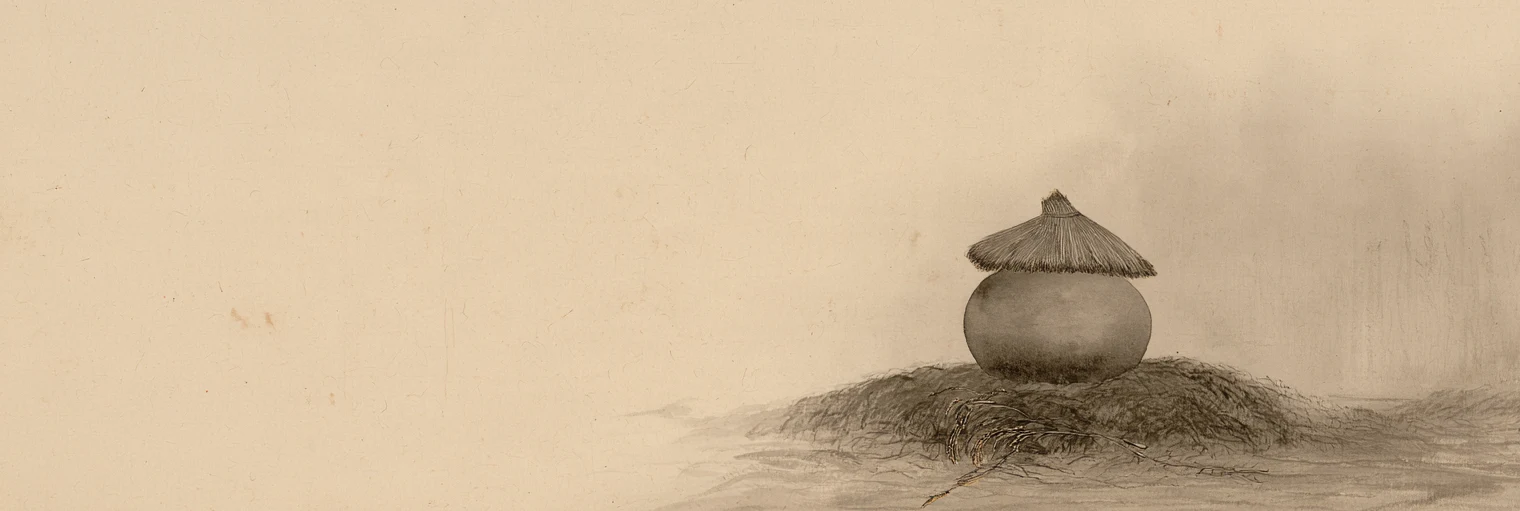
In the corner of an old Korean house, on a shelf in the inner room, there used to sit a small clay jar. Nobody cooked from it. Every autumn, after the harvest, someone emptied out last year's rice and filled it to the brim with the new. In many homes that jar had a name: the Buru danji — Buru's jar.
Buru (부루, 扶婁) was the son of Dangun Wanggeom, the founder of Korea's first kingdom, and he ruled after his father as the second Dangun. The chronicles remember him as the prince who tamed a flood and the king under whom no one went hungry. The people remembered him in a different way. They did not carve his face in stone. They kept him in a jar of rice — and, the old stories say, in the ribbon at the end of a braid.
Who was Buru?
The oldest Korean book that names him is the Samguk Yusa (삼국유사), a chronicle compiled by the monk Iryeon in the thirteenth century. In its chapter on Goguryeo, Iryeon quotes an older record called the Dangun-gi (Record of Dangun):
壇君記云. 君與西河河伯之女要親, 有産子, 名曰夫婁.
The Record of Dangun says: Dangun took as his wife the daughter of Habaek, lord of the West River, and she bore him a son, whose name was Buru.
— Samguk Yusa, Book 1, "Goguryeo"
Dangun, in Korean tradition, founded Gojoseon (고조선) — "Old Joseon," Korea's first kingdom — in 2333 BCE. The Samguk Yusa tells us he had a son. For what that son did, we turn to three later Korean chronicles: the Danggun Segi (단군세기, Annals of the Dangun Rulers), a chapter of the Hwandan Gogi collection; the Gyuwon Sahwa (규원사화), written by a scholar who called himself Bugae and dated his preface to 1675; and the Danggi Gosa (단기고사).
In those books, Dangun is not one man's name but a title, the way pharaoh or emperor is. Forty-seven rulers carry it, one after another. Buru is the second. The Danggun Segi gives him a reign of 58 years, from 2240 to 2183 BCE by its own count.
What did Buru do as crown prince?
The first thing the chronicles remember about Buru is water.
The Gyuwon Sahwa says that some thirty years into Dangun's reign a great flood came. The waves rose "as if to touch the sky," the rivers burst their banks, and the city of Pyongyang sank under the water. Dangun sent his sons out to find high, dry ground, and then he gave Buru the hardest task: to rescue the people of Pyongyang and put the land and rivers back in order. It took years. When it was done, the book says, the people settled in their new home and lived there in peace.
The Danggun Segi then sends the young prince abroad. China in that age was also fighting floods, and in the chronicle's year 2267 BCE Dangun dispatched him to a meeting at Mount Tu (도산, 塗山), on the Huai River in what is now eastern China:
帝遣太子扶婁與虞司空會于塗山. 太子傳五行治水之法.
The ruler sent the crown prince Buru to meet the Minister of Works of the Yu court at Mount Tu. The crown prince passed on the method of controlling water by the five phases.
— Hwandan Gogi, Danggun Segi, first Dangun, year 67
In Chinese tradition, the Minister of Works at the court of the sage-king Shun was Yu — the hero who finally tamed China's great flood and went on to found the Xia dynasty. The Danggi Gosa names Yu outright. It says Buru and Yu had been friends since Buru's days as crown prince, and that when Yu later called the meeting at Mount Tu, Buru — king by then — sent his envoy Paeng-o to explain the method of taming water.
So the first picture of Buru is a young man standing in floodwater, first at home and then far from it, handing on what his own country had learned.
What kind of king was he?
When Dangun Wanggeom died, the Danggun Segi says, the people mourned him "as if they had lost their own father and mother." Buru took the throne in 2240 BCE, and the chronicle opens his reign with a portrait:
帝賢而多福, 居財大富, 與民共治産業, 無一民飢寒.
The ruler was wise and richly blessed. He stored up great wealth and ran the work of the land together with the people, so that not one of them went hungry or cold.
— Hwandan Gogi, Danggun Segi, second Dangun Buru, year 1
The rest of the reign reads like a list of a good farmer's chores, done for a whole country. Every spring and autumn Buru travelled through the land and offered the rites to heaven. He watched over the regional lords, rewarding the good and punishing the bad with care. He had irrigation channels dug, urged the people to farm and to plant mulberry trees for silk, and opened schools, so that "culture greatly advanced."
In his third year he did something that sounds very modern. He ordered that measures and scales be the same everywhere, so that the price of hemp and ramie cloth was the same in every market. "The people did not cheat one another," the chronicle says, "and near and far found it convenient." In his tenth year he divided the fields into fixed plots so that no one could grab land for private gain. In his twelfth, a scholar named Gwi-gi presented him with a new calendar.
The Danggun Segi also records the hymn sung at the great sky festivals of his day, the Eoa song (어아가), in which the people call themselves "one great bow" with a single string, and every good heart a straight arrow. You can read it in our story of Korea's oldest festivals.
Buru ruled for 58 years. His son Garuk followed him — the same Garuk under whom, the chronicle says, the 38 letters of Garimto were made.
What is the Buru danji — the jar of rice?
The day Buru died, the Danggun Segi says, the sun went dark in an eclipse, and wild animals gathered in packs on the mountains and cried out. The people grieved bitterly. And then they did something no royal decree had told them to do:
後, 國人設祭, 家內擇地, 設壇而土器盛禾穀, 置壇上, 稱爲扶婁壇地, 是爲業神.
Afterwards the people of the country held rites for him. In their own homes they chose a spot, built an altar, filled a clay vessel with grain, and set it on the altar. They called it the Buru danji, and it became the spirit of the household's fortune.
— Hwandan Gogi, Danggun Segi, second Dangun Buru, year 58
Picture it: not a temple, not a tomb, but thousands of small clay pots of grain in thousands of ordinary homes. The king who had made sure no one went hungry was remembered with a jar that was never allowed to be empty.
The chronicle gives the jar a second name, eopju gari (업주가리, 業主嘉利). Eop (업, 業) means a household's work and fortune — in Korean folk religion, the eop spirit is the quiet guardian of a family's wealth. The Danggun Segi explains the name as "the person and the work both made whole." The jar was not only a memorial. It was a promise that the family, and the work that fed it, would stay whole.
Nearly four thousand years later, a scholar sat down in 1675 to write the Gyuwon Sahwa, and he described the very same thing — not as ancient history, but as something he could see in the villages around him:
今, 人家有夫婁壇地者, 籬落淨潔處, 築土爲壇, 土器盛禾穀, 置於壇上, 編葺藁艸掩之, 每十月, 必薦之以新穀, 或稱業主嘉利, 卽報賽夫婁氏治水奠居之義.
Today, there are households that keep a Buru danji. In a clean place inside the fence they build an altar of earth, set a clay pot full of grain on it, and cover it with woven straw. Every tenth month they never fail to fill it with the new grain. Some call it the eopju gari. It is a way of repaying Buru for taming the waters and giving the people a place to live.
— Gyuwon Sahwa, "Annals of Dangun" (1675)
Notice the reason he gives. The family is not thanking a distant god. It is thanking the prince who stood in the flood, the one who gave their ancestors dry land to live on.
Is the Buru jar still kept today?
In the twentieth century, Korean folklorists went from village to village recording the household gods, and they found the jar still sitting in the eldest son's house. Korea's national Encyclopedia of Korean Culture describes it under the name josang danji (조상단지), the "ancestor jar," and lists Buru danji as one of its other names. In the southeastern provinces, the entry says, the family fills it every year at harvest time with newly milled rice and keeps it on a shelf in the main inner room of the house. No wine and no meat are offered to it — only grain.
The jar goes by many local names. In the southwest it is the jeseok ogari; in the southeast, the sejon danji; around Yangju, near Seoul, families kept an eopju gari — a pot of rice under a paper cap — beside the storeroom or the terrace where the soy-sauce jars stand.
The encyclopedia also says what every Korean grandmother could tell you: the custom is disappearing, kept now only in a few eldest-son households. But follow the line from start to finish. The Danggun Segi places the first Buru jar in 2183 BCE. A writer of 1675 saw the same jar in the homes of his day. Folklorists of the twentieth century found it still being refilled with new rice. For some four thousand years, ordinary Korean families kept the memory of their second king in the corner of a room, without a decree or a book telling them to.
Why is a Korean hair ribbon called a daenggi?
If you have watched a Korean historical drama, you have seen it: a young man or woman not yet married, hair in one long braid down the back, tied at the end with a strip of red or black cloth. That ribbon is a daenggi (댕기).
The story of its name begins with Buru's father. When Dangun Wanggeom died, the Danggun Segi says, the people carried his banner, the dangi (檀旂, Dangun's flag), and sat together morning and evening to honour him, unable to put him out of their hearts.
Three years into his own reign, Buru issued an order about hair:
下詔使民編髮盖首, 服靑衣.
He issued a decree that the people should braid their hair and cover their heads, and wear blue clothing.
— Hwandan Gogi, Danggun Segi, second Dangun Buru, year 3
The Danggi Gosa records the same decree in the same year. The braid — and the ribbon that ties it — enters the chronicle under Buru.
Korean linguists, meanwhile, have traced the word itself. A 2024 study of its history in the journal Gugeosa Yeongu (Korean Historical Linguistics) found that daenggi appears in old texts in several spellings — danggi (당기), dangi (단기), dangui (당긔) — and that dangi (단기) is the oldest form. That is where the popular Korean telling picks up the thread: the ribbon at the end of every braid, it says, began as a small copy of the mourning banner, the dangi, worn by people who did not want to forget their founding king. (The linguist's own explanation runs a different way — to an old Korean verb meaning to tie.)
Either way, look at what was kept. A strip of cloth, tied every morning by millions of hands, through dynasty after dynasty, carrying a word that still sounds like the name of Dangun's flag.
What does Buru leave us?
Kings are usually remembered by monuments. Buru was remembered by habits.
The chronicles tell us what he did: he waded into a flood, he carried knowledge abroad instead of keeping it, he made sure the scales were honest and that no one went hungry. That is Hongik Ingan — broadly benefit all people — the founding ideal of his father's kingdom, turned into ordinary daily work.
And the people answered in the same language. They did not need to read the Danggun Segi. They only needed to empty the old rice in autumn and pour in the new, and to tie a ribbon at the end of a child's braid. Gratitude, done with the hands, once a year and once a day, is how a people carried one man's name for four thousand years.
You may not have a clay jar in the corner of your room. But you almost certainly have someone who, long before you arrived, stood in some flood so that you could have dry ground — a parent, a teacher, a stranger whose work you live inside. The Buru jar asks only one thing: keep it full. Remember them, every harvest, with something real.
Continue with Zexeda
If the image of a jar that was never allowed to be empty has stayed with you, the story continues in the Zexeda newsletter — a quiet weekly letter on Korea's ancient wisdom, one story and one small practice at a time. You are welcome to walk along.
Key takeaways
- Buru (부루, 扶婁) was the son of Dangun Wanggeom, founder of Gojoseon. The Samguk Yusa (13th century) quotes the Record of Dangun: Dangun married the daughter of the river lord Habaek, and their son was named Buru.
- The Danggun Segi makes him the second Dangun, ruling 58 years, 2240–2183 BCE by its own count. His son Garuk became the third.
- As crown prince, the Gyuwon Sahwa says, Buru rescued the people of Pyongyang from a great flood and restored the land. The Danggun Segi says that in 2267 BCE he met the Minister of Works of Shun's court at Mount Tu and passed on a method of flood control.
- As king, the chronicle records that no one went hungry or cold; he held rites each spring and autumn, dug channels, opened schools, standardized measures so markets were fair, and divided the fields so no one could take land for private gain.
- When he died, families set a clay jar of grain on an altar in their homes and called it the Buru danji (부루단지), or eopju gari (업주가리) — "the person and the work both made whole."
- The Gyuwon Sahwa (1675) describes the jar as a living custom: covered with woven straw, filled with new grain every tenth month, to repay Buru for taming the waters. The Encyclopedia of Korean Culture lists Buru danji as another name for the ancestor jar still refilled with new rice at harvest in the twentieth century.
- The Danggun Segi records that Buru ordered the people to braid their hair. The oldest recorded form of daenggi, the braid ribbon, is dangi (단기); a popular Korean telling links it to dangi (檀旂), the banner people carried to mourn Dangun.
This article is for educational and reflective purposes and shares interpretations of Korea's ancient wisdom traditions. It is not medical, psychological, or professional advice.