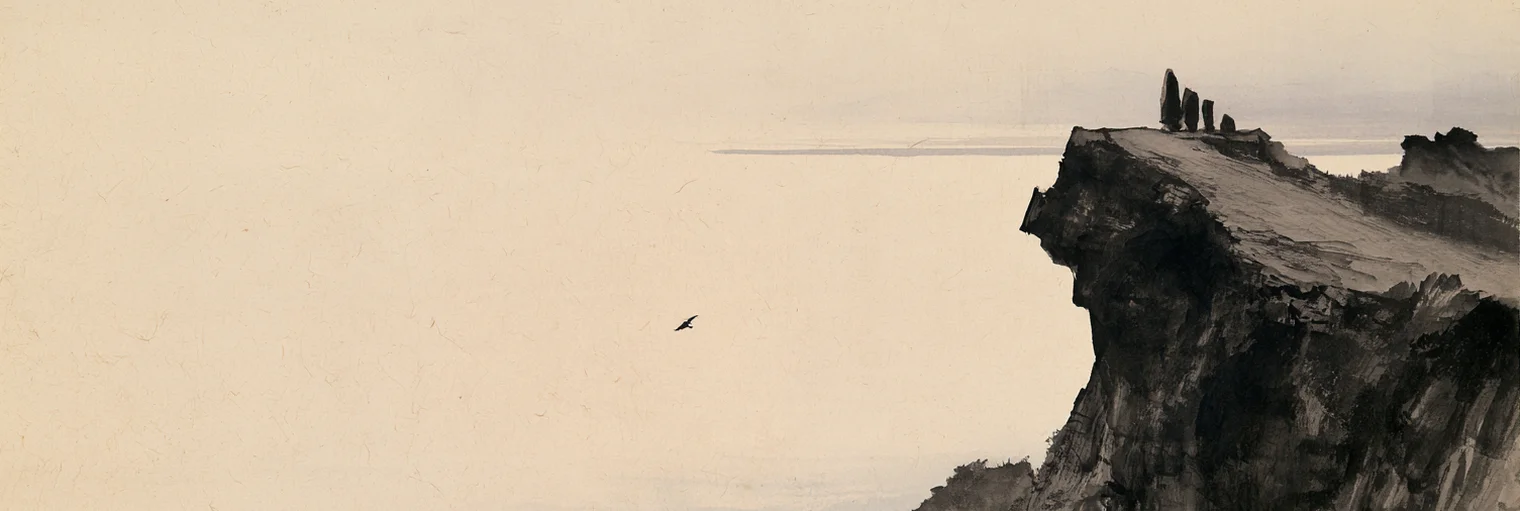
Bak Je-sang (박제상, 朴堤上) — often spelled Park Je-sang — was an official of the Korean kingdom of Silla who, in the early fifth century, brought his king's two captive brothers home: one from Goguryeo by persuasion, one from Wa in the Japanese islands by a ruse. He was burned to death in Wa because he would not call himself anyone's subject but Silla's. His wife later climbed a mountain pass called Chisullyeong (치술령, 鵄述嶺) with their three daughters, looked out toward the sea, and did not come down.
That is the story most Koreans know. But it has a second half, and it is the half this article is about. One of the three daughters did come down. She raised her five-year-old brother, and that boy grew up to carry his father's book — the book whose first part is the Budoji, a text this site has been reading from since its very first articles. The story of Chisul Pass is usually told as a story of waiting. Followed to the end, it is a story of something being handed on.
Who was Bak Je-sang?
To meet him, you need to know where he stood. In the early 400s, the Korean peninsula and the lands to its north were shared among three kingdoms — Goguryeo in the north, the largest and strongest; Baekje in the west; and Silla in the southeast, the smallest of the three at the time, with its capital at Gyeongju. These are the Three Kingdoms that fill so many Korean historical dramas. Across the sea to the east lay the islands that Korean records of the time call Wa (왜, 倭) — the old name for the kingdoms of Japan.
Small kingdoms in that world kept the peace with big neighbours by sending them royal hostages: a prince who lived at the foreign court as a living promise. The Samguk Sagi (삼국사기) — the History of the Three Kingdoms, compiled at the Korean court in 1145 — records that Silla sent one prince, Misaheun (미사흔), to Wa in 402, and another, his elder brother Bokho (복호), to Goguryeo ten years later. Both were sons of the late King Naemul. When their eldest brother, Nulji (눌지), became king in 417, he could not rest while they were gone.
He asked his officials who could bring them back. Three village chiefs gave the same name: Je-sang, governor of the district of Sapnyang, a man strong, brave and full of plans. The Samguk Sagi gives his family as well. He was a descendant of Hyeokgeose (혁거세), the founder of Silla, and a fifth-generation descendant of its fifth king, Pasa — a member of the Bak (박) clan, Silla's first royal house. The other great chronicle of the period, the Samguk Yusa (삼국유사), written by the monk Iryeon in the thirteenth century, tells the same story but calls him Kim Je-sang. Korean readers know him by both names. This article uses Bak, the name his own descendants kept.
There is a third record, and it is the one that will carry this story past the point where the first two stop. In the fifteenth century the poet and scholar Kim Si-seup (김시습) — best known today as the author of the Geumo Sinhwa, the New Stories from Golden Turtle Mountain — wrote a long afterword to a book he had read with Bak Je-sang's descendants. He called it the Jingsimnok Chugi (징심록 추기), Notes on the Jingsimnok. Kim Si-seup records that Bak Je-sang built a house above a clear river in Sapnyang, named it Jingsimheon (징심헌), the Hall of a Clear Mind, and there wrote down the history his family had passed down from the beginning of the world. He called that book the Jingsimnok (징심록), the Record of a Clear Mind. Hold on to that book. It comes back at the end.
How did he bring the first prince home from Goguryeo?
He went in by the front door. The Samguk Sagi records that Je-sang travelled to Goguryeo as a formal envoy and spoke to its king — Jangsu (장수왕) — directly:
"I have heard that the way to deal with a neighbouring country is sincerity and trust, nothing more. Exchanging princes as hostages falls short of even the old warlords; it belongs to a degenerate age. My lord's beloved brother has been here for nearly ten years. … If Your Majesty will kindly send him home, it will be like one hair falling from nine oxen — you will lose nothing. And my lord's gratitude to you will be beyond measure." — Samguk Sagi, Biography of Bak Je-sang
The king of Goguryeo said, "Agreed," and let Bokho go.
Kim Si-seup's Notes remember the speech differently, and the difference matters to this site. He records that Je-sang spoke to the king of Goguryeo about the matter of Budo — Budo (부도, 符都) being the ancient city of the heavenly seal that the Budoji describes, where Dangun gathered the peoples of the four seas under one rule — and asked, "We are the descendants of one root; how can such a thing happen between us?" With that one sentence, Kim Si-seup writes, Bokho was sent home. (The Samguk Yusa has yet another version, in which Je-sang slips into Goguryeo in disguise and the prince escapes by night to a waiting boat. The memory of how the first brother came home was kept in more than one shape.)
Whichever words he used, the first prince was home. King Nulji wept with joy and grief at once. "I have thought of my two brothers as my left and right arms," the Samguk Sagi has him say. "Now I have only one arm back. What am I to do?"
What happened at the harbour of Yulpo?
Je-sang told the king plainly that the second rescue would be different. Goguryeo was a great kingdom with a wise king, and a wise king could be persuaded. Wa could not be talked round. It would have to be tricked. He asked the king to put out a story that he had betrayed Silla and fled, so that Wa would believe him when he arrived.
Then, the Samguk Sagi records, he swore to himself that he would die, did not go to see his wife and children, and rode straight to the harbour of Yulpo (율포) and took ship.
His wife heard and ran after him. This is the first scene of the story that belongs to her, and both old histories keep it. In the Samguk Sagi, she reaches the harbour as the boat is pulling away, looks at it, and cries out: "Come back safely!" He turns and calls back: "I am going into an enemy country on the king's command. Do not wait to see me again." In the Samguk Yusa, she rides after him on horseback, reaches the shore, and calls his name — and he only raises his hand and waves, and the boat does not stop.
The Samguk Yusa remembers one more thing. On her way after him, before she reached the shore, she fell on the sand south of the gate of a temple called Mangdeoksa and lay there crying out for a long time, so the people named that stretch of sand Jangsa (장사), the long sand. When two relatives took her by the arms to bring her home, she stretched out her legs and would not get up, and they named that place Beoljiji (벌지지), the place of the outstretched legs. A whole landscape around Gyeongju was named after a woman who would not let her husband go.
Kim Si-seup adds a line of his own: when Je-sang waved goodbye from the boat, she encouraged him to go. She cried at the water's edge, and she told him to go anyway.
How did he free the prince in Wa?
Everything went the way Je-sang had planned. He arrived in Wa as a man who had fled his own king, and the Samguk Yusa records that he told the king of Wa that the king of Silla had killed his father and brothers for no crime. The Samguk Sagi adds that news reached Wa that Silla had thrown Je-sang's family in prison, and the king of Wa believed him.
For a long time he simply passed the days with the prince, Misaheun. They went out in boats on the water, catching fish and ducks and presenting them to the king of Wa, and the people of Wa, seeing two men with nothing on their minds but fishing, stopped watching them.
Then came a morning thick with sea fog. Je-sang told Misaheun to go home — now, and alone. The prince refused. The Samguk Sagi gives the exchange:
Misaheun said, "I have served you as I would my own father. How can I go home alone?" Je-sang said, "If we both leave, the plan will fail." Misaheun put his arms around Je-sang's neck, wept, said goodbye, and went.
Je-sang went back and slept late in the prince's room, so that no one would look for Misaheun until he was far away. When the servants asked why the general was still in bed, he told them he was worn out from the boat the day before. By the time they understood, the fog lay so thick on the sea that no one could see where the prince had gone. Misaheun reached home. Je-sang stayed behind.
"I am a subject of Gyerim"
The king of Wa had Je-sang bound and brought before him. What follows is the scene for which Korea remembers him, and it is the Samguk Yusa that tells it. The king asked why he had secretly sent the prince home. Je-sang answered:
"I am a subject of Gyerim, not a subject of Wa. I only did what my own king wished."
Gyerim (계림, 鷄林), the Forest of the Rooster, was an old name for Silla. The king of Wa said that since Je-sang had already come over to him, he was his subject now; if he went on calling himself a subject of Gyerim, he would suffer every punishment, and if he would only say Wa, he would be rewarded with rank and a rich salary. Je-sang's answer is the most famous sentence in the story:
"I would rather be a dog or a pig of Gyerim than a subject of Wa. I would rather take a beating in Gyerim than receive rank and salary in Wa." — Samguk Yusa, Book 1, "King Naemul and Kim Je-sang" 寧爲雞林之犬㹠, 不爲倭國之臣子. 寧受雞林之箠楚, 不受倭國之爵祿.
The Samguk Yusa records that he was made to walk over cut reeds, and then to stand on heated iron, and that each time he was asked whose subject he was, he gave the same three words: a subject of Gyerim. When the king of Wa understood that he would never give any other answer, he had him burned to death on an island called Mokdo (목도, 木島). The Samguk Sagi says the same. Where Mokdo was, no one now knows.
Kim Si-seup remembers his death in one image. He looked at death as if it were snow melting. And he notes that Je-sang changed his pen name three times in his life, and that the last of them was Gwanseoldang (관설당, 觀雪堂) — the Hall of Watching Snow, a name Kim Si-seup reads as the place where everything melts away and nothing is left but understanding. A man who called himself the one who watches the snow went into the fire as though it were a thaw.
Back in Silla, the king mourned him and gave him high rank after his death. The Samguk Yusa records that his wife was made Lady of the Realm, and that one of his daughters was married to the prince he had saved. When the brothers were all together again at last, the Samguk Sagi says, King Nulji held a feast and made up a song and dance of his own to show what was in his heart. It was played in Korea for centuries afterward as Usik-gok (우식곡), the Song of Grief Laid Down.
For the king, the grief was over. For Je-sang's wife, it was not.
Why is Chisul Pass called the mountain of the mother?
The Samguk Yusa gives her ending in a single long sentence:
Long afterward, the lady, unable to bear her longing, took her three daughters and climbed Chisul Pass. She looked toward Wa and wept bitterly until she died. And so she became the Mother Spirit of Chisul, and her shrine stands there to this day. — Samguk Yusa, Book 1, "King Naemul and Kim Je-sang" 久後夫人不勝其慕, 率三娘子上鵄述嶺, 望倭國痛哭而終, 仍爲鵄述神母, 今祠堂存焉.
Chisullyeong is a mountain pass in the southeast of Korea, on the ridge between today's Ulsan and Gyeongju, high enough to see the line of the sea to the east. The Samguk Yusa does not call the woman who died there a widow or a victim. It calls her Chisul Sinmo (치술신모) — the Mother Spirit of Chisul — a goddess of the mountain, and it records that her shrine was still standing in the thirteenth century, more than eight hundred years after she climbed the pass.
Kim Si-seup's Notes give this scene its names. He records that when she heard of her husband's death, Lady Kim took their three daughters up Chisul Pass, made a song of her own there, looked out over the eastern sea and wept, and gave up her life. The eldest daughter, Agi (아기, 阿奇), and the third, Agyeong (아경, 阿慶), followed their mother, and the bodies of the mother and her daughters turned to stone — three stone figures of the Mother Spirit on the ridge.
The song is the one Koreans call Chisullyeong-gok (치술령곡), the Song of Chisul Pass. Its name has come down among the songs of Silla; its words have not. The Jeungbo Munheon Bigo (증보문헌비고), a Korean reference work completed in 1908, records that the people of Silla made it after her death to mourn her. Kim Si-seup's Notes say she made it herself on the mountain. Either way, the song outlived everyone who sang it, and it was lost.
The villages under the mountain kept the story in their own way. The Encyclopedia of Korean Culture records that in the stories still told around the pass, the wife is remembered more than the husband — as a mangbuseok (망부석), a stone that waits for a husband, standing on the ridge looking out to sea. Some of those stories say she became a bird called chi and her daughters birds called sul — which is how the pass got its name — and that they flew down and hid at the foot of the mountain, where a small hermitage is still called Euneuram (은을암), the hermitage of the hidden bird.
So the mountain has three answers to what became of her. A goddess, says the thirteenth-century chronicle. A stone, say the fifteenth-century Notes and the villages. A bird, say the villages too. Not one of them says she was simply gone.
Which daughter came down the mountain?
Count the daughters again. Three went up. Kim Si-seup names only two who stayed.
The second daughter, Ayeong (아영, 阿榮), came down. Kim Si-seup records that she chose to live for the sake of the family, and that she brought up her little brother, who was five years old when their father died. When King Nulji heard of it, he grieved deeply, and he gave Ayeong in marriage to Misaheun — the prince her father had died to bring home.
Here two records written more than three hundred years apart, one at the royal court and one in a family's hiding place, land on the same young woman. The Samguk Sagi of 1145, which never mentions the mountain, records that King Nulji repaid Je-sang by having Misaheun marry Je-sang's second daughter. It does not give her name. Kim Si-seup gives it: Ayeong, the one who came down.
Think about what she walked back into. Her father burned on an island no one could find. Her mother and her two sisters gone on the ridge above her. A five-year-old boy who would not remember any of them. And a marriage to the man whose life had cost her father his. She is given only a few lines in any record, and every one of them shows her doing the same thing: staying, and keeping what was left.
Who was Baekgyeol, the man of a hundred patches?
The little brother grew up. Kim Si-seup records that he served briefly at the court of King Jabi, Nulji's son, then left his post, gave up worldly affairs, and spent his life playing the geomungo (거문고) — the Korean six-stringed zither, played sitting on the floor — as his way of practice, walking in the way of his forefathers until he withdrew from sight altogether. His name was Mun-ryang (문량). Korea remembers him by his nickname: Baekgyeol (백결, 百結), a hundred knots — Master Hundred Patches.
The Samguk Sagi gives him a chapter of his own, and it is one of the most loved short passages in the whole book. It begins by saying it does not know who he was:
Master Baekgyeol — no one knows where he came from. He lived at the foot of Mount Nangsan, and his house was very poor. His clothes were patched a hundred times, so that they hung on him like the feathers of a ragged quail, and the people of the time called him Master Hundred Patches of the East Village. — Samguk Sagi, Biography of Master Baekgyeol
He carried his geomungo everywhere, the chronicle says, and everything he felt — joy, anger, grief, delight, and every unfairness of the world — he put into its strings. One year, as the year was ending, the neighbours were pounding grain for the new year, and his wife heard the thud of their pestles and said, "Everyone else has grain to pound. We alone have none. How will we see the year out?" Baekgyeol looked up at the sky and sighed:
"Life and death are fated, and wealth and rank lie with heaven. What comes cannot be refused, and what goes cannot be chased. Why grieve? Let me make the sound of the pestle for you, to comfort you."
And he played the sound of rice being pounded on his geomungo. The tune was passed down for generations as Daeak (대악, 碓樂), the Pestle Song. Like his mother's song on the mountain, its notes are lost.
Set the two records side by side and the gap between them closes. The Samguk Sagi says no one knew where Master Hundred Patches came from. Kim Si-seup says he came from a burned father, a mother turned to stone, and a sister who came down a mountain to raise him. Read this way, the poorest man in Gyeongju, comforting his wife with a song about rice he did not have, was the son of the woman who sang on Chisul Pass. He had learned from his family that a song can hold what the hands cannot.
How did the Budoji survive?
Now the book comes back.
Kim Si-seup records that Bak Je-sang's Jingsimnok stayed in his family, copied out by each generation of the eldest line, for a thousand years. The edition of the Budoji in this site's library describes the Jingsimnok as a work in fifteen parts, with the Budoji (부도지, 符都誌) — the Record of the City of the Heavenly Seal — as its first. It is the Budoji that tells of Mago, the first mother, and her walled city at the beginning of the world; of the vow to return to the origin; of the white grass that Hwanggung bound about his body; and of Dangun's city of Budo, where rafts floated down the rivers to invite the peoples of the four seas. Its last chapters follow the people of Budo to the eastern sea, where, as the article on sodo and sotdae told, Hyeokgeose — Bak Je-sang's own ancestor — raised a new altar in the old pattern and founded Silla.
So when Kim Si-seup's Notes say that Je-sang spoke to the king of Goguryeo about the matter of Budo, and to the king of Wa about it too, they are saying that he went abroad carrying the same story he had written down at home.
The Notes follow that story through the son. Kim Si-seup records that when Kim Chunchu (김춘추) — the future King Muyeol, who began the unification of the Three Kingdoms under Silla — was still a young man of no rank, he went with Kim Yu-sin (김유신), the general who would fight beside him, to study at the foot of Mount Seondo under a teacher named Maryeonggan (마령간), Baekgyeol's great-grandson. Maryeonggan taught them in the way of Baekgyeol, Kim Si-seup writes, and spoke to them again and again of the Budo tongil-ron (부도통일론) — the teaching of uniting the land as Budo was united — and later the two of them, with Maryeonggan's son, laid the plans by which the three kingdoms became one.
And then the book came, one last time, into the hands of someone who could write it down. In 1455, when the boy-king Danjong was forced off the throne of Joseon and the Bak family scattered from the capital, one of Je-sang's descendants took the Jingsimnok and fled into the mountains to hide. Kim Si-seup records that he went with him, and that was how he came to read it. His Notes are what he wrote afterward.
The Jingsimnok itself did not survive. The introduction to the Budoji in this site's library records that the family's copy was kept for centuries in the house of the eldest line and was lost after 1945, when a descendant named Bak Geum (박금) came south across the new border without it — and that in 1953 he wrote out the Budoji again from memory. What remains of Bak Je-sang's book is the first of its fifteen parts, carried across fifteen centuries the way it began: by someone in the family deciding to keep it.
What does the story of Chisul Pass leave us?
There are two ways to tell this story.
The first ends on the mountain. A man is burned on an island for three words, and his wife climbs a pass and turns to stone looking at the sea he crossed. It is the version most Koreans learn, and Korea has told it for fifteen hundred years as a story of loyalty and waiting: the man who would not bend, the woman who would not stop watching for him.
The second does not end on the mountain. It walks down it with Ayeong. Zexeda reads the story this way, and the records support it at every step. The husband's death ends in a feast and a song for the king. The mother's grief ends in a goddess, a stone, a bird, and a song whose words are gone. But the daughter's choice ends in a living child — and the child grows into a musician who plays a pestle song for his hungry wife, and his great-grandson teaches two young men about Budo, and fifteen centuries later a descendant writes the first part of the family's book back out of his own memory.
Every link in that chain is someone who stayed. Je-sang stayed behind in Wa so the prince could go. Ayeong stayed on the road down so her brother could grow up. Bak Geum held the book in his head when he could not carry it in his hands. If you have ever read the Budoji on this site — Mago's city, the white grass, the rafts on the river, Dangun's market where no one cheated — you have been reading something a family kept alive by refusing to let it end with them.
The mountain is still there, and so, by the old accounts, is the mother looking out to sea. But the sea she was watching is not where the story went. It went down the other side of the ridge, with a girl holding a five-year-old by the hand.
Continue with Zexeda
If the idea of a story carried forward by the ones who stayed has stayed with you, the reading continues in the Zexeda newsletter — a quiet weekly letter that takes Korea's ancient wisdom one line, and one small practice, at a time. You are welcome to walk along.
Key takeaways
- Bak Je-sang (박제상, 朴堤上) — also spelled Park Je-sang, and called Kim Je-sang in the Samguk Yusa — was an official of Silla in the early fifth century. The Samguk Sagi (1145) makes him a descendant of Silla's founder Hyeokgeose and governor of Sapnyang.
- When King Nulji came to the throne in 417, his brothers were hostages abroad: Bokho in Goguryeo, Misaheun in Wa, the old name for the kingdoms of Japan. Je-sang brought Bokho home by persuading the king of Goguryeo — "like one hair falling from nine oxen." Kim Si-seup records that he spoke of Budo and of peoples of one root.
- At the harbour of Yulpo, his wife cried out "Come back safely!" and he answered "Do not wait to see me again." The places where she fell and would not rise were named Jangsa and Beoljiji.
- In Wa he posed as a defector, spent his days boating with the prince, and on a foggy morning sent Misaheun home alone, sleeping late in the prince's room to buy him time.
- Before the king of Wa he answered every question with "a subject of Gyerim" — Gyerim being an old name for Silla — and said he would rather be a dog or a pig of Gyerim than a subject of Wa. He was burned to death on the island of Mokdo. Kim Si-seup writes that he looked at death as if it were snow melting; his last pen name was Gwanseoldang, the Hall of Watching Snow.
- King Nulji honoured him after his death, made his wife Lady of the Realm, and celebrated his brothers' return with the song Usik-gok.
- The Samguk Yusa records that his wife later climbed Chisullyeong with three daughters, wept toward Wa until she died, and was worshipped as Chisul Sinmo, the Mother Spirit of Chisul. Village stories remember her as a waiting stone and as birds, with the hermitage Euneuram below the pass.
- Kim Si-seup's Jingsimnok Chugi (15th century) names the daughters: Agi and Agyeong died with their mother and turned to stone; she made the Song of Chisul Pass herself. The Jeungbo Munheon Bigo (1908) records instead that the people of Silla made it to mourn her. Its words are lost.
- The second daughter, Ayeong, came down the mountain and raised her five-year-old brother. The Samguk Sagi agrees that King Nulji married Je-sang's second daughter to Misaheun; Kim Si-seup gives her name.
- That brother was Baekgyeol, Master Hundred Patches — the poor geomungo player of whom the Samguk Sagi says no one knew where he came from, and who played the Pestle Song (Daeak) to comfort his wife at the end of a hungry year.
- Kim Si-seup records that Je-sang wrote the Jingsimnok, the Record of a Clear Mind, of which the Budoji is the first of fifteen parts; that Baekgyeol's great-grandson Maryeonggan taught the young Kim Chunchu and Kim Yu-sin the teaching of uniting the land as Budo was united; and that Kim Si-seup himself read the book in 1455.
- The Jingsimnok was lost after 1945; Bak Geum wrote the Budoji out again from memory in 1953. The story of Chisul Pass, followed to its end, is not only one of waiting but of a family that kept its book alive by refusing to let it end with them.
This article is for educational and reflective purposes and shares interpretations of Korea's ancient wisdom traditions. It is not medical, psychological, or professional advice.