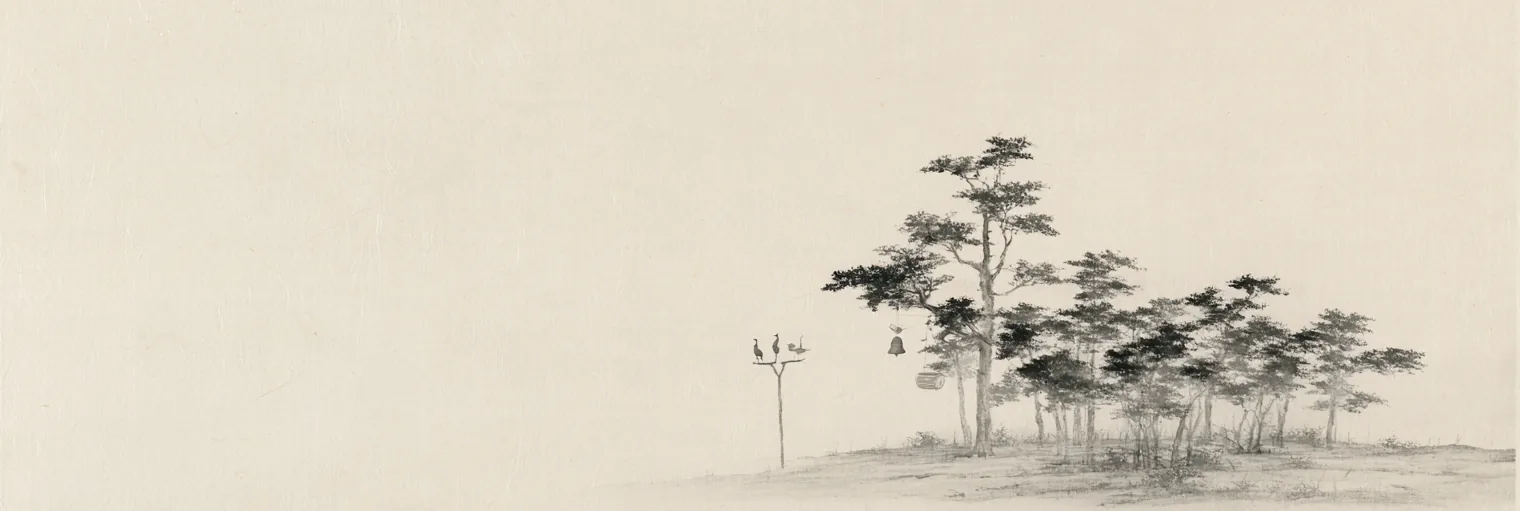
If you have walked through a Korean folk village, or past the edge of an old country village, you may have seen one: a tall, thin wooden pole, and at its very top a forked branch with small carved birds perched on it — usually three. It is a sotdae (솟대). Most people take a photograph and walk on.
It is worth stopping, because that pole is the last visible piece of something that began more than four thousand years ago as a sacred city built for the whole human world — and the old Korean texts that describe the city end with a hope that someone, someday, would build it again.
This article follows the pole back to that city, one step at a time, and then comes forward again to ask what it would mean to rebuild it.
What is a sotdae?
Start with what is in front of you.
Korea's Encyclopedia of Korean Culture defines the sotdae as a sacred tree — a sinmok (신목, 神木) — raised to mark holy ground or a boundary, or to guard a village. Its usual form is a long pole with a three-pronged branch at the top and three carved birds on it. The birds are called phoenixes or wild ducks, but they are not meant as any one species, which is why one of the pole's many regional names is simply jogan (조간, 鳥竿), bird pole.
The village sotdae keeps a few rules. It stands permanently at the entrance of the village, at its boundary, or on its sacred ground. When it rots and falls, a new one is raised in the same place, and the village holds a rite for it every year. It is most often found together with a sacred tree or a shrine at the spot where the village holds its communal rite. And the encyclopedia adds one more rule that turns out to matter a great deal: a sacred pole cannot be raised just anywhere. The ground has to be holy already.
Notice the word the encyclopedia uses even for a bare pole: sacred tree. The pole is standing in for a tree.
The encyclopedia names the tree. It traces the sotdae to the sodo (소도, 蘇塗) of ancient Korea, and records the view of the folklorist Son Jin-tae (손진태), who wrote in his study of the sodo that the sodo was, at heart, a great tree — and that this great tree is what has come down to the present as the sotdae.
So the first step back is a grove, and a tree in the middle of it.
What did a sodo look like when outsiders saw it?
The oldest surviving description of a sodo was written by a foreigner. In the third century a Chinese history, the Sanguozhi (삼국지, 三國志), described Mahan, a group of small states in the south-west of the Korean peninsula. First it describes the two great festivals of their year:
常以五月下種訖, 祭鬼神, 羣聚歌舞, 飮酒晝夜無休. 其舞, 數十人俱起相隨, 踏地低昂, 手足相應 … 十月農功畢, 亦復如之. "Every year in the fifth month, when the sowing is finished, they make offerings to the spirits. They gather in crowds to sing and dance, and drink day and night without rest. In their dance, dozens of people rise together and follow one another, stamping the ground, bending low and lifting high, hands and feet keeping time … In the tenth month, when the work of the fields is done, they do the same again." — Sanguozhi, Wei shu 30, Account of the Eastern Barbarians, Han
Then it turns from the festival to the place:
又諸國各有別邑, 名之爲蘇塗. 立大木, 縣鈴鼓, 事鬼神. 諸亡逃至其中, 皆不還之 … "Also, each of the states has a separate settlement, which is called sodo. There they raise a great tree, hang bells and drums on it, and serve the spirits. Anyone who flees into it is never handed back …" — Sanguozhi, Wei shu 30, Account of the Eastern Barbarians, Han
Picture it. A settlement set apart from the ordinary town — 別邑, a town set aside. In the middle, a great tree standing upright, with bells and drums hanging from its branches, the same instruments that kept time for the stamping crowd in spring and autumn. And an edge that meant something absolute: once a person was inside it, nobody took them out.
The chronicler wrote down the tree. He had no way of knowing how old it was, or what it had once been part of. For that we have to turn to Korea's own books, and go back roughly two thousand years before he was writing.
Where did the sodo come from?
The Budoji (부도지, 符都誌), transmitted under the name of Bak Je-sang (박제상) of Silla, opens its account of Dangun — called Imgeom (임검) in that text — with a world in trouble:
四海諸族, 不講天符之理, 自沒於迷惑之中, 人世因苦. "The peoples of the four seas no longer studied the principle of the Cheonbu, and had sunk of their own accord into confusion, and the human world was in suffering." — Budoji, chapter 12
Cheonbu (천부, 天符) means the heavenly token — the principle by which, in this tradition, heaven and human life fit together, the same word that stands at the head of the Cheonbugyeong. The peoples had not been conquered and they had not been cursed. They had simply stopped remembering, and drifted, and the drifting hurt.
What Imgeom did about it is the part to picture slowly. He did not send armies or messengers. He went himself. The Budoji says he lived on roots and dew until hair grew long on his body, and walked the four seas for a hundred years, visiting every people in turn, until there was nowhere he had not been. And everywhere he went, he made two promises:
盟解惑復本之誓, 定符都建設之約. "He swore the oath of undoing confusion and returning to the origin, and made the promise to build the Budo." — Budoji, chapter 12
解惑復本 — haehok bokbon — undo the confusion, return to the origin. That is the whole purpose, in four characters. The city came second. The oath came first.
Then he built it. On the bright summit of Mount Taebaek he raised the Cheonbudan (천부단), the altar of the heavenly token, set guard-altars at the four quarters, ran three rings of channelled roads between them and posted gates along the roads. The Budoji says what it had made:
雄麗光明, 足爲四海之總和, 諸族之生脈. "It was magnificent and full of light — enough to bring the four seas into one harmony, and the lifeline of all the peoples." — Budoji, chapter 13
This was the Budo (부도, 符都), the city of the heavenly token. And it did not wait for the world to find it. The next chapter has eighty thousand rafts cut from timber, each carved with a token of trust and floated out on the water to invite the peoples of the four seas. Those who found a raft came, group after group, and in a grove of bakdal trees they opened a great gathering, set their spoken and written languages back in order by the sounds of the Cheonbu, and sang together. From then on the gathering was held every ten years, and the Budoji says that through it language came into accord and the world under heaven became one. Dangun's own story on this site tells that part in full.
Hold on to two images from this, because they will keep coming back: an altar at the centre with guard-altars around it, and a grove of bakdal trees where people gathered to remember.
How did one Budo become a sodo in every region?
A single city on a single mountain cannot hold a whole people forever. The Hwandan Gogi (환단고기, 桓檀古記), the collection of Korean chronicles this site works from, shows what the Dangun rulers who came after Imgeom did instead — and Zexeda reads their records as the Budo tradition being carried out from the centre into every region, one sacred grove at a time.
The regions took it up first. In the time of the second and third Dangun rulers, the Taebaek Ilsa records the ruler of Mahan — the very region the Chinese chronicler would describe two thousand years later — setting up a sodo and teaching there:
立蘇塗, 施三倫九誓之訓, 治化大行. "He set up a sodo and gave the teaching of the three bonds and nine vows, and the way of governing spread widely." — Hwandan Gogi, Taebaek Ilsa, Mahan Segi
A sodo, from the start, was a place where something was taught.
Then, in the first year of the eleventh Dangun, Dohae (1891 BCE), the Danggun Segi records an order that looks very much like the Budo multiplied:
帝命五加, 擇十二名山之最勝處, 設國仙蘇塗, 多環植檀樹, 擇最大樹, 封爲桓雄像而祭之, 名雄常. "The emperor ordered the Five Ga to choose the finest ground on twelve famous mountains and establish the Gukseon Sodo. Many bakdal trees were planted around it in a ring; the largest tree was chosen and dedicated as the image of Hwanung, and offerings were made to it. It was named ungsang." — Hwandan Gogi, Danggun Segi, 11th Dangun Dohae, first year (1891 BCE)
Look at the shape. Twelve mountains instead of one. A ring of bakdal trees — the same tree as the grove where the peoples gathered at the Budo — and at the centre, the tallest, dedicated as the image of Hwanung, the heavenly prince whose descent beneath a sacred tree begins Korea's founding story. The tree was called ungsang (웅상, 雄常). The altar at the centre of the Budo had become a great tree at the centre of a grove.
What happened beside the grove mattered as much as the grove. The Taebaek Ilsa describes it as a fixed rule:
蘇塗之立, 皆有戒, 忠孝信勇仁五常之道也. 蘇塗之側, 必立扃堂, 使未婚子弟, 講習事物, 蓋讀書·習射·馳馬·禮節·歌樂·拳搏並釗術, 六藝之類也. "Wherever a sodo was raised, it had its precepts: loyalty, filial devotion, trustworthiness, courage and kindness, the five constant ways. Beside every sodo a gyeongdang was always built, where the unmarried young men were taught — reading, archery, riding, courtesy, song and music, and fighting with fists and with the sword: the six arts." — Hwandan Gogi, Taebaek Ilsa, Samsin Oje Bongi
And the Danggun Segi gives those young men a name. Under the thirteenth Dangun, Heuldal (1763 BCE), the country established many sodo and planted cheonjihwa — the characters read heaven, point, flower — and had unmarried youths read and practise archery there. They were called gukjarang, the youths of the country, and because they went about with the flower tucked into their hair, people called them cheonjihwarang.
Hwarang. The flower youths of Silla, who appear in every Korean historical drama, carry a name this record places at the sodo some two thousand years before them — a line this site follows through Korea's own tradition of practice.
The ground itself was protected by law. The Taebaek Ilsa, in its chapter on the Beonhan line, preserves eight prohibitions laid down for the people, and between the laws on killing and theft sits this:
相殺以當時償殺, 相傷以穀償, 相盜者男沒爲其家奴, 女爲婢, 毁蘇塗者禁錮 … "Whoever kills shall pay with his life at once; whoever wounds shall pay in grain; whoever steals — a man becomes a slave of that household, a woman a servant; whoever damages a sodo shall be imprisoned …" — Hwandan Gogi, Taebaek Ilsa, Samhan Gwangyeong Bongi, Beonhan Segi
So when the Chinese chronicler, much later, noticed that no fugitive could be taken out of a sodo, he was seeing the far end of something very old. Ground set aside for heaven was not a place where one person's quarrel with another could follow them.
The sodo multiplied. Under the twenty-fourth Dangun, Yeonna, the Danggun Segi says the regional rulers established more sodo and held the rite to heaven, and that whenever the country faced a great event or a strange calamity, they prayed there and settled the people's will into one. And under the twenty-fifth, Solna, there is a line that echoes the Budo almost word for word: the emperor, it says, was at the upper sodo, teaching the old rites — 帝在上蘇塗, 講古禮. Imgeom had built the Budo because the peoples had stopped 講, studying and teaching the principle. More than a thousand years later a Dangun ruler is standing in a sodo, doing exactly that.
Put it all together and picture one of these places when it was alive. A ring of bakdal trees on good ground. A great tree in the middle. Precepts spoken there. A hall beside it where the young learned to read, ride, sing and hold a sword, and went out with a flower in their hair. A law protecting the ground. A rite each year when the country gathered. The Budo on Mount Taebaek was no longer in one place. It had been planted, in smaller form, across the land.
How did the tradition reach Silla — and then the village gate?
Smaller, though, is the word to watch.
The Budoji records that the land was later pressed by war coming from the west, and that the people who remained of the Budo sealed the altar on the bright ground and withdrew to the shore of the eastern sea, where they settled in six villages and kept watch. Out of those six villages came Hyeokgeose (혁거세), the founder of Silla. And the Budoji describes what he did in terms that make the lineage unmistakable:
"He led the peoples, practised the way of the former age, revived the law of the sacred market, and built a Cheonbu Sodo on Nam-Taebaeksan. On its central terrace he raised the Cheonbudan, and on the four terraces east, west, south and north he set guard-altars. He performed the rite of cleansing … and every year in the tenth month he held the white-robe rite, following the meaning of Hwanggung binding white grass about his body." — Budoji, chapter 29
An altar at the centre, guard-altars at the four quarters — the Budo's plan, exactly. The white-robe rite, which goes back to the ancestor who first swore to return to the origin. Markets opened, farming and weaving encouraged, and the same chapter adds that he took up neither shield nor spear against his neighbours.
And look at what the Budoji calls it. 天符小都 — Cheonbu Sodo — and the characters mean a small capital of the heavenly token. The text itself names the place as a small Budo. Zexeda reads that name as the Budoji's own account of the line: Imgeom's Budo, carried by the Dangun rulers through their sodo, arriving in Silla as a small Budo — faithful in plan, reduced in reach.
The Chinese chronicler's Mahan, in the third century, is the same line seen from outside: sacred groves still standing behind their separate settlements, bells and drums in the great tree, the dance still shaking the ground twice a year.
And then, across the centuries that followed, the grove itself did not survive. What came down, in Son Jin-tae's reading, was the great tree — and what stands for that tree today is a pole, still called a sacred tree, still raised only on holy ground, still renewed when it falls, still found beside the old village tree where the rite is held. Zexeda reads that pairing, the sotdae and the sacred tree at the village gate, as the last descendants of the ungsang.
Now lay the whole line out end to end:
A city for the four seas, with an altar on Mount Taebaek. → Sacred groves on twelve mountains and in every region, with the young trained beside them. → A small Budo on a southern mountain in Silla. → A grove behind a separate settlement in Mahan. → A pole with three birds at the village gate.
At every step, the form was kept: a sacred centre, a boundary, a rite at the turning of the year. At every step, the reach grew smaller. And somewhere along the way, the thing the form was built for — 解惑復本, undoing confusion and returning to the origin — stopped being practised and started being remembered as custom. The pole still stands. Almost no one standing in front of it knows what it was for.
Four thousand years is a long time for a shape to survive without its meaning. That it survived at all is remarkable. But a shape is not a Budo.
Can the Budo be built again?
The Budoji does not end with the pole. It ends with a hope.
Its final chapter looks back over three centuries in which the people of the origin had held on, withdrawn by the eastern sea, and says that the principle of the Cheonbu had never actually died — that it was still alive even in a world of deception — and then it looks forward:
"… so that the people of today may know that the heavenly token is real, and so that those who come after, when their time comes, may put it into practice — build the Budo again, bring the four seas into harmony, return the human world to its origin, and make the truth plain." — Budoji, chapter 33
Build the Budo again. Not restore the pole. Not replant the grove. Build the Budo.
Which raises the question the whole line has been quietly asking. How was the Budo built the first time?
Go back to chapter 12 and read the order again. Before a single stone was laid on Mount Taebaek, Imgeom walked the world for a hundred years and swore an oath: undo the confusion, return to the origin. The altar came after the oath. The city was the outside of something that had already happened inside a person.
Every stage after that kept the outside and let the inside thin. The Dangun rulers kept the altar in the form of a tree. Silla kept the altar's plan. Mahan kept the grove. The village kept the pole. Each was faithful to the form it had received — and each time the form was passed on without the oath, it could hold a little less.
So the rebuilding cannot begin with a pole, or a grove, or a building. It has to begin where Imgeom began: inside one person, with the oath. A Budo raised that way does not stand on a mountain. It stands in whoever has undone their own confusion and come back to the origin — and the Budoji's picture of what follows is not a monument but rafts on the water, going out to others.
The reading is Zexeda's. The order is not — it is the order the Budoji itself gives: the oath first, the city second, the rafts third.
One thing to do after reading this
You do not need a mountain. You need the first step, and the first step was always an oath before it was a building.
Today, set aside ten minutes, sit still, and do the one thing the Budo was built for — at the scale of one person. Find one confusion you are living inside right now: a belief about who you are that you did not choose and have never checked, a story you keep telling about someone, a fear that has been making your decisions for you. Name it plainly. Then, instead of arguing with it, let it go and come back to what was there before it — the quiet, unhurried awareness that was present before the story started.
That is haehok bokbon, undoing confusion and returning to the origin, done once. In this tradition the undoing has a name — it is the work of the sword, the first of the three seals of Dangun — and the life that grows out of it has a name too: seongtong gongwan, the nature opened and the work completed.
Do it again tomorrow. That is how an oath becomes a foundation.
The next time you pass a sotdae at the edge of a village, look up at the birds. The pole has been standing there, renewed each time it fell, for longer than anyone remembers, pointing at something it could no longer explain. It was never meant to be the Budo. It was meant to keep the place until someone came back to build one.
Continue with Zexeda
If a pole at a village gate has started to look like a question addressed to you, the reading continues in the Zexeda newsletter — a quiet weekly letter that takes Korea's ancient wisdom one line, and one small practice, at a time. You are welcome to walk along.
Key takeaways
- A sotdae (솟대) is the bird-topped sacred pole of Korean villages, also called jogan, bird pole. Korea's Encyclopedia of Korean Culture defines it as a sacred tree raised to mark holy ground or a boundary or to guard a village, and records that it stands permanently at a village's entrance, boundary or sacred ground and is renewed when it falls.
- The encyclopedia traces the sotdae to the sodo (소도, 蘇塗), and records Son Jin-tae's view that the sodo was, at heart, a great tree — the tree that survives as the sotdae.
- The third-century Sanguozhi describes sodo in Mahan: 別邑 — a separate settlement — where people 立大木, 縣鈴鼓, 事鬼神, raised a great tree, hung bells and drums on it and served the spirits, and where anyone who fled inside was never handed back.
- The Budoji begins Dangun Imgeom's story with 四海諸族, 不講天符之理, 自沒於迷惑之中 — the peoples of the four seas stopped studying the principle of the Cheonbu and sank into confusion. Imgeom walked the four seas for a hundred years and swore 解惑復本 — undo the confusion, return to the origin — before promising to build the Budo (부도, 符都).
- The Budo had an altar on the summit of Mount Taebaek and guard-altars at the four quarters, and the Budoji says it was 足爲四海之總和 — enough to bring the four seas into one harmony. Peoples were invited by eighty thousand rafts and gathered in a grove of bakdal trees every ten years.
- Zexeda reads the sodo of the Hwandan Gogi as the Budo tradition carried into every region by later Dangun rulers. The Mahan ruler set up a sodo and taught there; the eleventh Dangun Dohae founded sodo on twelve famous mountains, with a ring of bakdal trees and the largest dedicated as the image of Hwanung, called ungsang (웅상, 雄常).
- Beside every sodo stood a gyeongdang (경당, 扃堂) where unmarried young men learned reading, archery, riding, courtesy, music and combat under five precepts; under the thirteenth Dangun Heuldal they wore the cheonjihwa flower and were called cheonjihwarang — the name behind the later hwarang.
- The ground was protected by law — 毁蘇塗者禁錮, whoever damages a sodo shall be imprisoned — and the twenty-fifth Dangun Solna is recorded at the upper sodo, teaching the old rites (講古禮), the very act of study whose absence had moved Imgeom to build the Budo.
- The Budoji records Hyeokgeose, founder of Silla, building on Nam-Taebaeksan a 天符小都 — Cheonbu Sodo, a small capital of the heavenly token — with the Budo's plan: an altar at the centre and guard-altars at the four quarters, and a tenth-month white-robe rite.
- The line, end to end: Imgeom's Budo → the Dangun rulers' sodo and cheonjihwarang → Hyeokgeose's Cheonbu Sodo → the sodo of Mahan → today's sotdae and sacred village tree. At every step the form was kept and the reach grew smaller, and the purpose — undoing confusion and returning to the origin — faded into symbol and custom.
- The Budoji ends with a hope, not a lament: that those who come after, when their time comes, will build the Budo again, bring the four seas into harmony and return the human world to its origin.
- The first Budo began with an oath before a building. Rebuilding it begins in the same place — in one person who undoes their own confusion and returns to the origin — and in the Budoji's order, the oath comes first, the city second, the rafts third.
This article is for educational and reflective purposes and shares interpretations of Korea's ancient wisdom traditions. It is not medical, psychological, or professional advice.